Showing posts with label Andrea de Cesaris. Show all posts

Tuesday, October 24, 2023

The Nearly Alfa - Part 1

The Alfa Romeo 183T was a ‘nearly car.’  As demonstrated at Spa in 1983, it was good enough to win Grands Prix.  Though it was – as are all racing cars – far from perfect, that its results fell below its potential was more to do with how it was operated rather than in its design/specification.  Key factors that undermined its results included a short window of opportunity.  Crucially, the following season’s limitation on permitted fuel use per race militated against the engine’s inherent consumption characteristics.  Additionally, two races were lost for lead driver, Andrea de Cesaris, because of technical regulations disqualifications.  And  performance was hampered early in the season because of inconsistent availability of the specific turbochargers suited to the Autodelta-developed V8 engine.  And, throughout ’82 and ’83, conflicting political considerations conspired to make it quite an achievement by Autodelta and Euroracing that the car displayed any measure of competitiveness and was present at all 15 Grands Prix.  In explaining the background, the development of the car and how it performed on-track, I need firstly to outline Alfa Romeo’s return to the Formula One scene long after winning the first two World Championships in ‘50/’51. 

Two decades on from its withdrawal from Grand Prix racing, the marque was dabbling as an engines supplier.  Initially this came about through Luciano Bianchi’s interest in fitting a Tipo 33 sport prototype 2.5 litre 105.80 engine to a Cooper F1 chassis.  This project stalled and the engine, in 3.0 litre form, emerged in its primary role as the motive power for the new Tipo 33/3 in February ‘69.  That season saw the return of Andrea De Adamich to the Settimo Milanese-based Autodelta Tipo 33 team after a spell with Ferrari.  Alongside, he had signed to drive in Formula 1 with the McLaren team.  Discussion between Autodelta chief, Carlo Chiti, and De Adamich resulted in the M7D and M14D versions of McLaren’s ‘70 F1 car carrying the 105.80 engine.  Also driven by Nanni Galli, neither car/driver was able to score any World Championship points.  The following season’s March 711 was engineered to accommodate both the Cosworth DFV, or the Alfa V8.  The Alfa powered version was driven mainly by De Adamich and Nanni Galli, though lead driver, Ronnie Peterson, contested the French Grand Prix in it.  As with the McLaren, results were disappointing and no World Championship points were gained.

McLaren-Alfa M14D - De Adamich, Holland, 1970 (Courtesy R Schlegelmilch)

Subsequent development of the Tipo 33 dictated the need for a 12 cylinder 3.0 litre engine, for which Chiti decided upon a 180° V (‘flat’) format.  Motor Racing Developments’ owner, Bernie Ecclestone, became interested in the engine for the team’s F1 Brabham cars.  Brabham designer, Gordon Murray, has said he believes that in a deal struck in ‘74 Ecclestone secured a supply of engines on a free of charge basis.  Unveiled in October ‘75, the BT45 was the first Brabham to be powered by the Tipo 115.12 unit.  Results were not encouraging, the size/weight of the engine and its prolific consumption of fuel proving challenging.  The BT46 was more competitive, thanks to some extent by developments which reduced the consumption.  The ‘78 BT46B was the fabled ‘Fan Car,’ which was victorious in Niki Lauda’s hands on its one and only Grand Prix outing in Sweden.  But the Lotus 78 and 79 changed the game entirely, ushering in the ground effects era.  The chassis architecture required for this – especially in terms of the floor underside and sidepod forms – made a wide engine block undesirable, so Murray prevailed upon Chiti to build a new 60° V12 power unit for the ‘79 season.  Chiti obliged, and the V12 BT48 debuted at the Argentine Grand Prix in January ‘79.  Murray felt that the inconsistency of the new engine’s specification – especially heads/camshafts – and its build quality, was worse than he had seen with the flat 12.  He became increasingly unhappy with the partnership, culminating in a switch to Cosworth DFV power for the final two World Championship rounds.

Brabham BT48, 1979. (Carlo Chiti is standing on the right)

While the Brabham team was wrestling with the BT45, Alfa Romeo President, Ettore Massacesi, gave the go-ahead for the creation of an all-Alfa F1 car.  This was announced to the public early in ‘78 and the first prototype was under testing by the summer.  After a long period in which there had been considerable resistance to such an idea within Arese and at Finmeccanica, (the state-created financial entity which ‘owned’ Alfa Romeo), once a running car could be observed, a wave of exaggerated enthusiasm took over, and an increasing number of internal advocates became besotted with the idea that the car could be debuted at that year’s Italian Grand Prix.  But this plan was scuttled in the wake of a test at the Paul Ricard circuit by Lauda in August.  His opinion was that the car was nowhere near ready for competition and an attempt to race it at Monza would probably result in embarrassment for the team and the corporate management.  So, for the remainder of ‘78, the 177 ran only in test sessions, with the driving shared by Bruno Giacomelli and Vittorio Brambilla.  Not until the following May was it deemed worthy of a race entry – to the Belgian Grand Prix at Zolder.  Giacomelli’s reasonable qualifying performance and race pace prior to a collision-prompted retirement provided encouragement.  The results of further outings were however relatively disappointing, though no surprise to the Autodelta team -  for, as soon as it was operating in the F1 race environment, the team had seen that an updated car with the new V12 engine was required as a matter of urgency.  Chiti - at this time assisted by Robert Choulet - was good at producing new designs and building prototypes within exceptionally short timescales and he did this again, surprising everyone by fielding the first 179 at September’s Italian Grand Prix at Monza.  Giacomelli qualified the new car 18th and ran well in the race until retirement after a mistake and off-circuit excursion at Ascari.

177 with Bruno Giacomelli in the car and Vittorio Brambilla on the sidepod

Despite a positive start for the 179 in the latter part of the ‘79 season, the viability of the team was questionable as the new year dawned.  With Alfa Romeo’s lack of profitability, the justification for spending on the F1 programme was frequently and vigorously challenged and Massacesi had to be at his most resilient.  His saving grace arrived however in the form of substantial sponsorship funds from Phillip Morris to promote its Marlboro cigarette brand on the cars.  For ‘80 Giacomelli was partnered with Patrick Depailler, Brambilla fulfilling a testing role.  There were good showings at Argentina and Long Beach and at Watkins Glen where Giacomelli was on pole and led the race, but the season was marred by the loss of Depailler, killed while testing at Hockenheim.  For the following season Giacomelli was joined by Mario Andretti, who took 4th place at Long Beach.  Though the team had a better car in the 179C and D versions, benefitting from input from Gerard Ducarouge, who had joined from Ligier, the only other highlights were Giacomelli’s 4th and 3rd at Montreal and Las Vegas, respectively.  1982 saw Andrea de Cesaris replacing Andretti and quickly proving his potential with pole and a spell leading at Long Beach.  Ducarouge’s value was fully confirmed by the superiority of his new car, the 182, in comparison with the 179.  He was assisted in the design of the 182 by Mario Tollentino.  The 177/179/182 era can be summed up as follows: Starts: 99; Wins 0; Podiums 3; Poles: 2; World Championship points – ’79 = 0; ’80 = 4; ’81 = 10; ’82 = 7.

Andrea de Cesaris in the 182 at Monaco, 1982 - classified 3rd 

In July ‘79, While Bruno Giacomelli was struggling to get the 177 round to a 17th place finish at Dijon, Jean-Pierre Jabouille was taking the chequered flag and celebrating the first Grand Prix victory for a turbocharged car.  His Renault RS10 was a development of the RS01.  That car, pioneering the use of a 1.5 litre turbocharged engine in place of the 3 litre, normally aspirated type, had been first entered to a Grand Prix just two seasons previously.  Thus, another new era was ushered in – the 1.5 litre/turbocharged format would hold sway in the sport’s pinnacle category for the next nine seasons.  Chiti was not slow in recognising the significance of the Renault innovation and began work on a forced induction engine as ‘79 drew to a close.  Given that Jabouille and teammate Rene Arnoux had claimed pole in four of the seven remaining rounds of the ’79 championship, it was no surprise that Chiti was on the task with some urgency, but few would have expected that he’d chose the V8 format.  Many would argue that simplicity of the fundamentals was a key success feature in Formula 1 while forced induction was the source of high power outputs.  This was most obviously demonstrated by the BMW 4 cylinder M12/13, based on the stock M10 which had powered the 2002.  According to some claims, this engine was capable in qualifying tune of generating over 1,200 bhp, enough to power Nelson Piquet’s Brabham BT52 to World Championship victory in ‘83.  Its performance in ‘84 enabled him to record the pole lap at nine of the season’s Grands Prix.  That said, the most obvious configuration for the formula was a V6.  This is what Renault had decided upon for its pioneering EF1 engine.  And it was the layout that featured in the turbocharged engines that were then developed by Ferrari, Honda, Porsche (TAG), Cosworth and Motori-Moderni.  Other than Alfa Romeo and BMW, only Hart tried something different, with its in-line 4.  Considerations of the size and weight of a V6 were seen as highly favourable by designers, especially in regard to packaging within the chassis of the power unit and transmission/ancillaries.
 
Ever since the recognition of the importance of aerodynamics and the exploitation of ground effects and the consequent greater difficulty in close-following/overtaking in Formula 1, designers had been obliged to look for ways in which marginal performance advantages relevant to specific aspects of driveability - aside from out-and-out power – could be created.  A very notable example is the capability of a car to pick up engine and road speed as it exits a slow speed corner.  This became a particular focus of attention given that turbo lag was a negative feature of the cohort of new engines appearing in Formula 1.  Whilst this would be addressed successfully over time by engine management/software developments – and, ultimately, the use of ERS energy in today’s hybrid powertrains – in the early ‘80s the most realistic approach was to optimise the basic responsiveness of the reciprocating componentry.  This was indeed the determining objective which led to Chiti’s decision to pursue a V8 solution.  Crucially, the smaller mass and weight of the pistons/conrods and various rotating parts would allow them to be accelerated more rapidly than those of a six – or four – cylinder engine.  A notable example of the principle’s value would be seen at the ’83 Belgian Grand Prix – as Nigel Roebuck, in observing the race start and reporting for Autosport magazine, wrote: ‘The Italian V8 gets off the line like no other turbocharged car . . .’  Chiti’s confidence in the value of this characteristic was bolstered by his previous personal experience in designing the ATS and Alfa Romeo Tipo 33 V8s.  Additionally, he believed in the basic principle that, all things being equal, a V8 would always have a better ultimate power potential vis-à-vis that of a V6.  Conventional wisdom would balance that with the generally accepted fact that a V6 would have a fuel consumption advantage, and this would be of notable significance in regard to Chiti’s V8.
 
Anyone believing that on a quasi-DNA basis a marque can tend to repetitively manufacture products with distinctive engineering characteristics – good or bad – might well cite the fuel consumption deficiency of Alfa Romeo racing engines as a classic example.  In the late stages of the 158/159 models’ working life, the one thing that might have derailed their run of success was the raging thirst of the supercharged 8 cylinder engine.  Despite needing a gallon of Shell Dynamin for every 1–2 miles covered, the 158 and 159 in ‘50 and ‘51 respectively managed to win 10 of the 15 Grands Prix and the Championship for both seasons.  Not bad, considering that because of the volume of fuel needing to be carried/used, the design and weight of the cars were compromised and significant time was lost on-track for ‘extra’ refuelling stops.  Another example of this weakness was seen in the flat 12 initially developed for the Tipo 33 TT12 and, as recounted above, subsequently deployed in the late ‘70s Brabham F1 cars.  Gordon Murray lamented that whilst the Cosworth-powered cars needed 40 gallon tanks and would do a Grand Prix on 36-37 gallons, a 45 gallon tank was required for the Alfa engine. So when early test running of Chiti’s V8 for the ‘80s - designated ‘890’ – showed that its fuel efficiency would not be a strong point, this was not a dramatic surprise.  Indeed, Chiti himself, in stating that a turbocharged engine of this type/size could be expected to consume 11% more fuel than a normally aspirated unit, was apparently content with the situation, given that in a further comparison of the two engine types, the forced induction example would deliver 16% more power.  His confidence was also probably buoyed by the notion that a post-launch water injection development programme might well be able to achieve efficiency gains of real substance as had been seen with such a project carried out at Autodelta on the GTA touring car in the late ‘60s.  Nevertheless, a major influencing factor in the design of the 183T was the need for it to accommodate a 250 litres (55 gallon) fuel tank.

Alfa Romeo 890 engine

The questions of power unit configuration and fuel consumption were engineering-centred matters, largely within the control of Carlo Chiti.  There was one further factor which very significantly affected the initial development of the engine and its potential competitiveness in its first season of racing.  This was the sourcing and the specification of the turbochargers, and this issue had as much to do with politics as it did with engineering.  The engineering aspect was well covered – Autodelta had recently developed a single turbocharger version of the Alfetta GTV 2000 and built 400 for Group 4 homologation purposes.  In line with the then current norm, Chiti had opted for Kulne Kopp Kausch (KKK) turbochargers manufactured in Frankenthal, near Mannheim, Germany.  So it was unremarkable that Chiti’s new V8 wore KKKs as testing got underway.  But, whereas the Alfetta GTV 2000 Turbodelta project had been of some interest throughout the motor sport industry/community, Formula 1 represented a very much higher profile/general newsworthiness activity.  Consequently, intervention from far above Chiti’s head was soon being visited on the team at work in Settimo Milanese.

Part 2 will cover the development phase with the interim 182T, design/technical details of the 183T and its initial development and pre-season testing, followed by a race-by-race account of the car's further development and performances through the 1983 F1 season. 


Friday, November 26, 2021

Andrea - What If? Part 3

Towards the end of the 1982 season the Alfa Romeo team was poised for breakthrough. Though the year’s results had been meagre, several positive measures of potential were in place. Much of the credit for the improvement of the 182 was owed to Gerard Ducarouge, and he was being retained. The 1.5 V8 turbo engine – which had been unveiled as long ago as 1980 – had been seen, albeit briefly at Monza, in a hack 182T, and the ‘proper’ turbo car, the 183T, was ready enough for winter testing at Paul Ricard – where it managed fastest time - and Rio. The Marlboro sponsorship was set to continue, and Andrea could be seen as an ongoing team-leader, lending stability and continuity.

But . . . at this very turning point, the opportunity was discarded. Fundamentally, Alfa Romeo – a state-owned, commercially underperforming car manufacturer – had neither the heart nor the funds to step up to the challenge. The company’s chairman, Ettore Massacesi, had a range of severe problems to tackle, most notably the lack of profitability, the uncompetitive nature and quality of the products and over-capacity, (especially at the Pomigliano plant). As an individual with no particular empathy for motorsport, his view of the Formula 1 activity was negative – it added significant costs and, since the results were mediocre at best, was not contributing to marketing efforts. Massacesi’s priorities became cost-cutting and implementing an agreement made with Nissan for the Arna model, which, it was hoped, would resolve the problem at Pomigliano, where everything was geared to the production of many more flat four engines than sales of the 33 and Sprint models could absorb. 

Massacesi chose a middle of the road answer, partially respecting the feeling that complete withdrawal at that point, with nothing much achieved since 1979, would be construed by many as pusillanimous. So, the responsibility for running the team was removed from subsidiary, Autodelta, and delegated to Euroracing. This was a team founded (in 1975) and run by Paolo Pavanello. It had been very successful in the Formula 3 category, winning the Italian and European (twice) championships. In 1982 the team had had taken the second of the European championships using March chassis, which it had modified and developed itself, and Alfa Romeo engines. Thus, the team was already well aligned with Alfa Romeo, even being located quite near to the Autodelta base at Settimo Milanese. For Massacesi the arrangement offered the prospect of constrained, capped costs, and the opportunity for Alfa Romeo to claim credit for any success but also the option to blame Pavanello for any failure. 

Andrea with Pavanello (Detroit) 1983

And the blame-game had an early outing in 1983! At the opening Grand Prix, in Rio, Andrea missed a car weight check in qualifying, and was summarily excluded from the event. Although the team attempted an appeal, there was a determination on FISA’s behalf to enforce strict compliance with the regulations. These had been amended over the winter, bringing in a new, lower minimum weight in an endeavour to reduce the inherent performance disadvantage borne by the Cosworth teams relative to the turbo cars run by the ‘manufacturers.’ The loss of running and potential points-scoring was bad enough, but, worse, as the culture required a scapegoat, Gerard Ducarouge was fired. Considering that he had previously been responsible for very successful design work at Matra and Ligier, and would repeat this at Lotus later in 1983/4, his was a loss that was significantly detrimental. 

Worryingly, prior to the weighing incident, Andrea’s practice in Brazil had been interrupted more than once by turbocharger problems. This was a weak aspect of the 183T, the components having been hastily developed in-house after a dispute with KKK, whose well-proven versions had been initially utilised. The situation was a pointer to Alfa Romeo’s corporate ineptitude in dealing with suppliers outside Italy. With better commercial ‘nouse’ the disagreement could have been resolved and continuity in this vital technical area assured. 

The running in Rio had also confirmed an issue of yet greater significance. Seemingly as some sort of self-harm DNA trait, Alfa Romeo’s post-war racing engines, be they inline fours, straight eights, vee eights or vee twelves, were notable for the high rate at which they consumed fuel. The new turbo V8 – Type 890 – carried on this ‘tradition,’ (the 890 being 11% thirstier than the V12 Type 1260). So, whilst the engine could output almost 100 bhp more than the 3.0 V12, optimum potential performance could not be achieved for two main reasons: 1) A 250 litre fuel tank was necessary, the mass of which made for a bulky car, compounded by the weight of the volume of fuel itself during the early phase of a race; b) To ensure that run-dry incidents were avoided, back-off to turbo boost was necessitated. 

All the disruption and change, including Andrea’s exclusion in Rio, which had affected the team since the latter part of 1982, continued to adversely influence performance at the second race, in Long Beach. In marked contrast with his pole-capturing feat here twelve months previously, Andrea could qualify no better than nineteenth, with new teammate, Mauro Baldi in twenty-first. Equally, the race did nothing for morale, Andrea retiring on lap 48, and Baldi out thanks to a spin. 

At Paul Ricard, April 1983

Andrea and the 183T came good at the next Grand Prix, at Paul Ricard. He initially qualified as the second fastest runner, but the time was subsequently disallowed when scrutineering revealed empty on-board fire extinguishers. Nevertheless he remained competitive the next day and recorded seventh fastest lap. The race began well enough, but the car’s gear linkage became maladjusted, resulting in considerable time lost in the pit. The eventual race conclusion, down in twelfth, did not reflect the potential speed of either car or driver. That potential was confirmed two weeks later in San Marino, where Andrea’s qualifying performance was good enough for eighth. That the car was improving was suggested by Baldi being able to go tenth fastest. There was wariness for the race in terms of reliability as the Autodelta-made turbochargers had given trouble throughout practice and qualifying. Despite this, Baldi at least finished, in tenth, but Andrea was out on lap 45 with a distributor problem. 

In Monaco, Andrea qualified seventh, but his race was over with just 13 laps completed, this time because of gearbox maladies. 

And then came Spa . . . 

. . . where Andrea took to the newly re-opened/reconfigured circuit with alacrity. Watching Friday practice, even Denis Jenkinson had to admit that Andrea was: ‘brave and fast, especially on his entry to corners.’ Not unexpectedly at Francorchamps, the following day saw plenty of rain, so Friday’s times served for qualification, but this was not a problem for Andrea, as he’d been third fastest, headed only by Alain Prost and Patrick Tambay. The race start was aborted as Marc Surer’s Arrows was stranded. However, in the few moments the front of the grid thought it was ‘go,’ Andrea shot past Prost and Tambay, and into the lead. Remarkably, exactly the same thing happened at the restart, and Andrea was comfortably in front around La Source and down the hill towards Eau Rouge. As the race settled down it was clear that Andrea was comfortable in the lead and not needing to drive on the limit, with Prost’s second-placed Renault not dropped, but, equally, unable to mount a challenge on the 183T. At half distance Andrea was in the pits for a scheduled stop, but this went very wrong, delaying his return to the track by around ten seconds longer than might have been expected. As well as the lost time/track position, the delay was thought to have resulted in excessive engine temperature, laying the ground for a consequent failure. Andrea’s pace was however good enough for him to rapidly recover to second, behind Prost, and the gap was closing when, on lap 25 the engine failed. His, and the team’s, disappointment was immense, but there was much to take as positive from the weekend, including fastest lap, as Andrea chased Prost after the pitstop.

At Spa, May 1983

Now, bear with me please, and let’s imagine that prior to this race, the following had happened: Alfa Romeo had, in 1982, appointed a motor sport-friendly chairman in replacement of Massecesi; this man had approved an increased budget for Formula 1 participation, including provision to strengthen the management of Autodelta, with that business remaining responsible for running the team, and still headed nominally by Carlo Chiti and, operationally, by Gerard Ducarouge; Ducarouge had acted swiftly to settle the dispute with KKK, allowing the 183T to run with the German maker’s turbocharger units; additionally, Ducarouge had instigated a top-priority project with the objective to improve the Type 890 engine’s fuel consumption by at least 5%. 

As those fundamental chunks of change are considered, they provoke another possibility that is not outlandish. Suppose Gordon Murray – emotionally Alfa-friendly from his Brabham-Alfa period – had lost interest in the successful Brabham-BMWs around 1984, and, instead of eventually moving to McLaren, had then elected to work on a consultancy basis to inspire and support Ducarouge’s work. Such a collaboration could have ensured that optimum advantage was realised from Alfa’s unique situation at the time of being the only team using a V8 turbo engine. This was an important factor given that even marginally superior measures of performance are the key to overtaking ability in closely matched competition. One area in particular is critical: the capability of the engine to pick-up and accelerate, (itself, and the car), from slow/low RPM corners. With its considerably smaller/lighter pistons, an 8 cylinder engine should always be able to do this better than a six or four cylinder engine of the same capacity. 

To unlock the promise offered by the scenario just outlined, the driver element needed to be formidable – and Alfa Romeo already had that in Andrea de Cesaris. In two full seasons, and still in his early twenties, Andrea had proven his speed with a pole position, fastest lap and race lead. The early stages of the 1983 season had seen him add enhanced consistency and better tactical thinking. Nigel Roebuck was one of several pundits who perceived a markedly more mature de Cesaris, saying, (in Autosport’s 1983 season review): 

De Cesaris made tremendous progress this year, and there were frequent signs that he is beginning to match his technique to the courage and speed of reaction which have always been present in his driving. Rosberg, who had frankly no time at all for Andrea 12 months ago, had a good old dice with him at Montreal, and afterwards commented that the Italian was a man transformed – still a hard racer, but now rational and fair. 

If you can accept the last four paragraphs above, I’d like to think that you too can imagine Nigel writing an even more glowing panegyric at the end of 1986. A season which had seen Andrea clinch his third consecutive World Championship, eclipsing the Alfa Romeo triumph of 1950-1!

At Österreichring, August 1983

Sunday, October 31, 2021

Andrea - What If? Part 2

After two years in Formula 3, it was important for Andrea to sustain momentum in his career by moving up to Formula 2 full time.  This he was able to achieve with the help of his Marlboro sponsorship and positive discussions with Ron Dennis.  Ron had founded his team, Project 4, in 1976, and it had run Chico Serra in 1979.  It had greater experience in F2 and put a lot of focus on this category for 1980, fielding March 802-BMWs for Andrea and Serra in the European series.  The first race of the new season was at Thruxton, in April, and Andrea outpaced Serra to finish third. The championship was comprised of 12 races, of which Andrea was entered in all but one.  He won the penultimate round in August at Misano, and ranked fifth in the championship.  That he did not appear at the final round and perhaps improve his position to fourth was due to the highly significant opportunity then afforded to him through the Marlboro connection.  1980 had been a fraught year for Alfa Romeo’s Autodelta team, headed by Carlo Chiti.  The flat 12 177 had proved uncompetitive and had been entered only intermittently.  The replacement, 179, with V-form engine, had been subject to reliability problems.  Off the circuit, there were concerns that the powerful unions in the Factory should not be alienated by any perceived lack of commitment to number two driver, Bruno Giacomelli.  The new driver, Patrick Depailler, brought in to spearhead the team’s endeavours, though brimming with confidence and ability, was found to be struggling as he had not fully recovered from a hang-gliding accident.  Then, just as he appeared to be finding his form, he was killed in a testing accident at Hockenheim.  At this point, Marlboro, naturally concerned to ensure return from its investment, (with substantial sponsorship payments to the team), overruled Chiti, who was inclined to recall the veteran Vittorio Brambilla. The tobacco manufacturer insisted on the vacant driver’s seat being taken by ‘their’ Andrea de Cesaris – the expectation being that by dint of his youth, much in contrast with Brambilla, he would be the more likely front runner.

In March 802 at Thruxton, 1980

Thus, Andrea was in Montreal in late September for round 13 of the Formula 1 World Championship.  Given his relative lack of experience, Andrea needed all the track time he could get.  So, the prevailing weather for the opening practice session was particularly unwelcome in the Alfa Romeo pit – it was raining cats and dogs, deterring even some of the most long-served of drivers from venturing out onto the circuit. Conditions did improve later, (and on the following day), but for a debutant they remained decidedly ‘tricky.’  It was therefore all the more to Andrea’s credit that he qualified in eighth, in front of some of F1’s then-established front line contenders, including Patrese, Prost, Villeneuve and Arnoux.  It was an encouraging situation for the team, as Bruno was fourth, half a second quicker than Andrea. But hardly had the race got underway than a big accident occurred, bringing out the red flag.  The restart was delayed for an hour – another very challenging and nerve jangling circumstance for a young driver in his very first Grand Prix.  However, Andrea handled the race resumption without difficulty and appeared to have settled well, only for engine trouble to intervene on lap 8, necessitating his retirement.  The sense of anti-climax and frustration experienced by Andrea in Montreal can only be imagined. Meanwhile, Giacomelli – who was never bestowed with a shunt-referencing nickname – crashed out when he misjudged an attempted overtake of Didier Pironi.

At Circuit Île Notre-Dame, Montreal for the Canadian Grand Prix, 1980

The final round of the championship, the U.S. Grand Prix, was run at Watkins Glen on 5th October.  The turn of speed shown by the Alfa 179s in Canada was maintained at the Glen, with Giacomelli taking pole and Andrea tenth.  On the race’s opening lap Andrea was pushed onto the grass, losing several places.  Reacting to this, Andrea was probably trying too hard when his 179 struck Derek Daly’s Tyrrell and sustained retirement-inducing damage on the third lap.  So, Andrea’s brief encounter with the Grand Prix scene ended in disappointment, though promise for future success was shown by the speed he had been able to show in both practice/qualifying and the races.  With the future in mind, it is germane at this point to say that several writers have observed that Ron Dennis came to be averse to running Italians in his cars, usually adding that this stemmed from his experience with Andrea in 1981.  His adoption of Andrea for the new season was probably not wholehearted from the outset.  With the merger of his Project 4 team with McLaren being a risky enterprise, pragmatic Ron needed to be especially closely compliant with the sponsor’s wishes, and Marlboro was keen to see Andrea in an M29. 

Speaking in 2012, Andrea reflected: 

I don’t think Ron ever treated me fairly. I had the old car, (M29), and very little testing - just 20 laps at Silverstone before my first Grand Prix with them.  Crazy.  I had connections with Marlboro at a time when Ron Dennis wanted the company to continue its sponsorship.  He was taking over from Teddy Mayer, and McLaren had been performing badly under Teddy. Ron needed good sponsorship, because he was building the first carbon-fibre chassis with John Barnard. So yes, he gave me a chance because I was important to Marlboro and Marlboro was important to him. I’d driven for Ron in F2, so he knew I could be quick. 


Ron and Andrea avoiding eye contact!

Andrea was teamed at McLaren with the Belfast-born John Watson, who had first driven a Formula 1 car in 1973. Broadly, in terms of experience, John was ten years ahead of Andrea.  This was evidenced by their comparative qualifying performances – John’s average being ninth, whereas Andrea’s was fifteenth, but it is notable that John was provided with the new MP4 from the 3rd race, Andrea having to wait until the 6th for the innovative and potentially far superior John Barnard-designed model.  As for the races, Andrea’s best result was sixth place in San Marino.  Any hope of a good championship placing was undermined by the numerous DNFs – 9 – but of these, only 3 can be attributed unequivocally to fault on Andrea’s part.  On the other hand, Watson made a mistake and had a colossal accident at Monza, the common wisdom being that his life was preserved only by the immense strength of the revolutionary carbon fibre monocoque construction of the MP4.

Andrea, #8, and team-mate Watson, #7, take to the grass at the Brazil Grand Prix, 1981

Further analysis of available data and contemporary reports shows that specific own-fault accidents/beaching spins by Andrea amounted to 10 in practice/qualifying/racing in the season’s 15 Grands Prix.  I would not dispute the previously quoted figure of 19+ since some reports refer to ‘multiple’ incidents/spins/offs, etc.  But for added insight, another driver’s 1981 is worth considering and comparing with that of Andrea’s.  Like many others, I greatly enjoyed seeing Gilles Villeneuve’s exploits on track in Ferraris which were often not exactly au-point chassis/handling-wise.  His chutzpah will remain in the collective memory for as long as the sport is ongoing.  However, in 1981 he too did a fair amount of spinning and shunting, just like Andrea, Gilles’s ‘score’ being 13.  An enthusiastic advocate for the man in the Ferrari #27 was Denis Jenkinson, the Continental Correspondent of Motor Sport magazine.  Conversely, that he formed a dim view of Andrea’s qualities from an early date is evidenced by the prejudicial comments/turns of phrase that frequently featured in his articles, e.g. (Argentina) – ‘Andrea de Cesaris spent most of his time spinning his older McLaren M29F.’  (Holland) ‘Andrea de Cesaris  . . . who had continuously crashed their (McLaren’s) cars throughout the season.’  (Italy) ‘de Cesaris, the Italian with the funny eyes actually keeping his car on the track this time.’  Contrast this approach to how Jenkinson generally wrote in admiration and affection about Giles Villeneuve. 

Fortunately, Marlboro had financially supported both the McLaren and Alfa Romeo Formula One campaigns in 1981 and was happy enough to continue this aspect of its marketing strategy for 1982.  With Nikki Lauda eager to join McLaren for the new season, Marlboro was once again instrumental in facilitating a move for Andrea back to Alfa Romeo where a seat had become vacant as a consequence of Mario Andretti’s retirement from Grand Prix racing.  So, Andrea returned to a team that he considered genuinely supportive, and once again was alongside Bruno Giacomelli.  They got on well, and among many complimentary things Bruno said about Andrea was that he was ‘very correct and honest,’ and that he was ‘not too proud to say when he was wrong.’  Their friendship was tested several times in 1982, notably at the Austrian Grand Prix when their cars collided at the start of the race, but the conciliatory nature of both men enabled them to resolve disputes relatively quickly and amicably – something many teammates struggle to achieve, given that if the man in the same machine as yourself is quicker, you can’t blame your car - he is your most direct competitor, the yardstick against which you must measure your own performance.

Andrea and Bruno at the presentation of the Alfa 182

The 1982 season was a controversial one.  It began with a drivers’ strike, ostensibly over new ‘superlicence’ stipulations proposed by FISA – a reflection of the continuing dispute between the ‘manufacturer’ teams, aligned with the FISA governing body and the ‘garagistas,’ members of FOCA, such as Williams, McLaren and Brabham.  The conflict by 1982 had much to do with the FOCA teams feeling at a disadvantage against the turbo-engined cars of the manufacturers.  A work-around, enabling their cars to run out on the circuit at reduced weight, compounded the situation and when ruled ‘illegal’ by FISA, led to a boycott of the San Marino Grand Prix by most of the FOCA members.  Meanwhile safety re-emerged as a major concern in the wake of the death at Zolder of the much-loved Gilles Villeneuve, (and of novice, Riccardo Paletti, in Canada).  Moreover, to confirm the season’s peculiarity, the Championship went to Keke Rosberg, despite his haul of wins being just one. 

Early in the year Alfa Romeo could be hopeful – an improved V12 car, the 182, had been developed and was ready for introduction at the second race, in Brazil.  At the same time, work was progressing on a new V8 turbo engine.  But at round 1, the 179s of Andrea and Bruno were not competitive, finishing thirteenth and eleventh respectively.  Andrea figured much more prominently in Brazil in the new car but was forced to retire when the undertray was dislodged.  Then came Long Beach.  A memorable event as Andrea snatched pole position – at that point the youngest ever driver to start at the head of a Grand Prix – and initially led the race in authoritative style.  Eventually outfoxed by the vastly more experienced Nikki Lauda, Andrea maintained second place for a while until he was distracted by deteriorating brakes and a supposed rear suspension failure, and lost control.  The damage sustained was sufficient to dictate Andrea’s retirement.

Pole position in the 182 for the U.S.West Grand Prix at Long Beach, April 1982

Andrea’s season was largely undermined by the 182’s unreliability.  Though his average qualifying position was eighth and at tracks to which the car was suited, he could race in the top 6, he failed to finish in 10 of the 16 events, of which 4 could be considered the result of own-fault accidents.  This would compare with several other drivers’ records – Rene Arnoux’s ‘score’ for example being 3 - once again giving the lie to the lazy ‘deCrasheris’ slur. 
Part 3 (next post) covers Andrea's 1983 season and presents the arguments for his potential as a World Champion

Tuesday, October 26, 2021

Andrea - What If? Part 1

Andrea de Cesaris was just 21 when he made his Formula 1 debut at the Canadian Grand Prix in September 1980.  His opportunity had arisen because of the retirement from the Alfa Romeo team of Vittorio Brambilla.  However, his presence in the team at such a young age also had something to do with his sponsorship from Marlboro, which in turn stemmed from his father being a business partner of the tobacco manufacturer, Philip Morris, owners of the Marlboro brand.  Although being under the Marlboro aegis facilitated a long career in F1, it was a mixed blessing for Andrea: from the early days it became a commonplace for competitors and commentators to assert that Andrea lacked talent and temperament and got his drives only because of the Marlboro money.  This was by no means the only prejudice that afflicted him – he acquired a reputation for wild driving and consequent accidents which I contend was questionable.  He was in fact a chance-taking, ambitious driver with chutzpah – the very qualities that so endeared his contemporary, Gilles Villeneuve, to so many observers of motor sport.  I intend to show here that had he benefitted from better management and a stable, well-funded team, he could have become a multi-Grands Prix winner – and potential World Champion, from the turning point of the Belgian Grand Prix of 1983 - a race he comfortably led and controlled until he became the victim of a poorly executed pit stop.

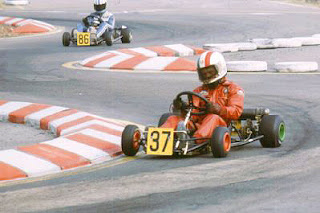
1977 World Karting Championship, Parma

By the age of 17, Andrea had accumulated a good deal of karting experience, giving him the confidence to compete in the World Championship, run in 1977 at the Parma circuit.  His performance was fully competitive and at the event’s conclusion his placing was fifth.  That year he also began his car racing career, initially practising in a 1970 Tecno.  This was an unusual model, being a F3 car adapted for Gustavo Palermo’s use in Formula Ford, a category for which Tecno did not build a specific variant.  Confident from that experience, Andrea took part in the Italian Super Formula Ford 2000 series.  At the wheel of an Osella, Andrea won 2 races, (and achieved 3 podiums), finishing fifth in the championship, which was won by fellow future F1 participant, Teo Fabi.  This success, especially in terms of sustaining performance over a series as well as at an individual event, warranted the step-up in 1978 to Formula 3.  The Marlboro connections/influence came into play once more, Andrea being taken under the wing of Tim Schenken and his Marlboro Team Tiga operation.  The team ran Andrea in a Ralt RT/1-Novamotor (Toyota), a car that proved ultra-competitive against the main rival March 783, though the Tiga car was a two year old example.  The category was at that time the main proving ground for drivers seeking elevation to Formula 1.  As a result, Andrea’s first season in really serious motor racing saw his nascent expertise pitched against such future super high achievers as Alain Prost, Nelson Piquet, Nigel Mansell, Arie Luyendijk and Bobby Rahal.  Formula 3 was very high profile in Britain, and two championships were based in the country, whilst some UK-based runners also entered the European Championship.  Andrea took part in all three, albeit only in two races of the European series – and in the Donington round in August in he finished a strong fourth. In the BARC BP Championship, Andrea was placed seventh after a total of 17 races, including a brace of third places.

Contemporary Team Tiga sticker

Building on the further experience gained in 1978, Andrea embraced a more challenging on-circuit 1979, with Formula 2 and sportscar involvement in addition to pursuit of the British F3 Vandervell Championship.  Usually, accounts dwell on how Andrea ‘threw away’ the F3 championship, but I believe there is more value in briefly considering the successful results and then examining an incident which bears on the issue of the prejudiced perception of his ability and driving standards. In Formula 3, Andrea continued in Team Tiga, but with a March 793, once again powered by a Novamotor-tuned Toyota engine.  He lost the Vandervell Championship by just 13 points to Chico Serra but outscored the Brazilian 6:5 in race wins.  In the European Championship race at Donington, he took pole position.  Debuting in Formula 2, the Project 4 team entered Andrea as a guest driver in the Vallelunga round of the European Championship, and he drove a Lancia Stratos in the Giro d’Italia.

Winning at Thruxton, April 1979

Having already characterised Andrea and Gilles Villeneuve as committed racers – always seeking victory rather than just a ‘points finish’ – there’s no incongruity now in referring to another such driver – Nigel Mansell.  His robust attitude and mental resilience in competing with Ayrton Senna made him a great British favourite, who was also lauded as ‘il leone’ in Italy when he drove for Ferrari.  But Nigel did complain a lot – as good a whinger as he was a driver – and he was well known for his tendency always to attribute blame for problems/incidents to anyone but himself.  And certainly, he did experience more than his fair share of problems, for instance, a broken back at the 1979 Formula 3 meeting at Oulton Park. Reports of the incident are typified by this: https://f1history.fandom.com/wiki/Andrea_de_Cesaris: 

A wheel banging incident with Nigel Mansell broke the Briton's neck, and did little to improve Andrea's wild reputation. 

Some were clearly a little uneasy about simply blaming Andrea, based on his reputation, but showed their residual prejudice by resorting to such ambiguous turns of phrase as: 

At Oulton Park, Nigel came into contact with his competitor and broke his back. (https://www.gptoday.net/en/news/f1/243962/the-second-chance-nigel-mansell-broken-neck-tears-and-a-championship-loss-at-suzuka) 

For further clarification we can consider what Nigel himself said, but bear in mind that he was prone to being unequivocal in pointing the finger of blame at his competitors: 

I broke my back in a very serious accident at Oulton Park, Cheshire.  From my point of view, the incident was totally avoidable.  Andrea de Cesaris was coming up on the inside of me going down a hill, but there was no room.* In those early days, he had something of a reputation for being erratic at times, and on this particular day his car touched mine and instantly flipped me over. 

*As is increasingly recognised, it is the duty – not just a manifestation of good track manners - of a driver to make reasonable ‘room’ for a clearly faster car. 

To this day I retain great respect for Nigel and his many high level achievements, but I believe that had Andrea been the sole culprit, his description of the Oulton Park incident would have been more along the lines of, ‘he just drove straight into me,’ rather than the woolly reference to ‘no room,’ and ‘his car touched mine.’  Apologies for repeating the word, but it does have a specific meaning in motor sport: what we seem to be considering here is a ‘racing incident,’ defined as an interaction wherein no single participant is wholly at fault, the occurrence of which from time to time is inevitable when people compete with one another at high speeds in relatively confined spatial areas. 

Away from the fierce competition seen in the three F3 championships, Andrea enjoyed two drives involving less pressure.  As mentioned above, he took part in his first Formula 2 race.  This was round 5 of the European Championship at Vallelunga.  Driving a March 792, he was a very respectable sixth.  In October he partnered Tony Carellos and Renato Meiohas in a Lancia Stratos, entered by Jolly Club to the Giro d’Italia, in which they finished fifth. 

March Cars provided Andrea with an early start to his competitive 1980 by entering him in a March 792-Ford BDA for the Aurora AFX International Formula Pacific run in January and February in New Zealand.  Of the eight races, Andrea won two and accumulated enough points to be ranked fourth in the championship.

Formula Pacific, New Zealand, 1980

Part 2 (next post) covers Andrea's early Formula 1 career up to the end of the 1982 season