Showing posts with label McLaren. Show all posts

Friday, August 25, 2023

There Were Four Thousand In Blackburn - The T260 Had Just 207

1971 was a very significant year.  From a personal perspective, I started my automotive career-proper at BMW, while, much more significantly, the BRM P160 proved highly competitive in Formula 1, LPs of great quality were released, such as Sticky Fingers, Who’s Next and Tapestry, there was the announcement of cars like the Alfasud, Maserati Bora and BMW 2002 Tii, and . . . hope sprung of a new dawn in the Cam-Am Challenge, with the addition to the grid of the Lola T260 and its driver, Sir Jackie Stewart.

BRM at Monza, September 1971

A Lola T70 Mk.2 in the hands of John Surtees had won the inaugural Can-Am Challenge in ’66.  However, since then, the M8 McLaren in its various iterations had steam-rollered the opposition, firstly as the Bruce and Denny Show (Bruce McLaren and Denny Hulme), then with Peter Revson partnering Hulme after McLaren’s death in 1970.  At the time, many of us resented the McLaren ‘win machine’ as the cause of the Group 7 series becoming boring because of repetitive, predictable results.

The Bruce (#4) & Denny (#5) Show, Laguna Seca, 1969. (Courtesy Motor Sport Images)

One of the very few series rivals to get anywhere near bothering the McLaren juggernaut was the Chaparral team of the innovatory Texan, Jim Hall.  Not content with seeking ultimate competitiveness from high downforce aerodynamics by mounting a tall rear wing on his 2E machine during the ’66 season, he surprised everyone four years later with his 2J – a car that achieved even more powerful ground effects by mechanically sucking air out from under its floor.  This was facilitated by a pair of rear-mounted fans and thus anticipated the similar solution devised by Gordon Murray for the Formula 1 Brabham BT 46B of 1978.  Not unexpected really, as his high wing concept had also found its way into Grand Prix racing during the 1969 season.  The 2J ran in only six Can-Am races in 1970, driven in the second of these – Watkins Glen – by the reigning F1 World Champion, Jackie Stewart.  In that first year of the new decade, Jackie was feeling the dispiriting effects of the deaths of several fellow drivers accumulated over the later years of the 1960s, and, ironically, persistent criticism of him about his safety campaigning.  Unsurprisingly, his enthusiasm for his profession was waning.  However, the revolutionary nature of the 2J was enough to revive his interest.  In his autobiography, Winning is Not Enough, he says: As we were discussing what to do about the Nurburgring, (its dangerous aspects) I was called away to take a telephone call from America.  It was Jim Hall, inviting me to drive the Chaparral in a sports car event, and, even in the middle of all that, I found myself getting as excited about the prospect of being behind the wheel of such a special car as I had at any stage of my life.  I instantly accepted his offer because the Chaparral was known as the most advanced racing car of its time.  Although his race at Watkins Glen ended in a retirement, the experience seems to have had a positive effect, for it was not too long before it was revealed that Stewart had reached agreement with Carl Haas to drive the new Lola 260T in a full 1971 Can-Am campaign.  Jackie was frank in the autobiography: The F1 season was my priority, but Cam-Am offered a second income stream that was hard to resist.

Jackie Stewart in the Chaparral 2J, Watkins Glen, 1970. (Courtesy Motor Sport Images)

Haas was a classic mid-century American automotive entrepreneur.  A Jewish immigrant to the ‘States just before WW2, he ran cars in several race series, including NASCAR, F5000, F1 and Indy/Champcar in addition to Can-Am, eventually becoming best known for his association with Hollywood’s Paul Newman and the formation of Newman/Haas/Lanigan Racing.  In the late sixties he contracted with Eric Broadley to act as the U.S. importer of Lola racing cars and developed the business to a highly successful level.  Broadley was happy to allow Haas to function as a works team and the American used his commercial nous to secure supportive sponsorship from cigarette makers, L & M.  Whilst Lolas had been a familiar part of the Can-Am scene in the late sixties, they had been relatively conventional and not front-of-the-grid competitive.  With such characteristics persisting in the new decade’s opening season’s Lolas – the T220 and T222 – Haas used all his powers of persuasion to convince Broadly that a more daring new design was essential if the perception of the Lola brand was not to be devalued because of lack-lustre results.

Left: Carl Haas at his business premises at Lincolnshire, Illinois. (Courtesy Racemaker/David Huson). 
Right: Haas with Eric Broadley, founder of Lola.  (Courtesy JKRacing50)

Broadley acceded to Haas’s entreaties and briefed his designer, Bob Marston.  He also sought input regarding bodywork from his associate, Peter Jackson, (and body engineer Peter Wright), at the expert glass fibre fabrication firm, Specialised Mouldings.  Broadley wanted a basically wedge shaped, compact form, with a relatively small overall footprint – he was keen for instance to avoid the substantial front end overhang seen on the McLarens.  But since the wedge format could, as had been seen with the Autocoast Ti-22 at Mont Tremblant in 1970, be prone to end-over-end loss of control incidents, the main aerodynamic emphasis was on the avoidance of front end lift, coupled with maximum possible downforce on the rear axle.  The latter was sought without any particular focus on the rear body surfaces but by simply using a large wing – not especially high mounted, but full width and located unusually far forward, most of its surface in front of the rear axle.  An additional distinctive bodywork feature was the presence of 207 small holes in the upper surface between the windscreen base and the front brake air duct openings.  These were for the purpose of releasing air that otherwise would cause a build-up of high pressure, and thus lift, underneath the front end of the monocoque floor.  The nose incorporated a depth-variable front splitter. 

Otherwise, the T260 was largely ‘state of the art’ for the time, featuring an aluminium monocoque, side mounted radiators, horizontal mounted, rocker arm actuated front springs and inboard brake discs, front and rear.  A relative novelty was the specification of 13” front wheels. The engine was a Foltz-built 8.1 litre big block Chevrolet V8 mated to a Hewland Mk.2 four speed transmission.  Output at 7,000 rpm was commonly quoted as being 700-760 bhp and 600+ lb-ft torque.  Foltz offered some options regarding the amount and spread of torque generated in order to make easier the evaluation of the car’s handling during the early stages of development. 

At the time, Frank Gardner – mostly known for his F5000 and saloon car exploits – was Lola’s test and development driver.  He was able to take the T260 out on track, (at Silverstone), for the first time in May 1971.  With the first round of the Can-Am due at Mosport in Canada in mid-June, scope was limited.  Gardner was quick to express his concern about this because it was immediately apparent that the car inherently understeered, and a ‘cure’ would likely require a considerable number of testing miles.

Gardner testing the T260 at Silverstone, May 1971.
Note especially the 13” front wheels and forward position of the wing. (Courtesy Motor Sport)

Stewart for his part encountered the car at Silverstone at the beginning of June.  The weather was against him – heavy rain – and his initial impressions are not recorded.  He had however already prevailed upon Broadley to make a significant change.  Ten months previously Jochen Rindt’s accident at Monza in the Lotus 72 still weighed heavily on the World Champion’s mind.  Not only were the Stewart and Rindt families very good friends, but Jackie was especially close to Jochen, considering the Austrian his principal rival on-track.  Though the sudden, violent sharp left hand swerve into the Parabolica armco was not per se the cause of Rindt’s death – that was attributable to his belts not being properly secured – Stewart was highly sceptical about the advisability of running inboard front brakes, given the possible consequences of a shaft failure.  Broadley had no alternative but to agree that the front brake discs be moved outboard.  At the same time, a similar revision was effected at the rear, since the limited testing so far completed had revealed problems with heat not being dissipated sufficiently from the discs.  And there was a knock-on from this.  To accommodate the relocated discs, larger diameter – 15” - front wheel rims were required – along with an enlargement of the leading curve of the wheel arch.

Stewart with the T260 at Silverstone, June 1971. (Courtesy Sutton Images)

We do know that Stewart at last had the chance to drive the T260 in unconstrained circumstances at the Mosport circuit on 10th June.  His perception of the car’s handling characteristics – not helped by the bumpy nature of the track – were summed up by his apparent likening of the machine to a ‘pregnant elephant!’  The following day he was nevertheless able to set the day’s fastest time and this proved to be good enough for pole position when the Saturday session became rain affected.  Next day, at the opening round of the Can-Am season, he led the race from Hulme’s M8F, but retired just short of quarter distance because of a failed transmission seal.  The McLaren team had had a scare, but Hulme took the victory and the marque’s cars filled places 1-6 in the race results table.

Stewart’s T260 at Mosport, June 1971. The bigger front wheels and related re-profiled front wheel arch are evident. (Courtesy Jerry Bendl Collection)

Two weeks later, Round 2 of the Can-Am series was scheduled for Mont Tremblant.  Like Mosport, this was circuit notorious for its uneven track surface.  Stewart however was hoping for a better ride from the T260 as some additional changes had been made after the Mosport event.  The rear suspension geometry had been revised and the wing relocated a little further to the rear of the car.  But in practice and qualifying the car still proved to be hard work.  Stewart nevertheless managed to qualify the T260 2nd, just three tenths slower than Hulme’s pole time and 1.8 seconds better than Peter Revson’s 3rd place time in the second M8F.  Though Hulme maintained a lead for much of the race, he didn’t really get away from the Lola and when he flagged in the latter stages, Stewart was able to get past and take his car through to its maiden victory.

Stewart closes in on Hulme at Mont Tremblant, June 1971

Road Atlanta hosted Round 3 in mid-July.  Stewart qualified 3rd, a full second off Hulme’s pole time.  The race was a mixed bag for the Lola – Stewart hustled it enough to record the race’s fastest lap, and moved up past Hulme and Revson into the lead.  However, the T260 then suffered a rear tyre puncture and the pit stop to fix this became prolonged when the engine cut and didn’t want to restart.  Although running at the finish, the car was several laps down having also developed a rear damper failure – a disappointing outcome as it had clearly had the beating of the McLarens on track. 

Stewart and the T260 were quickest at Road Atlanta until a tyre punctured. (Courtesy Autosports Marketing Associates)

A fortnight on, the Can-Am circus reconvened at Watkins Glen.  Perhaps helped by his familiarity with the Glen from his Grand Prix drives there, (as was the case too at Mosport, and, to a lesser extent, Mont Tremblant), Stewart put on another strong qualifying show, just pipping Revson and Hulme to the pole.  Next day he held a comfortable lead until a little past the halfway point, when a driveshaft failure intervened and forced retirement of the car.

Stewart enjoys a clear lead over the McLarens at Watkins Glen. (Courtesy Motor Sport Images)

Round 5 must have felt like ‘back to square one’ – the Mid Ohio circuit, like the opening, Canadian, rounds’ venues was something of a car breaker, being notable bumpy.  In qualifying the McLarens handled this better than the Lola – Hulme’s pole time was nearly a second quicker than Stewart’s 3rd place lap.  But it was fortunate that the T260 was not further down the grid as it had been afflicted with multiple suspension failures during practice.  The confidence evident in Stewart’s demeanour at the Glen was also undermined by his perception of Mid Ohio as a particularly dangerous track with limited run-off areas and a host of trackside hazards.  He was forthright on Sunday morning in saying how dissatisfied he was with the place and that he didn’t intend to run at anything like his or the car’s full performance potential.  Thus it seemed somewhat paradoxical that following the demise of both the M8Fs with driveshaft failures, Stewart was able to chalk up his second victory of the season.

The T260 at Mid Ohio – note how much further back the wing is by now mounted. (Courtesy Niagara Pauls Blogspot)

In late August the second half of the series opened with the 6th Round at Road America, (Elkhart Lake).  With the Mid Ohio win serving to re-boost confidence and signs that the long-established McLaren superiority might be faltering with reliability issues, there was good reason to expect that Stewart would be hunting Hulme and Revson down for the points table lead.  As an added positive, the Haas team was also keen to be more adventurous in its efforts to improve the car’s handling and aerodynamic behaviour – the chronic understeer still being a real issue for Stewart.  Thus, the car appeared at the Wisconsin circuit with a fully reworked rear end – an even larger-surface (and higher incidence) rear wing, with substantial end plates integrated with the rear quarter panel sides.  This was combined with a new ‘shovel’ form spoiler running across the bottom edge of the nose.

The new rear wing and front spoiler at Road America. (Courtesy Jim Buell)

Practice and qualifying threw up some surprises.  Whilst Hulme secured the pole with a time 2 seconds quicker than his nearest challenger, that competitor wasn’t teammate Revson – or even Stewart.  Finally coming good was the controversial Shadow Mk.2 of Jackie Oliver.  Stewart was 3rd, but apparently hampered by a lack of power.  The team bit the bullet and changed the engine for the race, but this overheated and failed after just 10 laps.  So it was an unsatisfying end to the weekend with uncertainties remaining, especially in regard to the car’s aerodynamics, the original rear wing form having been reinstated and no conclusions reached about the persistent understeer.  Broadley was struggling to understand cause and effect, though he had demonstrated his perspicacity in wondering how well the body surface holes were relieving under-floor pressure when the gauze covering of many of them was clogged with paint required for the L & M livery!  One could not help but wonder if the car was founded on an aerodynamic theory full of holes.
 
With five Grand Prix wins up to August 1st, Stewart was assured of his second World Championship by the time of Round 7 of the Can-Am at Donnybrooke.  He was no doubt philosophic about the contrast between his successes and confidence in his Tyrrell and his results with the Lola, to say nothing of how little he’d been enjoying driving the Group 7 car.  The team would have hoped to have had him smiling a little more by effecting some rear suspension upgrades following the Road America event.  But hope was outdone by reality in this instance – the McLarens seemed to be getting better after the mid-season frailties, whereas the Lola’s handling continued to tax Stewart’s patience.  With no improvement clearly obvious from the revisions tried at Road America, the rear wing form reverted to the original format.  As was becoming the pattern, Stewart was 3rd in qualifying, not especially close to the times of Hulme and Revson.  Nonetheless, the Lola got off the line well and headed the M8Fs initially until Revson went past for the lead.  Stewart was able to hold Hulme behind him, but various troubles led to pit stops that hampered Stewart’s progress to the extent that he could finish no better than 6th.

Stewart stays 2nd  in front of Hulme at Donnybrooke. (Courtesy Tim Winker)

Late September saw the Can-Am back in Canada, at Edmonton for Round 8.  There was a further revised, tacked-on ‘shovel’  panel in place to give the nose a more scoop-like profile and almost all of the rear wing depth was now behind the back edge of the rear panel.  The effectiveness of these changes was difficult to judge in the track conditions and Stewart’s qualifying performance could once again not achieve anything better than 3rd.  In the race, his ultra-smooth skills enabled him to take and maintain the lead on a wet circuit.  Eventually, however, he had an off, and this apparently caused some damage, as the T260’s handling was subsequently less manageable.  It nevertheless remained one of the car’s better days, as Stewart was able to run to the finish headed only by Hulme’s McLaren.

On the grid at Edmonton – note the revised front end and the extreme rear location of the wing. (Courtesy TheRoaringSeason)

Laguna Seca was the location for the penultimate round.  Despite Stewart’s big and unsalvageable points deficit vis-a-vis the McLarens, effort was ongoing to try and give him a car which could match his other-worldly driving expertise.  This time there was some astonishment when it was seen that the front of the car was no longer just being augmented with a relatively small re-profiler – it now had a substantial tubular structure projecting forward of the nose, supporting a large, full-width aerofoil which was promptly nicknamed, ‘The Cowcatcher.’  The rear wing remained distinctly rearward of the back panel and run at a steeper angle of attack than as seen at Edmonton.  The T260 had begun the season as the ultimate ‘stubbie’ but now boasted an exceptionally long footprint.

New wings, front and rear, at Laguna Seca. (Courtesy TheRoaringSeason)

In qualifying, Stewart was within a second of Revson and Hulme, the former taking pole.  However, the Lola was 4th on the grid as the Mk.2 Autocoast Ti22 was three tenths quicker in the hands of David Hobbs.  The Ti had less race pace and was soon displaced on the Sunday by Stewart who further progressed by passing Hulme for 2nd.  Revson struggled with an ailing engine to finish the race but hung on to take the win.  There was some post-race confusion as it was contended by the Haas team that Revson should have been black flagged and the race awarded to the Lola.  However, Revson’s victory was subsequently upheld, so Stewart had to be content with 2nd – itself by no means a bad result.

Though looking unwieldy with its front and rear ‘extensions,’ Stewart was able in the T260 to outpace Hulme’s M8F at Laguna Seca. (unattributed, via Bonhams)

The teams were at Riverside at the end of October to close out the Cam-Am series.  The T260 made its way to its customary 3rd fastest in qualifying.  Stewart took it past Revson and settled into a secure but lonely 2nd place until the engine failed with 3/5 of the race run.

Final aerodynamic tweak for the T260 is substantial end plates for the rear wing. (Courtesy Lola Heritage)

On face value, the final series points table for the top three suggested ‘business as usual’ for McLaren.  However, Stewart and the T260 had provided the most substantial challenge for a very long time to the dominance of the M8s.


Although there was never any prospect of Stewart committing to another season with Haas, it’s reasonable to suppose that with a winter of development and a new, ambitious driver, the wins tally could have been considerably greater than just two in 1972.  However, the obdurate handling problems of the T260 had taken their toll.  For Lola, the attraction of a new start became irresistible, and thus Broadley laid down a brief for the T310 – a Can-Am car that was long and wide and looking not at all related to its short and stubby, highly characterful, predecessor.  But I have to leave the last word to Sir Jackie: I enjoyed working with Carl Haas in 1971, but the car had been a dog to drive . . .


Monday, May 23, 2022

The Magnificent Six – Abarth’s '60s World Championships

Within the FIA’s World Sportscar Championship, Abarth reigned supreme for six consecutive seasons in the early '60s.  During the period, categories and classes were subject to several revisions.  For example, in 1962, Abarth’s campaign was for the WSC’s subsidiary competition, ‘The International Championship for GT Manufacturers,’ and the marque’s winning points total was accrued within the GT 1000 cc class.  The following year, Abarth’s effort was concentrated on the 1300 cc GT class.  In 1966 the title, ‘International Sports Car Championship’ was introduced.  Under this, Abarth ran primarily in the ‘Sports’ category, and, within this, Division I (1300 cc).  In response to this evolving competition framework, Abarth varied its track models focus, from the Fiat Abarth 1000 Bialbero GT, through the Abarth Simca 1300 GT, to the Abarth 1300 OT.  Throughout the period, several other related Abarth models competed in the WSC events, including 700 cc and Monomille versions of the Fiat-engine coupes, 1300 S, 1600 OT, Abarth Simca 2000 GT, 1000 and 2000 SP, 1000 Berlinetta and 1000 OTS.
 
Abarth frequently featured its championship achievements in its in-period advertising/promotional material, (see examples, illustrated below), and they are referenced by the marque to this day – no wonder, it was quite a feat!


Listed below are details of the (class) winning car/driver for the championship events for seasons 1962 – 1967, together with notes on lesser placings and relevant photographs.

1962 
International Championship for GT Manufacturers; GT 1.0 class victories:

Sebring (3 hours)
Bruce McLaren     Fiat Abarth 1000 Bialbero GT  #8


Circuit del Garda
Ludovico Scarfiotti     Fiat Abarth 1000 Bialbero GT  #56

This event was dominated by Fiat Abarth cars, with Gianni Lado 1st in the GT700 class.

Avus 
Robert Jenny     Fiat Abarth 1000 Bialbero GT  #40

Another event at which Abarth was a major presence, main opposition coming from the BMW 700 in the lower capacity class, which was nonetheless won by Teodoro Zeccoli in the 700 version of the Abarth GT.

Nurburgring 1000
This event was not significantly contested by Abarth (though Porsche Abarth GTLs were 1st/2nd in the GT1.6 class).  Claude Bobrowski/Claude Dubois Jean (entered by Jean Amic), Fiat Abarth 1000S, finished 3rd in the S1.0 class.

Pergusa (Coppa Citta di Enna)
Marsilio Pasotti/Giancarlo Scotti     Fiat Abarth 1000 Bialbero GT  #58 

Abarth cars were placed 1st to 6th, with Giovanni Pessina 5th and the GT700 class victor. 

Nurburgring 500
Eberhard Mahle     Fiat Abarth 1000 Bialbero GT  #86

Also taking class wins for Abarth at this event: Tommy Spychiger, GT700. and Marsilio Pasotti, (850 TC) Touring850. 

Bridgehampton 400
Bob Grossman     Fiat Abarth 1000 Bialbero GT  #9
 
Overall victory at this race went to a Porsche Abarth GTL driven by Bob Holbert.
 
1000 km. of Paris  
Though the best-placed 1000 Bialbero GT finished down in 14th, (Claude Bobrowski/Frank Ruata), this race was significant in that the GT1.3 class was won by Hans Herrmann/Mauro Bianchi in the new Abarth Simca 1300, #33. 

Championship points table:


1963
International Championship for GT Manufacturers; GT 1.3 class victories, (and significant other Series/Sub-Division results): 

Sebring (3 Hours)
Hans Herrmann, (Abarth Corse)     Fiat Abarth 1000 Bialbero GT  #18 

Mauro Bianchi (#19) was placed second in a similar car. 

Circuit del Garda
Marsilio Pasotti/Benedetto Guarini     Fiat Abarth 1000 Bialbero GT  #9 

Nurburgring (1000 kms) 
A rare lack-lustre event for Abarth, all three works Abarth Simca 1300 Bialbero GTs, including the pole sitter of Bianchi/Mahle, failing to finish.


Consuma (Hill Climb)
Mauro Bianchi     Abarth Simca 1300 Bialbero GT  #102 

Whilst Bianchi was 2nd overall and first in GT1.3, Tommy Spychiger was first in the 1.0 class in a 1000 Bialbero, (#22).


Monza (3 Hours)
Romano Perdomi (‘Tiger’)     Fiat Abarth 1000 Bialbero GT  #14

Wiesbasen (Rallye)
Peter Ettmuller/Xavier Perrot     Fiat Abarth 1000 Bialbero GT  #43
 
Schauinsland (Freiburg) (Hill Climb)
Giampiero Biscaldi     Abarth Simca 1300 Bialbero GT  #9 

Biscaldi took the GT 1.3 class, and there were also Abarth class victories for Tommy Spychiger (S/P1.0) and Vittorio Venturi (GT1.0).


Pergusa (Coppa Citta di Enna)
Romano Perdomi (‘Tiger’)     Fiat Abarth 1000 Bialbero GT  #52
 
The GT700 class was won by Gian Battista Mainetti for Abarth. 

Ollon-Villars (Hill Climb)
Giampiero Biscaldi     Abarth Simca 1300 Bialbero GT  #74
 
Nurburgring (500 kms)
Anzio Zucchi     Fiat Abarth 1000 Bialbero GT  #104


Monza (Coppa Inter-Europa)
Tommy Spychiger     Abarth Simca 1300 Bialbero GT  #16
 
Tour de France
Not a good race for Abarth – highest finisher, 8th in class, was an 850.


Bridgehampton 500
Tom Fleming/Otto Linton/Ray Heppenstall     Abarth Simca 1300 Bialbero GT  #3 

The Championship points tables were finalised: 


1964
International Championship for GT Manufacturers; Division I (1300 cc) victories: 

Sebring (12 hours)
Tom Fleming/Otto Linton/Jimmy Diaz     Abarth Simca 1300 Bialbero  #62


Monza (GT Grand Prix)
Franco Patria     Abarth-Simca 1300 Bialbero GT  #19      

This was a 1-2-3 for Abarth in the 1.3 GT class.  The 1.0 class was won by Anzio Zucchi, (Fiat-Abarth 1000). 

Consuma (Hill Climb)
Secondo Ridolfi     Abarth Simca 1300 Bialbero GT  #304

Abarth-Simca 1300 Bialbero GTs filled 1st to 9th place in class. 

Nurburgring (1000 kms)
Hans Herrmann/Fritz Jüttner     Abarth Simca 1300 Bialbero GT  #8


Schauinsland (Freiburg) (Hill Climb)
Hans-Dieter Dechent     Abarth Simca 1300 Bialbero GT  #12 

The winning Abarth Simca was entered by Scuderia Lufthansa.  Fiat Abarth GTs were 1st and 2nd in the 1.0 GT class.


Grosser Bergerpreis (Sierre Crans-Montana) (Hill Climb)
Denis Borel     Abarth Simca 1300 Bialbero GT  #113 

Nurburgring (500 kms)
Ernst Furtmayr/Hans-Dieter Dechent     Abarth Simca 1300 Bialbero GT  #97
 
The Furtmayr/Dechent car was another entry by Scuderia Lufthansa.  Overall winning car, running in the Prototype GT 1300 class, was the Abarth-Simca 1300 Bialbero GT of Hans Herrmann/Klaus Steinmetz (#130):


Bridgehampton (500 kms)
Although various Abarth GTs ran at the Saturday race, no championship points were scored for the marque. 

Paris, Montlhéry (1000 kms)
Herbert Demetz/Anton Fischhaber     Abarth Simca 1300 Bialbero GT  #52 

A strong 1-2-3 in class finish for Abarth Simca.

Top of the final points table for the GT championship (Division I) looked like this:

Abarth Simca was placed 3rd in Division II. 

Note: The International Championship for GT Manufacturers was run within 3 divisions: Division I – Under 1300cc; Division II – Under 2000cc; Division III – Over 2000cc.  Although there were 20 events, not all counted for each division.  For example, the opening round at Daytona counted for Divisions II and III, but not for I, whereas Round 4, Monza 3 Hours counted only for Division 1.  Points were awarded to the top six positions in each division in each race on a 9-6-4-3-2-1 basis with a points coefficient applied which reflected the relative arduousness of the event; for example, the 24 Hours of Le Mans warranted a 2.0 coefficient, the Nurburgring 1000 Kms 1.6, whereas the hill climbs tended to be just 1.0.  Only the best six race results plus one hillclimb result were retained towards the final classification.

1965
International Championship for GT Manufacturers; Division I (1300 cc) victories:
 
Sebring (12 hours)
Only one Abarth Simca 1300 and one Abarth Simca 2000 ran, neither finishing this race.
 
Imola (GT Grand Prix)
Herbert Demetz     Abarth-Simca 1300 Bialbero GT  #48
 
This was a 1-2-3 for Abarth Simca and Fiat Abarth Berlinettas were 4th to 8th.
 
Monza (Coppa Inter-Europa)
Klaus Steinmetz     Abarth-Simca 1300 Bialbero GT  #14
 
Another Abarth Simca 1-2-3.


Targa Florio
Salvatore Calascibetta/Giuseppe Virgilio      Abarth-Simca 1300 Bialbero GT  #26

Nurburgring (1000 Kms)
Salvatore Calascibetta/Giuseppe Virgilio      Abarth-Simca 1300 Bialbero GT  #95 

Another Abarth Simca 1-2-3.


Mugello (GP)
No provision here for the 1.3 GT class.  A 2.0 version of the Abarth Simca GT placed 2nd in the 2.5 GT class. 

Rossfeld (Hill Climb)
Again the 1.3 GT class was not contested.  However, Hans Herrmann was 4th overall in a 2000 OT and two Abarth Simca 2000 GTs also featured in the top ten. 

Le Mans (24 Hours)
No Abarth cars started this race. 

Reims (12 hours)
No Abarth entries.
 
Bolzano-Mendola (Hill Climb)
Giuseppe Dalla Torre     Abarth Simca 1300 Bialbero GT  #214 

2.0 versions were 1st and 2nd overall, the winning car driven by Herbert Demetz. 

Schauinsland (Freiburg) (Hill Climb)
Roland Stierli     Abarth-Simca 1300 Bialbero GT  #11 

Pergusa (Coppa Citta di Enna)
No Abarth entries.

Ollon-Villars (Hill Climb)
Denis Borel     Abarth Simca 1300 Bialbero GT #68 

Nurburgring (500 kms)
Kurt Ahrens, Jr.     Abarth-Simca 1300 Bialbero GT  #44 

Bridgehampton (500 kms)
No Abarth Simca GTs ran at this event. 

Championship points table:

1966
International Sports Car Championship; Sports, Division I (1300 cc) victories: 

The season saw the Abarth Simca 1300 GT replaced as the marque’s primary machine by the 1300 OT.  It featured many improvements though still Simca-based.  The car was not homologated until May. 

Nurburgring (1000 Kms)
Jo Ortner/Kurt Ahrens Jr./Ernst Furtmayr/Wolf-Dieter Mantzel     Abarth 1300 OT  #83 

1300 OTs finished 1-2-3 in class.


Mugello (GP)
Luigi Taramazzo/Giulio Bona     Abarth 1300 OT  #136 

Pergusa (Coppa Citta di Enna)
Alfio Gambero     Abarth 1300 OT  #22 

An Abarth 1-2-3 in the Sports 1300 class, with an Abarth Simca 1300 in 3rd.

Sierre Montagna (Hill Climb)
Jean-Daniel Grandjean     Abarth-Simca 1300 Bialbero GT  #73 

Another Abarth 1-2-3, with Abarth Simcas in 1st and 2nd and a 1300 OT in 3rd. 

Nurburgring (500 kms)
Ernst Furtmayr     Abarth 1300 OT  #35 

Zeltweg (500 kms)
Jo Ortner     Abarth 1300 OT  #28 

An event dominated by Porsche 906s, but Abarth scored another 1-2-3 in class.

Points at season’s end were:


1967
International Sports Car Championship; Sports, Division I (1300 cc) victories: 

Targa Florio 
Guido Garufi/Giuseppe Ferlito     Abarth 1300 OT  #98


Le Mans (24 Hours)
Marcel Martin/Jean Mesange     Abarth 1300 OT  #64           

Entered by Ecurie du Maine, #64 finished 16th overall and 1st in class.  It is the subject of a Spark 1/43 scale model.


Hockenheim (GP)
Toine Hezemans     Abarth 1300 OT  #3 

This event yielded a 1-2-3-4 for the Abarth 1300 OTs.  The Spark model mentioned above is also available liveried, with #3, as it ran at this event. 

Mugello (GP)                                     
Mauro Nesti/Ernst Furtmayr/Toine Hezemans     Abarth 1300 OT  #90 

A 1-2 in class for Abarth, and, once again, a race-specific Spark model was produced. 

Pergusa (Coppa Citta di Enna)                 
Alfio Gambero     Abarth 1300 OT  #26 

An Abarth 1-2-3, with an Abarth Simca 1300 GT in 3rd.

Zeltweg (500 kms)
Jo Ortner     Abarth 1300 OT  #25 

Again an Abarth 1-2-3 (all 1300 OTs).

Ollon-Villars (Hill Climb)
Toine Hezemans     Abarth 1300 OT  #148 

A Best-Model 1/43 die cast was made carrying Hezemans's number for this hill climb. 

Nurburgring (500 kms)
Ernst Furtmayr     Abarth 1300 OT  #42 

Last race of the season and yet another win for the OT. 

Final points for the championship (Sport, Division 1, 1300 class):


Sunday, February 13, 2022

More Magic from Corso Marche

The end of the Fifties and the beginning of the new decade was an especially busy period at the Abarth Corso Marche factory. The 750 GT Zagato had been well-established and a range of variants of the type was continuously developed, embracing Street and Race models, four different engine capacities, twin-cam engine option and an entry-level (‘Sestriere’) model. The desire/need for ever-changing specifications was compounded by the FIA’s propensity at the time for redefining/restructuring its Sports/GT racing classes. When the FIA GT Cup championship was introduced in 1960, there were class divisions for engine capacities up to 500 cc, 850 cc, 1000 cc, 1300 cc, 2000 cc, 3000 cc, 4000 cc and 5000 cc. For the ‘smaller’ events, (GT cars only – no ‘sportscars’), the subdivisions by capacity were, 500, 700, 850 and 1000. The following year, these were revised to 700, 1000, 1150 and 1300, (hence Abarth’s adoption of the Simca 1300 platform for a new GT, with a 1300 cc Abarth twin-cam engine – (see here). However, the 1 Litre version of the 750 GT Zagato emerging in 1960 also benefitted from a twin-cam engine and would spearhead Abarth’s racing efforts as the new decade got underway.

The 500, 700 and 850 versions were however still competitive in 1960, and Abarth was placed first in the results for each of these championship classes. In 1961, class honours were taken once again in the 700 and 1000 classes.

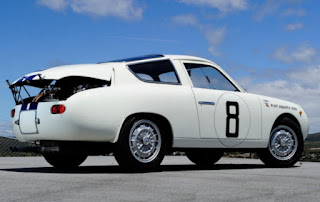
In 1962, GT cars ran in the World Sportscar Championship. At the second round, the Sebring 3 Hours, Abarth 1000 Bialbero GTs entered by Briggs Cunningham finished first and second, with Bruce McLaren taking the victory. It was a strong showing for Abarth, with other examples of the model coming fourth and fifth. Main opposition had come from Austin Healey Sprites, but none finished on the same lap as McLaren.

#1128948-’62 Sebring 3 Hours winner  Courtesy Bonhams


That season the 1000 GT class featured in six of the World Sportscar Championship events – and Abarth was victorious in each and every one.  In addition to McLaren’s win at Sebring, the 1000 GT took the flag at Circuito del Garda, (Ludovico Scarfiotti), Avus, Berlin, (Roberto Jenny), Pergusa, (Giancarlo Scotti and ‘Pam’), Nurburgring 500 kms, (Eberhard Mahle), and Bridgehampton 500, (Bob Grossman).  (Abarth also scored a one-two at Bridgehampton in the overall classification with the Porsche-engined GTLs of Bob Holbert and Bruce Jennings).  Thus, Carlo Abarth was able to add the accolade ‘World Champion’ to his marketing/promotional materials and affix celebratory badges to his production GTs.


Gioacchino Colombo is best known for the engines he designed for Alfa Romeo and Ferrari.  His straight eight powered the Alfa 158/159 Alfettas to the Formula 1 World Championship in 1950 and ’51.  He followed this up with a 1500 cc V12 which was at the heart of much of Ferrari’s early success.  Subsequently, Colombo was engaged by Carlo Abarth to create a major upgrade, in the form of a new twin-cam (Bialbero) head, to the Fiat 600-based engine.  A purpose-tuned special version of the new engine producing 75 bhp, and installed in a Pininfarina streamlined body, enabled Abarth to achieve records in 1958 for sustained high speed running at Monza.   A production version of the engine, outputting 61 bhp, was initially utilised in the 750 model designated ‘Bialbero Record Monza,’ introduced in 1959.  The following year, with capacity taken up to 982 cc, a 1000 Bialbero version appeared, shortly after a prototype had, like its predecessor, taken new records at Monza.  98 bhp was claimed for the new car, and its effectiveness was promptly confirmed by a hill-climb victory within weeks of the launch. 

Though the 1000 GT was initially built by Zagato, the cars were not identified with the usual external ‘Z’ badge of the Milanese carrozzeria.  To oblige Abarth, in another break with past practice, the first batch was constructed near Corso Marche in the ex-Beccaris premises of the small bodybuilder, Corna.  This seems to have been part of a considerable effort by Zagato to mollify Carlo Abarth, who had fostered a number of grievances, especially around issues of control.  As another gesture to indicate Zagato’s desire to restore confidence, newly-recruited Ercole Spada was delegated to be involved in styling the new Abarth model.  Spada was briefed to simplify the 750 body, and the result was good enough to see Ugo Zagato granted the ‘Compasso d’oro.’  Zagato was one of only 10 award winners, from an entry of 800 industrial designs that year.

From mid-1961, Race versions of the car featured a new body, built by Sibona & Basano.  Although some sources refer to a mid-‘62 interim model, built by Beccaris, and with a raised engine cover, S & B was responsible for the coachwork through to the end of production in 1964.  S & B crafted the first iteration of the ‘longnose’ (clamshell bonnet/wings) version in aluminium, but subsequently made use of its particular expertise as a pioneer of fibreglass construction with a further revision first shown in late ’63, which featured the front clamshell made with the new material.  By this stage, the engine output had been increased to 104 bhp. 

During the production run, there was considerable variation in the form of the engine cover.  The earliest version utilised the raised central scoop, giving the car’s rear section a rather bulky, inelegant outline.  This was followed by a simpler panel without the scoop, air ingress being facilitated by 18 louvres.  This form was subsequently modified by the addition of a transverse opening flap above the louvres.  This solution was eventually replaced by the ‘ducktail’ spoiler/full width gap design.

(Note: car illustrating the central scoop version is an 850 model.)

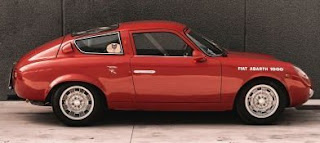
Although there was much to distinguish the 1000 Bialbero GT from the preceding 750 Zagato series in terms of body styling/construction, there were also mechanical innovations reflecting the model’s increased speed capability.  These included disc brakes and the adoption of a front-mounted coolant radiator.  Also significant was the introduction in ’62 of a five speed gearbox. 

Recently advertised/sold Abarth 1000 Bialbero GTs:

#0242 Courtesy Ruote da Sogno

#0268 Courtesy Fantasy Junction

Courtesy Supercars.net

#0286 (Longnose) Courtesy Bonhams