|
| Left
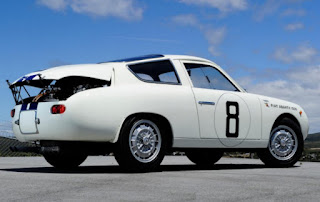
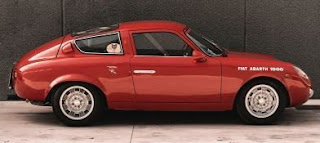
to right: Abarth 750 GT Zagato; Abarth Porsche Carrera GTL; Abarth-Simca 1300
GT |
Abarth’s success in creating a small GT car
with big motor sport potential was fully consolidated by the end of the 1950s. The Fiat 600 had provided an excellent
chassis/mechanical basis, and with a lightweight body by Zagato, the 750 GT had
been a winner since its 1956 launch.
Aesthetically characterised in its early form by the double-bubble roof
and ‘matching’ twin hump engine cover, (to optimise delivery of cooling air to
the bay), the 750 became an icon of the era.
By sports/GT industry sector standards, a substantial number of cars
was built, (500-600 units), through to 1960.
Over time, various engine options were introduced: 500, in ‘57/’58, 750
Bialbero, (twin cam), from ’58, subsequently, 700 and 850 versions, and,
eventually, a 1 litre, both single cam and Bialbero. In 1959, Abarth showed its ability with
another ‘base,’ this time the Porsche 356, creating the Carrera GTL. So, when Fiat’s collaborative association
with Simca was made closer at the beginning of the new decade, Abarth was well
placed to use the French marque’s 1000 model as a chassis platform for another
lightweight, competition-suited coupe.
It featured a new 123 bhp, 1288cc 4 cylinder, twin cam engine, (code: F.B.
1300-230), and this was good enough, given the car’s mere 630 kg kerb weight,
to allow a 0-60 mph time of around 6 seconds and a top speed of over 140 mph. A Simca 4 speed gearbox was utilised. This unit was not really adequate given the
power/torque of the engine and was superseded in the final year of production
by a Fiat 850-derived unit. At the same
time, a new engine block, under-bored and with a very short stroke, as used in
the 2.0 litre version, was introduced.
(1600 and 2000 versions of the car became available in 1963-4 in
response to revisions of the capacity limits prescribed by the FIA for the GT
racing classes.) This engine provided a
useful increase in power, to 138 bhp.
Like
most single-minded entrepreneurs, Carlo Abarth tended to be quite demanding and
inflexible in his expectations of performance by his business partners. As a result, relationships could become
strained and end abruptly. This proved
to be so with Zagato. Although the carrozziere’s
efforts in creating the 750 GT had garnered praise and admiration, there may
have been some fear of instability in the light of Zagato’s plan to move to a
newly-built, larger factory at Terrazzono di Rho, (achieved in early 1962). In
any event, Carlo Abarth had become dissatisfied with the relationship. Perhaps as a ‘marker,’ Scaglione was engaged
to style the Carrera GTL and Rocco Motto built the first batch of bodies. Quality problems then dictated a decision to
switch to Beccaris & Teraschi S.n.c. As this situation progressed it is likely that Abarth became further
assured that he could manage ongoing body design/building without needing to
refer and sub-contract to Zagato. From
an aesthetic viewpoint, a core Abarth GT ‘look’ had been established, primarily
by Zagato, but now with some detail variation possibilities from Scaglione’s
pen. With a colleague as skilled as Mario
Coluccio, Carlo was confident that styling could now be carried out in-house,
establishing, initially without any formality, a new function which would
eventually be labelled as ‘Carrozzeria Abarth.’ Construction of the new body,
in aluminium, was entrusted once again to Beccaris & Teraschi. However, around the same time, a relationship
with the bodybuilder Sibona & Basano was cultivated. The prudence of this was confirmed when a
falling-out with Beccaris saw S & B appointed to build the bodies not long
after the production run had begun.
Abarth
Simca 1300 GTs have 4 digit chassis numbers with the prefix ‘130.’ Of extant cars recorded in various Internet
resources, the lowest number found is 0047 and the highest, 0128. It is understood that 100 cars would have
been required for FIA homologation purposes, but it would appear that this
figure may have been exceeded by at least 28 units.
Most cars left the factory with either red or
light blue paintwork, though some cars in period racing photographs, (and some
contemporary survivors), are seen finished in yellow, e.g., #0067 at Le Mans in
1962. U.S. Abarth authority, Les Burd,
also cites photographs of the factory interior in which other colours are to be
seen. There was considerable variation
of bodywork details at a granular level during the production run and,
throughout, there was a basic differentiation between racing, (Corsa), and
street (Stradale), versions. My
understanding is that three substantial iterations are notable: 1) As
originally presented, the engine cover was similar to that of the 1000 GT
Bialbero, though that featured 18 cooling vents, whereas the 1300 had 30. At the front of the car the fuel
tank/radiator bay was covered by a conventional hinged, flat bonnet panel. The transverse front panel had a small
central air intake aperture; 2) With a revised engine cover incorporating a
‘ducktail’ spoiler, lacking multiple vents, but shaped to allow a single large
transverse opening for cooling purposes between its lower rear edge and the
rear panel. Perhaps only on the Corsa
version, some cars feature a pair of brake cooling intake ducts in the front
panel below the headlamps. Between these, a central, rectangular, lower intake for the oil cooler is seen on some Corsa
examples. Some examples of this version
also had ‘c’ pillar air intake scoops, which Cosentino* attributes to ignition
cooling requirements; 3) Referred to as a ‘long nose,’ and as built by Sibona
& Basano. This features a front
clamshell in fibreglass and is readily identifiable by twin external release
handles (as used on the British Triumph Herald), and a full width frontal
aperture. However, with the lack of
documentation available today there can be no certainty about the dates of such
modifications, and it is most likely that there were multiple running changes
and subtle variations in addition to those just mentioned. Furthermore, a neat classification of
versions is made less viable by the fact that when the original batch of 1300
bodies was exhausted, the version developed for the 1600/2000 models was
utilised. These cars featured an engine
cover bulge which was required to accommodate the bulkier greater capacity
power units. Abarth expert, Amedeo
Gnutti, has told me that after the first 1300 model bodies were built at
Beccaris, both that carrozziere and Sibona & Basano were making ducktail
versions, (with the original front ‘short nose’), in 1964-5. Amedeo refers to a few interim types by
Sibona & Basano in 1964 which had revisions to the lower part of the nose,
(to promote downforce), anticipating the ‘look’ of the 1965 ‘long
nose/clamshell’ solution.
* Abarth
Guide, by Alfred Cosentino. Published by
Alfred Cosentino Books, USA, 1990. ISBN
10: 0929991117
 |
Left: Early engine
cover; Right: Later ‘ducktail version |
 |
#0091 (Middle Barton
Garage) showing front
clamshell |
 |
Left: Early front end; Right: ‘Longnose’ clamshell version
|
 |
#0117 featuring lower
front and C pillar intakes |
 |
| Interior
(#0091 ex- Guikas Collection) |
The
car was presented at the Geneva Show in March 1962. Just a month later three works-entered cars
achieved a 1-2-3 at a French hillclimb, the first of many victories for the
1300 GT. Less successful that first year
were the entries to the 24 Hours of Le Mans. Works cars with race numbers 41 and 42 were
driven by Roger Delageneste/Jean Rolland and Henri
Oreiller/Tommy Spychiger, respectively – both cars failed to finish, with
ignition problems. A third car, #0067,
run by Équipe National Belge, bearing race number 43, and driven by Claude Dubois/Georges
Harris, won the 1300 cc class, finishing 14th overall. FIA-homologated for GT racing in October, only
the last race of the International Championship for GT Manufacturers
season could be entered. There
was a significant result - 9th overall and first in class for future
F1 driver and 1970 Le Mans winner, Hans Herrmann, partnered by Mauro Bianchi,
at the Paris 1000kms held at Montlhéry. In total, including more minor events, nine
class victories were recorded that year.
 |
| Delageneste/Rolland, Le Mans, 1962 |
The
GT championship was restructured for 1963 to include a 1300 cc class. This allowed the 1300 GT to race much more
competitively over most of the championship’s fifteen rounds. At Daytona, Herrmann ran strongly and
finished 9th overall. In
March, at the Sebring 12 Hours, four works 1300 GTs appeared. Race number 61 was driven by Spychiger/Teddy
Pilette to 1st in class and 21st overall. The other three cars of Piero
Frescobaldi/Giampiero Biscaldi, Bob Grossman/Ray Cuomo and Herrmann/Bianchi all
succumbed to engine failures. Four cars
also ran in the Targa Florio, but all retired. Unreliability struck again at May’s Nurburgring
1000kms, with all four works cars failing to finish. A similar outcome occurred in the Tour de
France. However, the season saw class
victories in three of the Hillclimbs counting towards the championship, a class
1-2-3 at the Coppa Inter-Europa (Monza) and a class win at the final
round in September in the U.S. at Bridgehampton, with drivers Fleming,
Linton and Heppenstall taking the car to 15th overall in the 500kms race. Final standings in the championship for the 1300
class saw the 1300 GT in second place with 72 points, not far behind Alfa
Romeo’s winning tally of 87.
 |
Spychiger/Pilette,
Sebring, 1963 |
The
engine was uprated in 1964, when twin spark ignition was incorporated and
homologated. 134 bhp was claimed for the
new version, and this allowed the top speed to increase to 147 mph. At that year’s Sebring 12 Hours another
class win was recorded for a 1300 GT, this one driven by Fleming/Linton/James
Diaz, with an overall classification of 24th. A second car, entered by Scuderia Bear for
William McKelvy/Richard Holquist finished down the field in 34th. In
April’s Targa Florio, Pietro Laureati/Secondo Ridolfi scored an
excellent class win and came in 17th overall. The following month at the Nurburgring
1000kms, six 1300 GTs were to be seen, with that of Herrmann/Fritz Juttner
taking class honours and 16th overall. This event resulted in a class 1-2-3 for the
1300 GT, an outcome repeated at six of the other rounds that year. Indeed, at a second event at the ‘Ring,
in September (500kms) Herrmann led home an overall 1-2-3. The final table for the 1300cc division of
the championship had Abarth-Simca in first place with 60 points – the runner-up,
Triumph, scoring less than half that number.
 |
| Herrmann/Juttner,
Nurburgring, 1964 |
In
the early stages of the 1965 season, 1300 GTs achieved class 1-2-3s at both Imola
and the ‘Ring. A class victory, (10th
overall), was again secured at the Targa Florio. Over the nine rounds contested, the car
managed 1-2-3 finishes in eight, easily good enough to capture the ‘World Championship,' 1300 class.
 |
| Schiek/Schmalbach,
Nurburgring, 1965 |
By
1966 focus had shifted to the 2000cc version. In the 1300 GT class the Lancia Fulvia HF
was now setting the pace. Also featuring
as front runners in the class were the Alfa Giulietta SZ, Lotus Elite and MG
Midget. At the Targa Florio the
highest finishing Abarth-Simca 1300 was 8th in the 1300 S class,
behind Alpine 110s and Giulietta SZs. Through
that season, and 1967, the numbers of Abarth-Simca 1300 GTs seen at major
sports car races dwindled, and the days of significant class wins were over. Meanwhile, the 2000 was achieving the sort of
results for which the 1300 had become known in its heyday. In 1965, for instance, future F1 World
Champion, Jochen Rindt, and Herrmann finished 1-2 (overall) in the Preis von
Wien GT race at Aspern. Rindt
also won at Innsbruck. That
season there were also wins for Bob Burnard at Goodwood and at Brands
Hatch, Frank Ruata at Montlhéry, Jaime Silva at Vitoria and
at Interlagos (Brazil) and Herbert Demetz at the Bolzano-Mendola
hillclimb. More broadly, in the realm of
GT racing, Abarth had looked to the base class - for cars below 1000cc - and
built the 1000 Bialbero to contest this category, winning all six of the races,
and thus the Championship in 1962. Abarth
cars were similarly dominant the following season. By 1966, the 1300 OT model was spearheading
Abarth’s efforts which resulted in another 'World Championship' for the 1300cc
class. Overall, the decade had seen
Abarth as a major factor in GT racing and the Abarth-Simca 1300 had been instrumental
in much of the marque’s success.
In
recent years a few cars have come up for sale at auction. As with any car from the ‘60s, value now is mostly
dependent on the individual example’s condition, and with some positive influence
from a documented competition history and originality. An incomplete car sold for as little as £82,140
in 2015. #0091 (ex-Guikas Collection)
has twice been knocked down in the last 7 years, realising £233,315 in November
2021.
Special
thanks for their help to Tony Berni, Amedeo Gnutti, Les Burd and Tony Castle-Miller.