Showing posts with label Carlo Abarth. Show all posts

Sunday, February 1, 2026

The Giant's Last Tiny Car - Fiat Abarth 1300/124 Scorpione

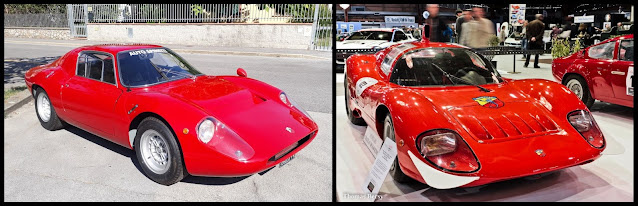
The October ’68 Paris Motor Show is probably best remembered for its hosting of the Bertone Alfa Romeo Carabo styling concept car’s debut.  All these years on, it is a design that still seems futuristic and is an example of Marcello Gandini’s best work.  Though its lines were comparatively restrained and it housed a far more mundane engine than the Carabo’s Alfa Romeo 33-based V8, there was another wedge-shaped car making its first public appearance that year at the show’s Parc des Expositions, Porte de Versailles venue.  The Fiat Abarth 1300/124 had been in preparation since May ’68 at Corso Marche.  That was only very shortly after the car on which it was based had itself been launched in March ‘68.  This was the Francis Lombardi Grand Prix 850, itself an evolution of a vehicle that had been created at Fiat to explore the idea of utilising an Autobianchi driveline in a sporting coupe.  Although some accounts assert that the body was styled by Giuseppe Rinaldi, (working at Francis Lombardi), it was more likely finalised at Fiat well before any knowledge of its existence had reached the Vercelli-based Carrozzeria.  That being the case, it was very probably from the drawing board of Pio Manzù, then in his twenties and about to become a rising star at Fiat.  Although a photograph of that car – which was shown at the Turin Show in ’67 – has not come to light, a Manzù design from ’64 shows some aspects which can be discerned in the Lombardi Grand Prix, especially the somewhat disproportionate C pillar/rear quarter panel – see below:

’64 Autonova GT by Pio Manzù  Courtesy Carrozzieri-italiani.com

Through the Fifties, the Lombardi business had specialised in custom conversion work, at first in limousine styles, on, by way of the first Popemobile (!), and further still in the Sixties to the upgrading of small cars such as the Fiat 500.  Indeed, the Grand Prix was built on a Fiat 850 chassis and powered by the 843 cc Fiat 4 cylinder engine.  While this was hardly in tune with the Grand Prix’s name and sleek body, since it produced only around 45 bhp, the car’s weight at under 700 Kg allowed performance at a level considered ‘sporting’ in the late Sixties.  But not sporting enough by Carlo Abarth’s standards, so he saw another opportunity to make a significantly more zestful version through the company’s proven elaborazione method focused on engine capacity and gas flow modifications.  Thus, the Tipo 104 1300/124 Scorpione was created as a distinct Fiat Abarth model.  Its main distinguishing feature was the Fiat 124 engine, bored to 1280 cc.  It was given a higher (10.5:1) compression ratio, equipped with a Solex 32 mm carburettor and designated Abarth Tipo 204.  This provided 75 bhp – a healthy 66% increase on the Grand Prix’s output.  With this increased performance potential in mind, Abarth prudently revised the mechanical configuration by relocating the coolant radiator to the front end of the car.  The Scorpione’s factory-claimed metrics were  0-60 mph in 9.8 secs and a 114 mph top speed.  With pricing at around Lit. 1.600.000, the Scorpione promised strong sales appeal based on its style – notable especially for its GT40-like ultra-low height, at 43“ - and brisk performance.  It is tempting nevertheless to speculate as to whether it could have been even quicker if it had been lighter still - given the era and the general shape of the body, it might be supposed that it was constructed in alloy or fibreglass, but it is in fact all steel, with the exception of the composite rear panel.

’68 Fiat Abarth Scorpione #1341901192  Courtesy Bonhams

The interior is attractive, with a distinctive feature in the unusual, centre mounted instruments pod.  There has been some criticism of this from an ergonomic viewpoint by drivers who expect to see the main instruments - especially the rev counter – in clear view in the centre of a natural line of sight, straight ahead.  Seen below is the interior of OTAS 820 CC, #0035:

’71 OTAS 820 CC OTAS #0035  Courtesy RobM, Bring a Trailer

For a car that was in production for just 4 years, there was quite a proliferation of variants and – looking at what has been written about it – a good deal of confusion about specifications.  However, despite some claims that Abarth made and marketed some versions powered by the ’68 Fiat 903 cc Sport version of the 850 engine, the Corso Marche-made models are generally considered to be just the Scorpione, S and SS.  Otherwise, the following related, same-body models were:

Francis Lombardi Grand Prix –  launched in March ’68 and subsequently updated with the 850 Special engine and also with a black louvred engine deck lid. In production until ’72.

OTAS 820/Giannini Grand Prix – The Officina Trasformazioni Automobili Sportive company was formed in ’69 by Lombardi in collaboration with the tuning business, Giannini.  It made 817 cc OTAS 820 versions for Europe and, with emissions modifications for the U.S., designated OTAS 820 CC, and a twin cam 982 cc ‘Tigre’ engine model for the U.S.

It is possible – but not proven – that in total up to 400 Scorpione/Grand Prix/OTAS/Giannini cars were produced.

Seen below is a ‘68 Francis Lombardi Grand Prix model version to which aftersales Abarth badging has been applied.  The Campagnolo alloy rims were also likely aftermarket-fitted in period.  It was offered for sale in 2015 by Bonhams, fetching £13,800:

’68 Francis Lombardi Grand Prix #14170049  Courtesy Bonhams

For comparison, this ’70-built Grand Prix appears to wear badging for the Francis Lombardi marque, without any attempts to ‘Abarthise!’:  It carries a Fiat roundel on the front trunk lid, ‘FL’ badges near the trailing edge of the front wheel arches and a ‘Fiat 850’ chrome script on the left hand side of the rear panel; there is also a Francis Lombardi script on the right hand side of the dashboard.  The car was sold by Iconic Auctioneers at Silverstone in 2023 for £16,313.

’70 Francis Lombardi Grand Prix #15975006  Courtesy Iconic Auctioneers

A ’68 Abarth Scorpione S is illustrated next.  Chassis #1236614103, carries the standard badging with just an Abarth crest on the front trunk lid in the centre, near its leading edge, and a chrome script ‘ABARTH 1300’ on the right hand side of the rear panel.  The VIN plate is engraved: Tipo 1300/124; No Telaio 1233614103; No  Motore 0659475.  In the auction lot description, Bonhams claimed: ‘This Scorpione S is believed to be one of just 4 examples in the USA of the approximately 30 produced.’  It sold at Scottsdale in January 2025 for $47,040.

’68 Fiat Abarth Scorpione #1236614103  Courtesy Bonhams

An example of the OTAS version is this ’68 ‘Grand Prix 820 CC,’ batch #0033.  The seller suggests this car is number 33 of a run of 120 built and so, ‘early,’ though the date attribution must be in doubt as the OTAS company was not formed until ’69.  Also, the car’s engine deck lid is of the later, 2nd series, louvred type.  It would be reasonable to suppose that it was in fact a ’69 or ’70 build.  Engine is the 903 cc version.  This is another Grand Prix which has had Abarth badges applied post-production.  But, most significantly bodywork-wise, notice that the front trunk deck incorporates a central, longitudinal raised section – this feature is also seen on the later OTAS Grand Prix seen further below.  Notice also the insubstantial tubular bumpers – the rear item seen here is also evident on the other OTAS Grand Prix further below.

’69-’70 OTAS Grand Prix 820 OTAS #0033  Courtesy CarandClassic

Although it’s never wise to bank on chassis/batch numbers being reflective of build chronology – especially with Italian cars of the era – another reason for questioning the date attribution of batch #0033 is that the next OTAS Grand Prix, dated to ’71, has a much lower batch number - #0007.  It’s a car that sold for $26,880 in 2019 by Bonhams at Quail Lodge.

71 OTAS Grand Prix 820 CC OTAS #0007  Courtesy Bonhams

From the same year, #1447434, batch #0014, the OTAS 820 CC Grand Prix seen below started life in red, but is today repainted in Verde Miura – a nod perhaps to the notion that the Grand Prix has the look of a ‘mini’ version of Lamborghini’s first great supercar.  Bonhams sold it 2010 in New York for $28,080.  The OTAS 82 CC script badge is applied on the rear panel to the left of the right hand side tail light unit.

‘71 OTAS Grand Prix 820 CC #1447434  Courtesy Bonhams

The Abarth Scorpione SS was introduced in February ’69, (that is the date recorded by the Factory – other sources have suggested that the SS appeared before the S, the latter replacing the SS).  The SS version featured twin Webers and was a few Kg lighter, benefitted from upgraded brakes, wider track, double wishbone front suspension and had Campagnolo Elektron (magnesium-alloy) wheels with 165 section tyres (155 on the S).  Top speed was claimed to be 118 mph.  (There is something of a mystery about the SS in that the factory’s data sheet records the model as equipped with the single Solex C 32 PHH carburettor and the same bhp value – 75 – as quoted for the S model).  On the twin Webers, the car’s Tipo 204 engine has been rated elsewhere at 100 bhp.  Bonhams says that only six SS Scorpiones were built, one of which is #128/292067, seen below.

’70 Fiat Abarth Scorpione SS #292067  Courtesy Bonhams

In late ’68 when the Scorpione was launched, with the given success of the established models in Touring/Sport competition – 595, 695, 850 TC, 1000 Berlina, 1000 SP, OT 1300 – a factory racing programme was not envisaged for the model.  Inevitably though, some owners saw potential competitiveness in minor events, and, seen below, is an example which was hillclimbed in-period.  # 1411387261 was offered in ’15 with an estimate of £45-50,000 (but not sold) by RM Sotheby’s.  The lot description notes that the original owner sold it to Italian racing engineer, Francesco Landi, a hillclimb competitor.  Landi fitted twin Weber 40DCOE carburettors and re-configured the front suspension from transverse leaf spring to his own coil-over-shock design.  He took 2nd place at the Coppa dello Collino on his first outing with it.  Recent colour photographs of the car are shown below together with some in black & white, competing in-period:

’69 Fiat Abarth Scorpione S #1411387261  Courtesy Tom Wood/RM Sotheby’s

’69 Fiat Abarth Scorpione S #1411387261  Courtesy RM Sotheby’s

It is often cited that the Scorpione was the last Abarth model developed and launched prior to the company’s absorption into Fiat.  Carlo Abarth’s sale of his business was formalised in mid-October ’71.  An early decision taken by the new management at Corso Marche was the cancellation of the Scorpione and all production was completed before the close of that year.  Parallel with his role in creating the Scorpione, Carlo maintained an interest in the establishment of the Grand Prix as a mainstream car available in the U.S. market.  To this end, he co-operated  both with John Rich and the OTAS company.  Rich’s Rich Motor Company was the leading dealer for Fiat and Abarth on the West Coast but John was ambitious and resourceful in seeking to further expand his business.  Empathetic with this, Carlo helped with the fabrication of a U.S.-specific engine for the Grand Prix.  This was necessary because of new legislation that sought to address the increasingly recognised problem of environmental pollution.  The Clean Air Act of ’70 had led to the establishment of an Environmental Protection Agency.  This rapidly became home to a team of zealot officers who perceived the automotive industry in very negative terms, especially because of the contribution to ‘smog’ from vehicle exhaust emissions.  Further, there was likely a notably socialist basis to the political leanings of the Agency’s personnel, strengthening their desire to take such huge corporations as America’s Big Three – Ford, GM and Chrysler - to task.  A major imposition introduced was the requirement for the engines of all cars marketed in the U.S. to be compliant – proven by stringent testing and mandatory certification – with new exhaust emission standards aimed at levels of hydrocarbons, carbon monoxide and nitrogen oxide outputs being reduced by 10% around the mid-decade point.  There was however a glimmer of relief for smaller makers who would be unable to fund all the development and testing involved – engines with a capacity of less than 50 cubic inches were exempt.  Thus, the existing U.S. version of the Fiat 850 engine was derated to 817 cc.

If the EPA could frustrate the mighty power that was Ford Motor Company – charged with failing to certificate the compliance of production output prior to offer for sale – it would have no difficulty with applying scrutiny and demanding proof of justification for exemption from a minnow like OTAS – a significant distraction as the company attempted to market the car and build a dealer network.  Consequently OTAS struggled to establish a volume of sales sufficient to consolidate the company’s viability.  And the situation was not helped by the spread of stories about the Grand Prix being prone to engine failure because of a marginal cooling system causing overheating problems in the hotter states – a similar experience being reported about cars exported to Australia.

As a result of these issues, the company folded in ’71, so, as with the Scorpione version, the OTAS 820 was out of production by ’72.  Some sources have suggested that as many as 100 cars (one specific assertion is of 76 units) may have been imported/sold, but the actual number is not verifiable from available documentation.




Sunday, July 21, 2024

Double Bubble? Better double check!

When my enthusiasm for Abarth in its pre-Fiat guise began, much of it stemmed from a liking for the 750GT models – the association with Zagato playing a big part, as I had long revered the work of the Milanese carrozzeria.  Zagato versions had been amongst my favourites when I worked for Alfa Romeo from the late 70s through to the early 90s, and I had greatly enjoyed the opportunity to visit the Via Arese, Terrazzano, factory during the 80s.

However, I soon found myself heavily focused on Abarth’s wonderful Sixties models and their achievements in circuit racing and hill-climbing.  The 750s remained something I loved to see and admire, but I was accumulating not much in the way of specific knowledge about the production run and the variant types that came and went.  More recently, my OCD kicked in and I realised that I needed to tidy up – in my own mind at least - the mass of information fragmented in many resources.  As I started out on the task, I envisaged as an outcome being able to create a document encapsulating a succinct outline of the model’s production history, distinct sub-models, modifications/updates, with a particular focus on external bodywork features, enabling anyone interested to make an assessment of an individual car’s age/specific type/originality – no real ‘science,’ (or forensics), but something more orderly and accessible than what we already have in published form.

After assembling, analysing and documenting a considerable amount of data, I tentatively shared the results, looking for an indication that either: 1) There was something developing which would be worthwhile, or, 2) That the information is not solid or ‘fresh enough’ to make it likely to result in an outcome of value.  Now, I am just an automotively-romantic old English bloke trying to make sense of information that was mostly inaccurately recorded at the time and is now ‘historic,’ making it even more difficult to check and verify.  So I was especially disappointed to find myself being told that most of the information sources to which I refer are unreliable and/or known to provide data that’s erroneous, inaccurate or fallacious.

As an immediate reaction, I stopped working on the project.  But I have now reconsidered, and think it worth taking it to a logical conclusion.  I will however be very careful to strongly emphasise within an introduction that all such information is liable to include errors and misinterpretations – it will be offered as a ‘guideline,’ and not as any kind of definitive document.  As such, I hope Abarth enthusiasts will find it to be of interest.  I would expect to be posting it next month.


Friday, May 3, 2024

Differing Fortunes: The Abarth 1300 OT and The1600 OT Sport Coupe

 
Left: Abarth 1300 OT (1st Series). Courtesy Autoemotodepoca.com; Right: Abarth 1600 OT Sport Coupe. Courtesy Thomas Bersy

Abarth’s extraordinary run of sportscar racing success, taking a World Championship for six consecutive years in the Sixties, is summarised in https://davidbuckdenlooksback.blogspot.com/2022/05/the-magnificent-six-abarths-60s-world.html .  Initially, it was the 1000 Bialbero GT which brought home the victories, but in ’63-’65 the mantle passed to the Simca-based 1300 GT.  With the lapse of the agreement between Abarth and the French manufacturer, a priority at Corso Marche became the creation of a new model to contest the championship from ’66.  A prototype coupe emerged in ’64.  A Mario Colucci-owned project, the car was mid-engined and built around a tubular chassis, very distinctive in appearance and dynamically promising.  But on this occasion Carlo Abarth stuck to his guns regarding the configuration, his concern about the relative costs of construction reinforced by the fact that the Simca platform had provided a simple, inexpensive basis.  Thus he halted ongoing development at an early stage, insisting that the car be disposed of – which it was, to Scuderia Lufthansa.  The German team in effect ‘finished’ the car, but without notable success.  Though designated at Corso Marche as the 1300 OTC, the car became known simply as the ‘Lufthansa.’ 

A new Omologata Turismo (OT) line began to take shape in early ’65.  Being based on the Fiat 850 platform, the new models not only fulfilled Carlo’s simplicity/reduced-cost objectives, but also signified a reconsolidation of the ‘traditional’ alliance with Fiat following the flirtation with Simca.  The first results of the programme were Sport Spider models, offered in both 1600 cc and 2000 cc form.  In short order the new coupe, Tipo 137/C, followed – in March – powered by the 1288 cc, 147 bhp, Tipo 237 engine.  Though Colucci was no doubt disappointed by Carlo’s axing of the tubolare/mid-engine format, the boss had given him the freedom to design a glass fibre body which he did with considerable aplomb, the 1300 OT’s styling receiving general acclaim for its aesthetic quality.  And as well as looking good, the 1300 OT’s performance was enhanced by the aerodynamic efficiency of the Sibona & Basano-built body.  A feature which many consider fundamental to the car’s distinctive visual attractiveness was the roof mounted air intake, (for cabin comfort purposes), which gave rise to the sobriquet, ‘Periscopia.’  This, however, was not seen on the launch version, not being introduced until the advent of the Series 2 1300 OT.  Indeed, there was a series of updates for this model, summarised by Sergio Seccatore in ‘The Scorpion’s Tale’: Series 2, ’66;  (‘Sport Coupe’) ‘World Champion,’ September ’66, 148 bhp 237-C engine;  ‘Longnose,’ September ’66, 147 bhp; ‘World Champion,’ June ’67, 157 bhp 237-B engine;  ‘World Champion,’ January ’68, 157 bhp 237-B engine and coil-over suspension.
OT 1300 Series 1 and 2 compared in profile. From Seccatore’s The Scorpion’s Tail. Courtesy Registro Fiat Italiano

There is some confusion in the factory records regarding these iterations as in the summary, ‘Vetture Abarth Da Competizione’ the 2nd Series version is dated ’66, while in the list, ‘Riepilogo Progetti Abarth,’ the June ’67 version is tagged as ‘1st Series.’  In his ‘Abarth Guide,’ Alfred Cosentino records the 2nd Series as a ’66 development and comments: ‘It wasn’t until the last two championship races in 1966 that the basic body design was established for the OT 1300.  There were four types of nose sections with different air intakes, headlight covers and aerodynamic body shapes tested . . . since September 1965.’  Cosentino also documented a further ’66 variant, the Longtail.  The photograph of this reproduced in the book is captioned: Udo Schutz driving a factory Fiat Abarth OT 1300 Longtail at the Nurburgring 500 km in 1966.  Ing. Colucci redesigned the front nose section of this OT 1300 and the top speed increased by 17 km per hour.  A technician of Alpine Renault redesigned the rear section which increased the top speed by only 4 km per hour.

Udo Schutz’s OT 1300, Nurburgring 500, ’66.  Courtesy Alfred Cosentino Books

The car’s early competitive outings required entry in the Prototype category.  At the Nurburgring for the 500 Kms on 5th September ’65, Klaus Steinmetz took 3rd place both overall and in the P 1.3 class.  For the Group 4 Sport category, homologation depended on the completion of 50 examples, and this was achieved in May ’66.

Karl Steinmetz, 1300 OT, Nurburgring 500 kms, September ’65.  Courtesy Registro Fiat Italiano

A little later, in September that year, a new model, the 1600 OT Sport Coupe, was unveiled.  It represented a speculative venture on the part of Abarth.  The firm’s Spiders had been successful in attracting a substantial and loyal cadre of hill-climbing enthusiast owner/drivers.  However, there were only so many such clients, and it became reasonable by the decade’s mid-point to assume that very few if any of them not already Abarth-equipped would be stopping by at Corso Marche to make a purchase.  At the same time, an opportunity was perceived to increase Abarth’s penetration of the market for similar competitors whose penchant was for circuit racing in the Sport and Prototype categories.  With the objective of appealing to such prospective buyers, a prototype closed car was built on the previous year’s OT 1600 Spider.  It certainly looked the part – attractively curvaceous and sophisticated, with clamshell front and rear sections and gullwing doors.  Designated Tipo 139/C, the 235-C engine was specified.  This 1592 cc, 172 bhp unit was a higher-revving development based on that utilised in the ‘63 Abarth Simca 1600 GT Coupe Stradale, rated in that form at 155 bhp.
1600 OT Sport Coupe. Courtesy Registro Fiat Italiano

1600 OT Sport Coupe. Courtesy Giorgio Nada Editore

By the time the 139/C was being shown and promoted, the 1300 had completed a very successful debut full season, instrumental in Abarth once again being crowned World Champion in the Sport, Division 1 class.  Victories had been scored by the model at the Nurburgring 1000 Kms, Mugello GP, Coppa Citta di Enna, Nurburgring 500 Kms and at Zeltweg.  1-2-3 finishes had been recorded at the ‘Ring 1000 Kms and at Pergusa (Enna).  The car was an all-round success and this was reflected in ready marketability and good sales profitability.
 
Meanwhile, the performance of the 1600 Coupe on-track – further evaluated at Abarth’s multi-model testing at Vallelunga in late January ’67 - was nothing like as encouraging.  Initially the car was run with a 1600 cc engine and the 6 speed Tipo 132 transmission – about which concern had been building in regard to its durability as engine outputs continued to increase.  In comparison with the Sport Spider in 2 litre form and equipped with the new Tipo 139, 5 speed transmission, its lap times were disappointing – around 4% slower.  A new 16 valve 1.6 engine was on hand and this was tried in the Coupe, but there was no conclusive outcome from this experiment.  It was therefore decided – and there was a certain inevitability about this – to try a 2 litre unit, and this enabled the Coupe to near-match the lap times of the Spider. 

As is usually the case with what are hoped to be ‘private’ test sessions, news of the performance of the various models leaked out by word of mouth.  This left the circuit racer community unimpressed.  Aware of this, Abarth revised its marketing expectations and attempted to interest hill-climbers in the car.  But, here again, the reception was lukewarm at best.  Whilst the Coupe had the agility and performance with some potential for this specialist form of competition, the visibility restrictions imposed by the coupe body were a very significant downside.  By the end of the ’67 season it was all too apparent that the car had virtually no commercial appeal and it was decided to abandon the project with just the single chassis completed.

Fortunately, Abarth had a hill-climb specialist customer, Eris Tondelli – who did see some potential.  As Eris recalls, after he tested the Coupe he called for a replacement, 2 litre, engine to be installed because the weight of the car was greater than had been expected and was significantly inhibiting performance.  Previously it has been asserted in print that Tondelli purchased the Coupe, but I recently heard from another source that it was simply entrusted to him by the factory – Abarth itself retaining ownership.  Tondelli – who also campaigned the 1000 SP, 1300 OT and 2000 Sport models – drove the car at a number of hill-climbs, notably the ’68 Bologna-Raticosa; three photographs of the car on that event are reproduced in Deganello and Rizzoli’s ‘Abarth, All The Cars.’  Subsequently, it was purchased by Michel Pont.  As recently posted on Tondelli’s Facebook,  the car was a high profile feature at an event in ’89 at Château de Savigny-lès-Beaune, accompanied by Abarth personalities, Renzo Avidano, Mario Colucci and Vincenzo Osella.  It remains as an exhibit at Musée de la voiture de course Abarth, at the Château.

1600 OT Sport Coupe (nearest camera) at Abarth group test, Vallelunga, January ’67. Courtesy Giorgio Nada Editore

Eris Tondelli testing the 1600 OT Sport Coupe. Courtesy Giorgio Nada Editore

Colucci (left) and Tondelli (right) in the 1600 OT Sport Coupe, Beaune, ’89. Courtesy Eris Tondelli 

The ’67 season saw the 1300 OT fully dominant in the World Championship events, winning the Sport, Division 1 Class, up to 1.3 litre at Hockenheim, (1-2-3-4 finish for the model), Mugello, Pergusa, (1-2-3 finish), Zeltweg, (1-2-3 finish), Ollon Villars and Nurburgring 500.  At the Targa Florio, Guido Garufi and Giuseppe Ferlito came home first in the Sport 1.0-1.3 class, 19th overall.  Ecurie du Maine entered a 1300 OT for Marcel Martin and Jean Mesange who took it to the finish 16th overall and victorious in class.  The model in this second full season was clearly well sorted and reliable, but also benefitted from attracting a number of top line drivers of the period, among them Toine Hezemans, Ernst Furtmayr and Jo Ortner.  In the end of season championship class table, Abarth boasted 45 points, with a huge gap to Diva in second place – the Camberwell, London-based marque accumulating just 12 points.

The following year was to be first since ’61 that World Championship honours could not be trumpeted from Corso Marche.  However, 28 major event (mainly hill-climbs) class wins were taken by the 1300 OT at: 

Avola, Coppa Belmonte (Gambero)

Arezzo, Pieve St. Stefano Passo dello Spino (“Drason)

Brescia, Scalata al Colle Sant’Eusebio (Pilone) and Autoscalata della Maddalena (Becchetti) and Trofeo Valle Camonica (Presenti)

Parma, Castione Baratti-Neviano Arduini (Boeris)

Volterra, Coppa Citta di Volterra (Zuccoli)

Piacenza, Castell’Arquato-Vernasca (Presenti)

Rieti, Coppa Bruno Carotti (Ramoino)

Bassano del Grappa (Becchetti)

Livorno, Antignano-Monteburrone (Ungelli)

Reggio Calabria, Santo Stefano-Gambarie (Benini)

Cortona, Coppa Citta di Cortona (Mugelli)

Vallelunga, Coppa Gallenga (Ramoiono)

Cosenza, Coppa della Sila (Gambero)

Trento-Bondone (Federhofer)

Sestriere, Cesana-Sestriere (Federhofer)

Freiberg, ADAC Bergpreis Freiberg-Schauinsland (Federhofer)

Pescara (Cronoscalata Svolte di Popoli (“Mici”)

Ascoli Piceno, Ascoli-Colle San Marco (Ramoino)

Nurburgring 500 Kms (Walton)

Verona, Caprino Veronese-Spiazzi di Monte Baldo (Pilone)

Bergamo, Castione-Passo della Persolana (Presenti)

Ragusa, Coppa dei Monti Iblei (Gambero)

Aosta-Pila (Ramoino)

Gubbio, Coppa Mengara (Fabroni)

Siracusa, Coppa Val d’Anapo-Sortino (Gambero)

Orvieto, Trofeo Citta di Orvieto (Fabroni)


Gratifyingly, the 1300 OT remained competitive right through to the end of Abarth’s independent era, with the victories counts being: ’69: 19; ’70: 31; ’71: 30.  In that period, two drivers in particular excelled in the model:
 
Karl Federhofer, (1927-1990).  The German driver competed in the early Sixties in Porsche 356s.  In ’65 he campaigned an Abarth Simca 1300 Bialbero, switching to a 1300 OT the following season and he remained with the model up to and including 1970.  The stand-out achievement was outright victory at the ’68 running of the prestige Trento-Bondone hillclimb event.

Karl Federhofer, Abarth 1300 OT, ’70 ADAC-Bergpreis Freiburg-Schauinsland Hillclimb. Courtesy www.forum-auto.com

Luigi Moreschi, (1947 - ).  A Mantuan, Moreschi developed a passion for motorsport at an early age, entering races even before he held a driving licence.  Though most of the great many races in which he competed were at club level, he also acquitted himself well in Sportscar World Championship races, including the Targa Florio, an event in which he participated on six occasions, his best result on the Circuito Piccolo delle Madonie coming in ’73 when he finished 4th – and first in class in a Chevron B21 – partnered with Francesco Matteo.  Two other significant victories came in ’77 at the Vallelunga 6 hours, (Porsche 935), and, ’78, Misano, this time in an Osella PA6.  More recently, and for over 30 years now, Moreschi has run a motorsport sales and service/parts business in his home town of Quingentole: https://www.moreschi.info/veteran/index_en.htm  Moreschi’s victory count, ’69-’71 in the 1300 OT was eight.

Moreschi’s contemporary business has notable Abarth focus – this is a Tipo 237 engine. Courtesy Luigi Moreschi Motorsport

Also repetitively successful in the 1300 OT were Münchner, Peter Stutz, and Klaus Brand.

So, we have one car – the 1300 OT – with results in competition which signify it as one of the very best Corso Marche products.  And, from the same era, a car – the 1600 OT Sport Coupe – which disappointed statistically, but which is no failure, as it is, arguably, the most aesthetically pleasing machine to emerge from that same factory.  Certainly, its creator, Mario Colucci, was of that view, saying in an interview, recorded twenty years on, that it was his most beautiful design. Indeed, not only was it a superb example of mid-Sixties Italian automotive styling, but it also provides us in the 2020s with a glimpse of how the elusive T140 might have looked in fully developed form . . . as I’ve often said before; if only . . .

Sunday, March 17, 2024

Piccolo ma Potente - Abarth 1000 SP


Courtesy of Tony Berni

Carlo Abarth’s manager of mechanical, chassis and body development, Mario Colucci, joined from Alfa Romeo following the collaborative Abarth-Alfa 1000 project which culminated in November ’58 with the presentation of a Scaglione-styled version at the Turin Motor Show.  This model featured a tube frame chassis, the preference of both Alfa Romeo corporately, and Colucci personally.  Following on from this, despite his own contrary chassis construction and engine location principles, Carlo Abarth gave Colucci the opportunity to design and develop a new line of lightweight spiders, initially with the Fiat 600-based 748 cc #221 engine.  By ’62, 1300, 1450 and 2000 cc versions had evolved, utilising the Simca-based engine.  However, these models did not achieve competitive successes to an extent which could attract an ongoing/increasing cohort of racing customers.  In addition, Carlo’s retained prejudices re-emerged in an edict which contended that the expense involved with the tubular chassis and mid engine location further undermined the cars’ marketability.  Thus, the series was discontinued for the ’65 season.  Effort and focus was transferred to bigger capacity spiders designated OT (Omologato Turismo).  As well as being available in both 1600 and 2000 cc versions, the OTs were distinctive in being Abarth’s first all-glassfibre bodied models.  Buoyed also by on-track success of a sister coupe model, the 1300 OT, Abarth relented in regard to a smaller capacity Spider and gave Colucci the go-ahead to create a new 1000 Sport Prototype version for ‘66.  It was a ‘brave’ decision since Carlo had to allow Colucci once again to specify a tubular chassis and central engine.  Furthermore, it only made sense to produce the new model in Group 6-compliant form, and that meant committing to a production run of 50 cars for homologation purposes.  The resulting 1000 SP, also known internally as the SE04, was ready in the Spring, making its racing debut at the 14th Coppa della Collina at Pistoia, (May, ’66).
 
In Alfred Cosentino’s Abarth Guide, he refers to the 1000 SP as the 1965 Fiat Abarth 1000 SP Barchetta Tubolare, also citing earlier (‘63/’64) versions as bearing the SE04 designation.  In his note about the model, he suggests 25 were initially built in ’65 and all were readily sold, prompting a second run of 25, dates unspecified.  However, all other sources relate the SE04 tag to cars known simply as 1000 SP.  An SE (Speciale Esecuzione) internal model code incidentally was applied to some Abarth racing models produced from the mid-Sixties, beginning with SE08, conferred on the ‘64 Formula 2 single seater.  SE025 was the highest code number used up to the end of ’71.  During the subsequent ‘Fiat’ period when Abarth was involved in the development of the new Lancia rally car, an SE designation, 037, identified the project and this became used as the car’s ‘public’ model name.  The Lancia Delta S4 bore the last designated SE code – 038, in ’85.

Courtesy 2015 Registro Fiat Italiano


The SE04 as launched, was powered by the #229A (dry sump), 4 cylinder, twin cam, 982 cc engine on twin Weber 40 DCOE2s, rated at 105 bhp @ 8000 rpm.  As coupled with the #A.102 5 speed gearbox and in a vehicle with a kerb weight of just 480 kg, it was both an agile and fast package, capable of over 135 mph.
 
The FIA eventually conferred Group 4/up to 1000 cc Class homologation on the 1000 SP in March ’68 – sample pages from the document, #241, are shown below:


Luciano Greggio’s ‘Abarth the Man, the Machines’ lists all (though the author indicates that some data may be missing for the years ’68 and ‘69) the outright/class victories scored by the marque from 1949 to 1971.  For the period ’66-’71, the list includes 150 victories for the 1000 SP, the peak year being ’68, when 66 first places were recorded.  Throughout the whole period, the great majority of successes was achieved at hillclimb events, at which multiple entries were frequently run in both the Sport and Sport Prototype categories.  Most events were in Italy, but the 1000 SP saw success also on hills/tracks in France, Germany and Switzerland.
 
The most successful driver- by a considerable margin - was Salvatore Calascibetta, who triumphed 15 times in a 1000 SP.  Calascibetta ran a workshop and parts store in Sicily but was also employed for several years by Abarth both as a test and a racing driver.  His driving career extended from the late Fifties to the mid Seventies.  Also known as ‘Toto,’ he resided and traded in Palermo, and this was convenient for his many participations in the Targa Florio – 13 in all, with the final outing (’71), in partnership with Paolo Monti, yielding a 1st in the GT 2.0 class, 9th overall.  On that occasion he was driving an Opel GT 1900 for Conrero Squadra Corse.  Eight years earlier, he had taken the class honours at the Targa in an Alfa Giulietta SZ.  For Abarth – in a 1000 SP entered by Scuderia Pegaso – he shared the Sport 1.3 class victory in ‘69 with Vincenzo Ferlito.  Their car was placed 11th overall.

Left: Salvatore Calascibetta (Targapedia2); Right: Calascibetta’s 1000 SP at the ’68 Targa Florio

Next most successful multiple winner was Luigi Tommasi with 9 victories.  He was active from the early Sixties through to ’79 and appeared at several high profile circuit races, though all his 1000 SP exploits were at hillclimb meetings in ’67 and’68, subsequently trying his hand at Formula 3.  His 1000 SP class wins were taken at, (’67): Sorrento, Rieti, Monopoli, Pescara,  and Ascoli Piceno, (’68): Rieti, Cosenza, Avezzano and Pescara.

Paolo Lado took the chequered flag in first place 6 times behind the wheel of a 1000 SP.  He was successful on circuits as well as hillclimbs, especially in ’68, when he won twice at Vallelunga and also at Imola.

Paulo Lado, (at Trento-Bondone hillclimb, July ’68)

Other notable drivers who enjoyed multiple wins in a 1000 SP were: Enzo Buzzetti (5 wins), Gianni Varese (4 wins) and Giuseppe Vergilio (4 wins).

     Left: Enzo Buzzetti, ’67 Targa Florio;                                               Right: Gianni Varese, ’68 Cesana-Sestriere

The agility possessed of this little barchetta is clearly demonstrated by its excellent run of Targa Florio results – up against generally more constructionally robust and higher powered opposition - in the years ’67-’72:
 

Year

Race #

Entrant

Drivers

Place

Class

67

142

Buzzetti

Enzo Buzzetti - Secondo Ridolf

22

2nd P1

68

96

Scuderia Pegaso

Salvatore Calascibetta - Vincenzo Ferlito

44

2nd S1

69

122

Scuderia Pegaso

Salvatore Calascibetta - Vincenzo Ferlito

11

1st S1.3


126

Buzzetti

Enzo Buzzetti - Walter Donà

16th

3rd S 1.3


124

Scuderia Nord-Ovest

Eris Tondelli - Marco Crosina

31st

4th S 1.3


202

Jolly Club

Ugo Locatelli – Mario Zanetti

5 laps only


70

262

Scuderia Nord-Ovest

Renzo Ruspa - Pier Giorgio Pelegrin

16th

1st P1


254

Scuderia Etna

Francesco Patanè - Orazio Scalia

DNF


71

82

Barone

Maurizio Campanini – Mario Barone

14th

1st P1.0


83

Scuderia Brescia Corse

Giovanni Boeris - Maurizio Roasio

15th

2nd P1.0


77

Scuderia Nettuno

Giuseppe Bargotti - Sergio Guibar

DNF


79

Patane

Francesco Patanè - Orazio Scalia

DNF


72

70

Scuderia St Paul

Francesco Patanè – Orazio Scalia

DNF


It’s been said that perhaps around 25 of the 50-70ish originally built 1000 SPs are extant.  One of the most familiar in recent times is #0038, which was sold by Hyman, St. Louis, MO, US: https://hymanltd.com/vehicles/7351-1966-abarth-1000sp/ .  It had previously been offered on Bring a Trailer in April 2023, https://bringatrailer.com/listing/1966-abarth-1000sp/ and was bid to $210,000, (reserve not met).  (At that time Sports Car Digest published an illustrated feature on the car: https://sportscardigest.com/car-of-the-day-1966-abarth-1000-sp/ )

#0038. Courtesy of Sports Car Digest


#0024 was presented in November 2014 by Bonhams, https://cars.bonhams.com/auction/21904/lot/8/from-the-maranello-rosso-collection1966-fiat-abarth-1000sp-tipo-se04-racing-sports-prototype-chassis-no-se04024/ selling for £135,900.

#0024. Courtesy of Bonhams


#0049. Courtesy of Radical Mag.com


The SE04 proved to be an especially important car for Abarth, not only because it remained competitive in 1 litre form for several years, but also as it was an excellent base for the development of new versions and reconfigurations which emerged as ‘new’ models.  The ’67 SE04/L identified a 2 litre version with a longer (by 60 mm) wheelbase.  That same year, SE04 FB appeared, this time with the wheelbase re-dimensioned in the other direction.  This was necessary because of the car’s ‘real’ distinguishing feature – relocation of the engine to Carlo’s preferred rearward position; FB = fuoribordo – ‘outboard.’  The following year saw a further developed version of the 2 litre Sport with sufficient updating to warrant a new SE number: 10.  The SE010 itself was the basis of a new Prototype, SE014, launched in ’69.  And all that had been learnt with the SE04 and its successors, SE010 and SE014, informed the similar competition cars for the new decade, the SE018 (outboard, 1 litre) and SE019 (available in either mid or outboard form).  Though Abarth would cease to be an independent marque the following year, this was a period of intense activity, further substantiating the perception of the Corso Marche firm as a major player in international motor sport.