Showing posts with label Colucci. Show all posts

Saturday, August 1, 2026

074 Abarth Simca GT 2000

 
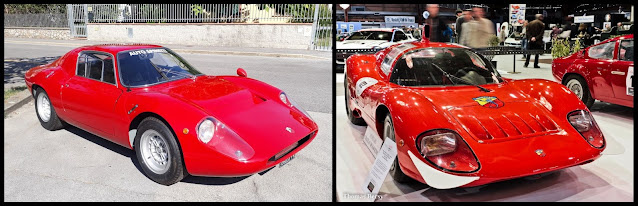
The creation of a new, non-Fiat-derived model was for Abarth a significant step in mid-‘61.  The basis of the Abarth Simca 1300 GT is outlined in the Do Look Back post, A Bit of Scorpion Worship  . As pointed out there, neither the chassis nor the engine were developments of any existing Simca products.  Equally, at this point Abarth had completed its divorce from Zagato, confident to execute styling in-house and to entrust the construction of the bodywork to the carrozzeria, Beccaris & Teraschi S.n.c. in nearby Grugliasco.  The collaboration with Simca was supposed to benefit the French maker by allowing it in forward-looking mode to develop more sporting products – especially high performance engines - using the specialist expertise and knowledge available at Corso Marche.  However, for Abarth the immediate and very necessary pay-back was a steady supply from Poissy of the 1000 model floor pans on which the Mario Colucci-designed Abarth 1300 GT body, (initially made at Beccaris and subsequently at Sibano & Basano), was mounted.

Carlo Abarth tasked Lucano Focchi with design of a new engine to power the Abarth Simca.  Focchi was happy that the Abarth 982 cc block would make a good basis and be capable of enlarging to a capacity of 1288 cc.  The resulting Tipo 230-A unit featured three main bearings and as installed in the GT Coupe developed 90 bhp @ 6000 rpm – very similar performance to the Fiat Abarth 982 cc Tipo 229 which powered the Fiat Abarth 1000 Coupe, though this required 7100 rpm to reach maximum output.  Both these engines had twin cam heads.  A further, enlarged, Abarth Simca coupe road engine emerged in ’63 – the 1592 cc Tipo 235 (the first Abarth twin spark engine) giving 155 bhp @ 7400.  With this version the car adopted the revised ‘duck tail’ rear which contrasted markedly with the more ‘bulbous,’ and multi-louvred engine cover usually associated with the bodies made by Beccaris.  Meanwhile, a ‘Corsa’ 2.0 litre (1946 cc) model, Tipo 136, utilised the Tipo 236-SC engine, producing 177 bhp @ 6800 rpm.  In deference to the increased power ratings of these two higher capacity versions, the crankshaft was carried on five main bearings.  ’63 also saw an uprated engine for the 1300, Tipo 230-S, which generated 125 bhp.  A batch of one hundred 2.0 litre GTs were scheduled to be built for Appendix J Grand Touring category homologation purposes; how many actually were, is a matter for conjecture!  The FIA documentation cited 14th January ’64 as the effective homologation date.

FIA Homologation document

Tipo 236 engine  Courtesy Berni Motore

In ’61 if anything of the Corso Marche enterprise symbolised its proprietor’s attitude towards life, it was the new models development programme.  Like Carlo’s personal outlook on life in general: so self-confident that it feared no opposition or interference, it was self-fuelled such that the more you asked of it, the more ready it was to take on even more; each new objective sparking the creation of yet another.  The more varied the ambitions became, the more additional variations were seen as possible and the more determined became the drive to achieve them.  Thus, as Carrozzeria Abarth took control of styling, a new bodybuilding contract was established with Beccaris, only for this to be swiftly superseded by another with Sibona & Bosano, which company built the bodies from ‘64.  The engine size constraint stemming from the use of the Fiat 600 unit as a basis was abolished with the new 1 litre capacity and this was optimised by the addition of a twin cam head option courtesy of the great Gioacchino Colombo, while, from within Corso Marche’s own headcount, Focchi came up with another addition to the range of engines with the 1288 cc unit primarily intended for the new Simca floor-based GT.  And within these development strands, four distinct generic product types emerged: 1) A ‘soft’ version for customers looking for the Abarth style rather than out and out performance, e.g. the Monomille GT; 2) (Ongoing), continuously evolving sporting cars of the ‘fast road’ type like the Bialbero coupes, both Fiat Abarth and Abarth Simca; 3) ‘Amateur,’ gentleman’s race car versions for competition in national grade circuit and hillclimb events, and, 4) Full race machines, close to the works cars’ specifications for supply to race entrants such as Jolly Club.

‘Early’ Abarth Simca 2000 GT – ‘shortnose,’ and no brake or engine bay cooling duct intakes.  Courtesy Ultimatespecs.com

During ’64 running changes were applied to the bodywork – two circular intakes for ducting to cool the front brakes, a rectangular additional intake running between these and below the level of the central elliptical intake, and circular intakes in the C pillar to increase air circulation in the engine bay.

Next iteration – still ‘shortnose’ but now with additional intakes. (#0046).  Courtesy en.wheelz.me


Further points of detail on #0046 are seen below:


For ’64 there were two more Abarth Simca GT 2000 versions.  In the January, a new 6 speed model was powered by the Tipo 236-S/A engine, tuned for 202 bhp.  In addition to the power increase, the car was a little lighter – at 665 Kg – resulting in a top speed capability of 168 mph.  A more radically revised variant appeared the following month.  The main new characteristic was a bodyshell largely still of aluminium construction, but now featuring a front clamshell in GRP.  This swiftly became known as the ‘longnose,’ a format which had been first seen in the 1300 version of the Abarth Simca GT in Spring ’63; the same configuration was evident in the Fiat Abarth 1000 Bialbero GT released in September ’63.  As usual, there is some confusion as to these dates, the factory for instance citing January ’65 as the point at which the 1300 became available as a longnose.  With a higher engine output of 209 bhp and concerns about the durability of the gearboxes ongoing, the opportunity was taken to specify a Tipo 132-A, 5 speed transmission for the GT 2000 longnose.  This version was back to a kerb weight of 675 Kg and claimed top speed of 161 mph.

‘Longnose.’ (0117) A well-known Abarth Simca 2000 GT owned by Les Burd.  Courtesy Mike Gulett 

The car below, #0125, was built from one of a batch of bodyshells which were in ’66 still on the premises at Corso Marche after production of the 1300/2000 GTs had ceased two years previously.  It is included here to illustrate the form of the 2000 GT ‘longnose’ body.  Otherwise, it is not typical, however, in so much as it was equipped with a Simca 1204 cc engine, as featured in the Bertone-styled Simca 1200S coupe.  Further details about these bodies and their utilisation are provided in the concluding paragraph of this article.

‘Longnose.’ (#0125) Just a larger single, central intake at the front, but engine bay intakes retained.  Courtesy Bonhams

A second longnose appeared in January ’65.  This was tweaked in minor degrees to enhance reliability and better accommodate the Tipo 132 six speed gearbox – featuring a reversion to the 202 bhp specification Tipo 236-S/A engine. 

As mentioned above, the relationship with Beccaris for the Simca floor-based GTs was short-lived.  The Carrozzeria was well respected for its proven capability to provide bodies in aluminium to a consistent dimensional quality standard.  But it is probable that disputes arose with Carlo Abarth over production aspects such as delivery scheduling, as he was soon prospecting for an alternative bodyshell supplier.  Perhaps he first became aware of Sibona & Basano as a newly formed Turin company in ’62 when Pietro Sibona joined forces with the Basano brothers, Emilio and Elio.  It quickly established itself as an innovative enterprise, keen to exploit new technologies.  As such, it sought to rapidly build its experience of working with the ‘plastic’ materials then becoming seen as an alternative to the sheet metal traditionally utilised in car body construction. This focus enabled the company to be of interest to the automotive trade and consumer publications and resulting coverage of its activities apparently resulted in a higher profile/reputation than might otherwise have been the case.  Carlo Abarth for one considered Sibona & Basano’s focus aligned with his own objective of creating cars with exceptional power to weight ratios.
 
Technically and aesthetically, the Sibona & Basano collaboration was successful.  However, there must be doubt about how well the Carrozzeria had been able to negotiate a sound financial relationship with the forceful and commercially astute Carlo Abarth, by then well into his second decade as the proprietor of a vehicle manufacturing business.  It may be inferred that this was a distinctly asymmetric relationship whereby Sibona & Basano enjoyed a substantial volume of purchase orders from Corso Marche, but with a very limited margin for the generation of profit.  The gaining of new, additional, trade clients swiftly became a matter of urgency.  Once found, it would also be vital that any new contracts be inherently more profitable than that governing the arrangement with Abarth.  That Sibona & Basano’s quest for new business was not something for which it had a high level of experience and expertise is evidenced by the range of projects/proposals addressed.

One of the companies that Sibona & Basano found itself working for was Studebaker, the innovative American manufacturer which managed for some time to be competitive with the mighty Big Three of Detroit.  Legendary designer, Brooks Stevens, as well as consulting on industrial design across many business sectors, became involved with efforts to revitalise and ‘save’ the Studebaker company.  In seeking to achieve this with a product-led strategy, Stevens came across Sibona & Basano and his account of his visit to the business illustrates the commercial naivety of the Carrozzeria: “Fortunately, I discovered the small body shop in Turin called Sibona-Basano. I went in and there was laundry on the line and chickens running around.  I got the two little guys out and filled them with Camparis.  We got (from) them good prices - $ 16,500 per car - an incredibly low price.  Even better, the finished vehicles were worthy of a Pininfarina." 

A project in collaboration with Ghia and Virgil Exner fizzled out before becoming financially beneficial for Sibona & Basano – perhaps ‘bad luck,’ as the design involved was deemed to be somewhat bizarre in its press reportage.  Subsequently, the possibility of a production run for Lamborghini arose, but Sibona & Basano found itself outflanked/outbid for this by the vastly more experienced carrozzeria, Touring.  There should too have been potential with a beach car, ‘The Decathlon,’ for Fiat, based on the 500, but this was another that attracted criticism for being ‘odd.’  Another 500-based project was a city car named Tsé-Tsé, but Fiat’s management could not be convinced to push it forward for production. 

Sibona & Basano’s tendency to become involved with projects which lacked commercial focus and were liable to drift was again seen when there was renewed contact with Virgil Exner.  This time, a nostalgia-based concept was proposed – an open sports car echoing a design that had stalled in its original creation, some forty years previously.  The vehicle, titled Mercer Cobra, looked good on paper, but once ‘in the metal,’ could only have a ‘show car’ existence where it usually drew complimentary comments but failed to attract any orders for a functioning model.  In another ‘success’ within the halls of a motor show, Sibona & Basano enjoyed some good press for the Autonova MPV when it was presented in conjunction with NSU in ’65 in Frankfurt, but full development was ruled out when the Neckarsulm-based manufacturer reviewed its strategic position and decided that it should put all its focus on the nascent RO80.

Further hope that new business would enable Sibona & Basano to prosper was not rewarded.  A Bizzarrini proposal for a new Spyder model to be bodied by Sibona & Basano failed to get past the planning stage and it became common within the industry for Sibona & Basano to be thought of as a jinxed business.  It was not surprising therefore that Pietro Sibona decided to exit the business in ’66.  As of ’67, Sibona & Basano was no longer trading.  Considering the situation at the beginning of the decade, when Sibona & Basano was involved with the GT models which did so much to establish Abarth’s reputation as the maker of attractive, innovative sports cars, it was both an unexpected and sad end.

Much more inspiring was the record of results achieved by Abarth 2000 GTs in competition.  Following up on the many victories scored by the 1300 model, the 2.0 litre chalked up its first significant victory at Aspern, Austria in April ’64.  At its wheel, Eberhard Mahle’s works car saw off Ernesto Prinoth’s Ferrari 250 GTO for the outright race win.  A good race for Abarth, with Hans Herrmann taking a 2000 Sport to third.  Both Mahle and Herrmann proved that a Scorpion-badged car could get the better of higher capacity/longer developed competition.

Eberhard Mahle, Aspern April ’64  Courtesy Rajdy i Wyścigi

Just one week later, Abarth Simca 2000s were first and second at a GT2.5 race at Imola, Franco Patria being the winner.  Patria enjoyed a successful summer in the car with DARM GT wins at Mainz and at Wunsdorf, further victories at the Coupes du Salon and the Coupes de Paris Salon, a second placing in the Coppa Citta di Enna and another second placing at the major hillclimb meeting at Schauinsland.  But, as the season turned to autumn, Patria’s good fortune deserted him – he was killed in an accident, (in which he was not at fault), at the 1000 Kms of Paris, at Montlhéry, on October 11th

In that first full year on track for the Abarth Simca 2000 GT, Herrmann also took a victory – at the Coppa Citta di Enna – while Kurt Ahrens Jr. was also a winner, in the Pries von Tirol at Innsbruck.  Behind closed doors at Corso Marche however, Carlo Abarth had lost interest.  He was especially unimpressed with the Simca transmissions, which, despite modifications/the addition of ratios, proved to be prone to failures, often, it was believed, because of inadequate heat treatment of the gears themselves.  But, in any event, the original co-operation agreement with Simca – by then in effect with Chrysler, new owner of the brand - came to an end as ’64 concluded.  At that point, production of both the 1300 and 2000 Abarth Simca GTs ceased.
 
’65, nevertheless, saw plenty of Abarth Simca 2000 GT front running.  Jochen Rindt made it victory for the model for the second year running at Aspern.  Bob Burnard, who – along with Bobby Buchanan-Michaelson - had been a pioneer with the car in England in ’64, won at Goodwood in May.  He followed up with further wins at Snetterton in July and Brands Hatch in September. As in ’64, the model could be highly competitive on the major European hillclimbs, Herbert Demetz winning at Bolzano-Mendola, for instance.  Another ’64 Abarth Simca 2000 GT win repeated in ’65 was Frank Ruata’s at the Coupes du Salon.

After the 2000 GT’s racing competitiveness had lapsed, the model became the subject of an unexpected ‘rebirth,’ orchestrated by the West London Abarth specialist garage, Radbourne Racing.  The business, (alongside an associated Weber carburettor distribution firm), was founded in October ’65 by brothers John and Geoff Anstead together with Lincoln Small.  Initially servicing/repairing and providing parts for Abarths being run in and around London, Radbourne was soon assembling cars for local supply in the UK with agreement from Corso Marche.  Small became the partner usually making the trips to Turin necessary for facilitation of the business.  In his account , Abarth, Radbourne Racing and Me, published in 2025 by Whitefox Publishing Ltd, (ISBN 978-1-916797-04-8), Small outlines this episode of serendipity: 

On one of my regular visits to Abarth’s factory in late 1966 I was looking around the yard with Lorenzo Avidano when I spotted some forlorn-looking Abarth Simca 1300 and 2-litre bodyshells just sitting there in one of the warehouses.  There were thirty of them.  . . . judging by the look on Avidano’s face when I said, ‘I’d like to buy those bodyshells, please,’ he thought I was totally mad.  . . . I’m convinced he thought we’d go broke buying those bodyshells.  As it turned out we nearly did! 

They would become the Radbourne 1300, of course, which despite everything else of a much larger nature that we were involved in seems to be the thing that put us on the map in some ways.

The Radbourne Abarth 1300 was finally ready by the summer of 1968 . . . to avoid purchase tax I decided to sell (them) in component form.  . . . We priced them at £1,350, but it should be pointed out that we also just happened to offer a completion service and every customer went for that so no one actually built one from a kit. 

Unfortunately, interest was less than we expected . . . By the time we’d sold eight we were forced to pull the plug on the project due to pressure from the bank.  . . . We were left with twenty-one remaining ‘shells and we reluctantly decided to just get rid of them almost regardless of price. 

Production of the Abarth Simca GT models was a short-lived affair and in-house sentiment was marred by the fragility of the Simca-made/based transmissions.  However, the 1300 was very successful in winning the World Championship in ’63, ’64 and ’65 and the 2000 became a useful addition for running in the 2 litre class, though the rival Porsche and Alfa Romeo models were inherently more competitive, precluding an Abarth triumph in this class.  Away from race circuits, both models contributed well to Abarth’s status as a maker of good-looking, well performing GTs.  This, together with the rarity of extant examples, explains their still rising value – the Longnose, #0125 mentioned above, was sold by Bonhams at Goodwood in September ’24 for £117,500.

Wednesday, April 1, 2026

One Last Fabulous Zagato Abarth - the 750 Record Monza Coupe

Courtesy Bring a Trailer

Carlo Abarth had good reason to have a particular affection for the two words, ‘record’ and ‘Monza.’  As related in the Do Look Back post, Abarth 850 TC and 1000 Berlina - Sixties Supremacy, in ’56 he instituted a World Records programme run at the Monza circuit: Two years later an Abarth 500 achieved a record by covering 18,186 km at an average speed over 7 days of 108.5 kph.  Fiat was impressed!  So impressed that Carlo was able to gain agreement from Fiat that it would make a payment to Abarth for every motor sport victory recorded by a Fiat-based Abarth product.  This arrangement proved to be extremely helpful over many years, primarily in supporting the development of new products and race activity at Corso Marche.  So, in fact, there were over 7,000 ‘reasons’ why the name ‘Record Monza’ should be chosen for the new version of the Fiat Abarth 750 GT Zagato launched in Paris in October ’58 – those ‘reasons’ being the number of win bonus payments eventually made by Fiat through to ’71. 

The 750 GT Zagato had emerged in April ’56.  Performance was reasonable for the era considering the engine’s small displacement, the combination of 47 bhp and a kerb weight of 535 Kg enabling a 0-60 mph time of around 15 seconds and a top speed of about 93 mph.  However, given the Abarth marque’s inherent sporting aspirations, there was no hesitation in work beginning on a faster version.  This was founded on the availability for ‘58 of the Tipo 222 (696 cc) and Tipo 221 (747 cc) engines which incorporated the new twin cam (Bialbero) head designed by Gioachino Colombo.  Both were equipped with twin Weber 36 DCL 4 carburettors.  The 221 engine was rated at 57 bhp, allowing the 750 Record Monza to achieve a 0-60 mph time of 11.4 seconds and a top speed of 109 mph.  Priced at Lit 2,075,000, the model symbolised Abarth’s serious intent in regard to top flight sportscar racing, albeit that it was the succeeding 1000 Bialbero that eventually racked up the victories.  The 1000 model was unveiled in January ’60 with the designation, Fiat Abarth 1000 Bialbero Coupe, featuring the Tipo 229, 982 cc engine and with bodywork devised by Mario Colucci without input from Zagato, (though with several aspects, the single intake engine deck lid for instance, carried over from the Record Monza).  Confusingly, the Automobile Club d’Italia Homologation form for the new 1000 Coupe has the value ‘Coupe Record Monza’ in the field Tipo di Carrozzeria.  Regarding the homologation, Luciano Greggio asserted that following the Record Monza’s launch, ‘a semi-production run of 100 cars went ahead immediately to obtain homologation in the Grand Touring category.’  Though this could be a confusion with the homologation of the 1000 Coupe in March ’61, (whereas the FIA archive for ‘59 does not contain such a document for the 750 Record Monza), the 750 Record Monza began, in Spring ’59, to appear in the list of Abarth race/class victories compiled for administration of the Fiat bonus payments.  The model’s victory count for the year reached 53.  There were 51 in ’60, but by ’61, the 1000 Bialbero had taken over, with 55 wins during the course of the year.  Indeed, by late ’61 the 750 Record Monza had been replaced in effect by a ‘family’ of Colucci’s coupes comprised of the Monomille (single cam), 700 Bialbero and 1000 Bialbero, with bodies made successively by Corna, (immediately following the break with Zagato), Beccaris and, finally, Sibona & Basano.

Stand out 750 GT Record Monza first placings were in ’59: Six Hours, Vallelunga, (Prinoth); Targa Florio, (Prinoth/Carini); Mille Miglia, (Prinoth/Pitscheider); Eight Hours, Lime Rock, (Penske/Callahan); Coupes de Paris, Montlhéry, (Fabi).  In ’60: Six Hours, Hockenheim, (Seidel/Poltronieri); GT Grand Prix, Monza, (Seidel); 500 Kms, Nurburgring, (Castellina/Vinatier); Preis von Tirol, (Fabi); 1000 Kms de Paris (Consten/Condriller).

Surveying extant 750 Record Monzas offered for sale in recent times, several may be considered ‘early,’ indicated as having been built in ’59.  Two have been described as ’57-made.  As seen below, #441205 is certainly a ‘low’ chassis number – every other one I’ve seen is in the range #500000 to #860214.  It is claimed to be ‘pre-production’ and possibly prepared originally as a works race car.  But the date is surely unfeasible – the year of first presentation of the Record Monza being ’58, and the public debut in Paris ‘late,’ (in October).  This car has two features that are characteristic for ’59-made examples, distinguishing them from ’60-manufactured cars – absence of indicator repeater lamps on the front wings and no centrally-located intake aperture in the front valance.  As usually found, the chrome engine deck lid badge script incorporates ‘Derivazione’ in its abbreviated form, ’deriva’ – ‘fiat deriva ABARTH 750.’  The car was offered in February 2025 in RM Sotheby’s sale in Miami and was sold for $78,400.

#441205  Courtesy Classicdriver.com

#534203 is described without any equivocation as being of ’59 production.  Externally it differs from #441205 in having black, rather than bright metal frames for the two small rectangular intake apertures low in the front valance panel.  Also at variance is the engine deck lid badge, which reads, ‘fiat derivazione ABARTH 750.’  In addition, there appears to have been an aftermarket modification to the rear lamp clusters.  As on #441205, these are mounted with vertical orientation in standard specification, but are differently shaped, fitted to the engine decklid rather than the rear of the wings and are horizontally orientated on #534203.

#534203  Courtesy CarsandClassic.com

Bonhams, in handling the sale at Goodwood in July ‘08 of #541508, described it as having been made in ’57.  As Lot 595, the car’s auction description notes do not provide any information that would be a basis for attributing this date and I would be confident that this is in fact a ’59-built example.  This car provides evidence that the front wing indicator repeater lamps, (not fitted on the two cars shown above), were introduced early in the production run, probably around June/July, ’59. This car is fitted with  Campagnolo Abarth alloy wheels, (probably recent recreations given their apparently ‘unworn’ condition).

#541508  Courtesy Bonham's

Another ’59-built Record Monza is #546440.  It incorporates a few unusual features: 1) Currently fitted with an ex-Fiat 850 Berlina 903 cc race engine; 2) Tubular bumpers; 3) Single, Raydyot style front wing-mounted external mirror; 4) Plain, full size bright metal wheel trims.  Also of note is the absence of front indicator repeater lamps.  Offered for sale in 2025 for £64,950. 

#546440  Courtesy CarandClassic.com

The unrestored #550070 was sold on Bring a Trailer in 2025 for $30,000.  While the new owner’s first concern would surely be attention to the bodywork/chassis, this car will be in need of a replacement, original specification Abarth Tipo 221 engine.  The motor then currently fitted is described in the BaT listing:  The non-running Tipo 100.000 inline-four is believed to have been sourced from a Fiat 600 and installed under previous ownership. It is fitted with an Abarth intake manifold and air cleaner along with a single Weber downdraft carburettor.  

Among points of note with the bodywork is the absence of Zagato ‘Z’ front wing badges, engine deck lid badge, front bumperettes and centre grille/shield, missing rear side ‘glasses’ and flared extensions to the rear wheel arches.

#550070  Courtesy Antczak Motors

In late ’58 Carlo Abarth agreed to grant distribution rights in the U.S. East Coast region to the Roosevelt Automobile Company.  This enterprise was the creation of Franklin Roosevelt Jr, son of the former American president.  There was mutual agreement that participation in American motorsport would be an essential aspect of the marketing strategy.  Thus, there was immediate implementation of a plan in which cars would be race-prepared at the factory and shipped to New York, with ongoing race entry and maintenance/repair carried out and funded by Team Roosevelt.  Initially, this involved the supply of four Record Monzas to run in the 12 Hours of Sebring in March ’59.  The outcome was highly successful, the cars finishing 1-2-3-4 in the 750 GT class.  One of them was #550486.  It was sold in recent times – 2014 – by Bonhams for $203,500.  According to the auction lot description notes, this is the Record Monza that carried race number 62 and was driven by Lanzo Cussini and Remo Cattini to 2nd place in class.  Restoration was apparently started in the ‘90s according to Bonhams and by late in the decade it was being raced at Lime Rock in VSCCA historic events.

#550486  Courtesy Bonhams

14th April ’59 was apparently the date on which #555575 was delivered to its first owner in Palermo, capital of Sicily.  Apparently never raced or owned/operated outside Italy, the car was sold in 2019 by Girardo for €115,000.  The front end is notable, being non-standard in terms of an absence of the usual central ‘grille,’ scorpion crest shield and whiskers combination, and of brake cooling duct intake apertures below the indicator lamps.  At the rear, a crest shield badge has been mounted centrally on the engine deck lid above the ‘fiat ABARTH 750’ chrome script badge.  Distinctive on this car are the wheels.  These were made by Ruote Amadori.  Founded in 1950, Amadori was one of the first Italian makers of cast alloy wheels.  The company’s design was chosen by Zagato for fitting so some of the Giuletta Sprint Zagatos built for Alfa Romeo.  The same type was original equipment for the OSCA 1600 GT Zagato – see here.  Also of interest are the seats.  The standard type featured rectangular transverse cut-outs towards the top of the backrest and near to the leading edge of the squab.  In #555575 they have the backrest cut-out, but the squab does not – while it has two buttons in a similar position.  This would appear to identify these as being the lightweight, tubular frame type fitted as original equipment to the Giulietta Sprint Zagatos, as seen below.

#555575  - note Amadori wheels  Courtesy Girardo


Left: Seats in #555575  Courtesy Girardo;  right, as in Alfa Romeo Giulietta SZ, #00008  Courtesy ComtedeFlensburg (BaT)


An example of a Record Monza delivered with racing upgrades – including oversize drum brakes, Zagato racing seats and  Borrani 12-inch bimetal, 14-hole road wheels - from the factory is #556150.  The first owner was Emil Knecht of Zollikon, Zurich, a motorsport competitor with Squadra Tartaruga – a team of Swiss and British drivers, including in its number Rico Steinemann, who became Porsche’s racing and PR chief in ’69.  Later, he was appointed as the editor of the Porsche magazine, Christophorus.  The car was restored circa 2008 and offered for sale in ’13 with an asking price of £150,000.  It is seen racing in-period in the B&W photographs below.

#556150  Courtesy Bring a Trailer

#556150  Courtesy Bring a Trailer

A Facebook post from December ’24 presents details and photographs of #560697, which ‘FIAT ABARTH’ says was manufactured on March 27, 1959.  An extensive restoration process is outlined, with emphasis of a focus on returning the car, as far as possible, to original specification.  This includes features the post states as being exclusive to the Record Monza model: ‘The Jaeger rev counter with a painted redline zone around 7000 rpm, the starter lever with the choke lever removed, etc. are features that are only found on the 750 Bialbero . . .’  These items are seen below, as is the engine bay, an especially attractive feature of the car.  As with #556150, Borrani bimetal wheels are fitted.

#560697  Courtesy Corgys

#560697  Courtesy Corgys

Another Record Monza for which a date of manufacture is asserted is #577535 – 20th April ’59.

#577535  Courtesy Bonhams

Although positively identifying vehicle built in its era is often a complex and difficult matter, a Record Monza tends not to be since it bears multiple ‘tags,’ reflecting the origin of its chassis structure, the Abarth marque itself and the source of the body.  Thus, a car will have a Fiat factory stamping into the chassis sheet metal, an Abarth-fitted plate with stampings for, 1) Tipo, 2) No. Telaio (chassis), and 3) No. Motore (engine) and a body number, assigned by Zagato.  Regarding the later, this will usually be found in various places, including on the underside of internal trim, door apertures and on the windscreen frame under the dashboard.  For #577535, the body number is quoted as being Z47.

#577535 Identifications  Courtesy ClassicDriver.com

As indicated in the third paragraph of this survey, initial racing successes for the Record Monza in ’59 were attributable to the exploits of driver, Ernesto Prinoth.  According to Bonhams’s notes for the recent sale of #577535, Prinoth was its first owner, taking delivery in April ‘59.  It had apparently previously been an Abarth works race car, featuring the 14-hole Borrani alloy wheels and front disc brakes.  It was also suggested, although not confirmed, that it is one of the cars that participated in the Mille Miglia, Targa Florio, and Coppa Sant Ambrosius in ‘59.  The Bonhams sale, in Belgium, October ’19, saw a price of €95,000 realised.

#614316 is said to have been manufactured in July ’59.  In September ’25 it was referenced on the authoritative Fiat Abarth 750GT Zagato Forum.  The post stated that ‘The car currently has an Abarth 850S motor (214) and the original 750 motor is currently being rebuilt to go in the car next year.

#614316  Courtesy Michael B/Fiat Abarth 750 GT Zagato Forum

Prior to joining Abarth in ’59, Mario Poltronieri had been one of the drivers participating in the legendry world record breaking at Monza.  Subsequently employed by Carlo Abarth, he was mainly a test driver, but he was also involved in the workshop with engine tuning and in the office with Public/Press Relations.  In the days before the volume of cars produced at the ‘old’ Abarth Via Trecate factory premises and subsequently at the new base at nearby 38 Corso Marche, when the staff headcount was small, various tasks were delegated to Poltronieri on an ad-hoc basis – he journeyed to England for example to evaluate Dunlop’s disc brakes and this led to their adoption by Abarth.  Having played a part in the records breaking, it was especially appropriate that Poltronieri should have become the owner of the Record Monza, #711565, once he was  member of staff.  The deal may have come about through his involvement with the car in an experimental/development role since it has been said that the car was originally built as a spider and rebodied as a coupe in ’62. 

#711565  Courtesy AutomotiveMasterpieces.com

In October ’18, Record Monza #780410 was offered in a sale at Padua by Bonhams with an estimate of €120,000 - €160,000.  The auction lot notes included, (it) ‘was comprehensively restored by renowned Italian coachbuilders Faralli of Pisa, Tuscany some 10 years ago, while the overhaul of the mechanicals was entrusted to the Abarth specialist Fallorno of Empoli, again in Tuscany.’  Despite its excellent condition and Abarth Classiche certified status, the car remained unsold.

#780410  Courtesy Bonhams

#780410  Courtesy Bonhams

Probably conducive with its chassis number, #860214 was described at Sotheby’s ’16 London sale as a ’61 car.  It was offered with an estimate of £75,000 - £90,000, but not sold.  Any sales resistance may have stemmed from it being equipped with a replacement, single cam engine.  On the other hand, it is a car with racing history, having most notably been driven by the well known Umberto Maglioli, three times winner of the Targa Florio.

Although the Sotheby’s description incudes an indication that it had, ‘the benefit of Abarth Classiche certification,‘ a non standard engine deck lid (with 8 louvres in the lower area) and absence of a script badge on the panel are evident.  The front valance panel incorporates a central, elliptical intake aperture.  This feature has been seen on no other examples in this survey of extant Record Monzas, except for a believed-’60 made car for which the chassis number is unknown.  Also noted are non-standard B pillar badges, (‘lightning' version fitted in place of the usual ‘flag, ‘RECORD MONZA’, scorpion crest items).  Sliding race inserts are installed in both side windows.  Wheels are Campagnolo Abarth style alloys.

#860214  Courtesy RM Sotheby's

The 850 Record Monza was introduced in June ’59, outdoing the 747 cc model in performance terms with 70 bhp and a top speed of 118 mph.  But the key to Abarth’s ongoing GT racing success was the new 982 cc Fiat Abarth 1000 Bialbero Coupe, (ES 01).  Announced in January ’60, the new car’s Tipo 229 engine gave 91 bhp and was capable of 121 mph.  Initially, it was Zagato-bodied and had the appearance of the 850 Record Monza, but not ‘Z’ badged.  With the establishment of Carrozzeria Abarth, the building of restyled bodies was  re-assigned to Beccaris.  Thus, the Record Monza designation lapsed.  A more detailed account of the transition is found in the Do Look Back post, Abarth's 912 - the Mono Mille GT 


Friday, May 3, 2024

Differing Fortunes: The Abarth 1300 OT and The1600 OT Sport Coupe

 
Left: Abarth 1300 OT (1st Series). Courtesy Autoemotodepoca.com; Right: Abarth 1600 OT Sport Coupe. Courtesy Thomas Bersy

Abarth’s extraordinary run of sportscar racing success, taking a World Championship for six consecutive years in the Sixties, is summarised in https://davidbuckdenlooksback.blogspot.com/2022/05/the-magnificent-six-abarths-60s-world.html .  Initially, it was the 1000 Bialbero GT which brought home the victories, but in ’63-’65 the mantle passed to the Simca-based 1300 GT.  With the lapse of the agreement between Abarth and the French manufacturer, a priority at Corso Marche became the creation of a new model to contest the championship from ’66.  A prototype coupe emerged in ’64.  A Mario Colucci-owned project, the car was mid-engined and built around a tubular chassis, very distinctive in appearance and dynamically promising.  But on this occasion Carlo Abarth stuck to his guns regarding the configuration, his concern about the relative costs of construction reinforced by the fact that the Simca platform had provided a simple, inexpensive basis.  Thus he halted ongoing development at an early stage, insisting that the car be disposed of – which it was, to Scuderia Lufthansa.  The German team in effect ‘finished’ the car, but without notable success.  Though designated at Corso Marche as the 1300 OTC, the car became known simply as the ‘Lufthansa.’ 

A new Omologata Turismo (OT) line began to take shape in early ’65.  Being based on the Fiat 850 platform, the new models not only fulfilled Carlo’s simplicity/reduced-cost objectives, but also signified a reconsolidation of the ‘traditional’ alliance with Fiat following the flirtation with Simca.  The first results of the programme were Sport Spider models, offered in both 1600 cc and 2000 cc form.  In short order the new coupe, Tipo 137/C, followed – in March – powered by the 1288 cc, 147 bhp, Tipo 237 engine.  Though Colucci was no doubt disappointed by Carlo’s axing of the tubolare/mid-engine format, the boss had given him the freedom to design a glass fibre body which he did with considerable aplomb, the 1300 OT’s styling receiving general acclaim for its aesthetic quality.  And as well as looking good, the 1300 OT’s performance was enhanced by the aerodynamic efficiency of the Sibona & Basano-built body.  A feature which many consider fundamental to the car’s distinctive visual attractiveness was the roof mounted air intake, (for cabin comfort purposes), which gave rise to the sobriquet, ‘Periscopia.’  This, however, was not seen on the launch version, not being introduced until the advent of the Series 2 1300 OT.  Indeed, there was a series of updates for this model, summarised by Sergio Seccatore in ‘The Scorpion’s Tale’: Series 2, ’66;  (‘Sport Coupe’) ‘World Champion,’ September ’66, 148 bhp 237-C engine;  ‘Longnose,’ September ’66, 147 bhp; ‘World Champion,’ June ’67, 157 bhp 237-B engine;  ‘World Champion,’ January ’68, 157 bhp 237-B engine and coil-over suspension.
OT 1300 Series 1 and 2 compared in profile. From Seccatore’s The Scorpion’s Tail. Courtesy Registro Fiat Italiano

There is some confusion in the factory records regarding these iterations as in the summary, ‘Vetture Abarth Da Competizione’ the 2nd Series version is dated ’66, while in the list, ‘Riepilogo Progetti Abarth,’ the June ’67 version is tagged as ‘1st Series.’  In his ‘Abarth Guide,’ Alfred Cosentino records the 2nd Series as a ’66 development and comments: ‘It wasn’t until the last two championship races in 1966 that the basic body design was established for the OT 1300.  There were four types of nose sections with different air intakes, headlight covers and aerodynamic body shapes tested . . . since September 1965.’  Cosentino also documented a further ’66 variant, the Longtail.  The photograph of this reproduced in the book is captioned: Udo Schutz driving a factory Fiat Abarth OT 1300 Longtail at the Nurburgring 500 km in 1966.  Ing. Colucci redesigned the front nose section of this OT 1300 and the top speed increased by 17 km per hour.  A technician of Alpine Renault redesigned the rear section which increased the top speed by only 4 km per hour.

Udo Schutz’s OT 1300, Nurburgring 500, ’66.  Courtesy Alfred Cosentino Books

The car’s early competitive outings required entry in the Prototype category.  At the Nurburgring for the 500 Kms on 5th September ’65, Klaus Steinmetz took 3rd place both overall and in the P 1.3 class.  For the Group 4 Sport category, homologation depended on the completion of 50 examples, and this was achieved in May ’66.

Karl Steinmetz, 1300 OT, Nurburgring 500 kms, September ’65.  Courtesy Registro Fiat Italiano

A little later, in September that year, a new model, the 1600 OT Sport Coupe, was unveiled.  It represented a speculative venture on the part of Abarth.  The firm’s Spiders had been successful in attracting a substantial and loyal cadre of hill-climbing enthusiast owner/drivers.  However, there were only so many such clients, and it became reasonable by the decade’s mid-point to assume that very few if any of them not already Abarth-equipped would be stopping by at Corso Marche to make a purchase.  At the same time, an opportunity was perceived to increase Abarth’s penetration of the market for similar competitors whose penchant was for circuit racing in the Sport and Prototype categories.  With the objective of appealing to such prospective buyers, a prototype closed car was built on the previous year’s OT 1600 Spider.  It certainly looked the part – attractively curvaceous and sophisticated, with clamshell front and rear sections and gullwing doors.  Designated Tipo 139/C, the 235-C engine was specified.  This 1592 cc, 172 bhp unit was a higher-revving development based on that utilised in the ‘63 Abarth Simca 1600 GT Coupe Stradale, rated in that form at 155 bhp.
1600 OT Sport Coupe. Courtesy Registro Fiat Italiano

1600 OT Sport Coupe. Courtesy Giorgio Nada Editore

By the time the 139/C was being shown and promoted, the 1300 had completed a very successful debut full season, instrumental in Abarth once again being crowned World Champion in the Sport, Division 1 class.  Victories had been scored by the model at the Nurburgring 1000 Kms, Mugello GP, Coppa Citta di Enna, Nurburgring 500 Kms and at Zeltweg.  1-2-3 finishes had been recorded at the ‘Ring 1000 Kms and at Pergusa (Enna).  The car was an all-round success and this was reflected in ready marketability and good sales profitability.
 
Meanwhile, the performance of the 1600 Coupe on-track – further evaluated at Abarth’s multi-model testing at Vallelunga in late January ’67 - was nothing like as encouraging.  Initially the car was run with a 1600 cc engine and the 6 speed Tipo 132 transmission – about which concern had been building in regard to its durability as engine outputs continued to increase.  In comparison with the Sport Spider in 2 litre form and equipped with the new Tipo 139, 5 speed transmission, its lap times were disappointing – around 4% slower.  A new 16 valve 1.6 engine was on hand and this was tried in the Coupe, but there was no conclusive outcome from this experiment.  It was therefore decided – and there was a certain inevitability about this – to try a 2 litre unit, and this enabled the Coupe to near-match the lap times of the Spider. 

As is usually the case with what are hoped to be ‘private’ test sessions, news of the performance of the various models leaked out by word of mouth.  This left the circuit racer community unimpressed.  Aware of this, Abarth revised its marketing expectations and attempted to interest hill-climbers in the car.  But, here again, the reception was lukewarm at best.  Whilst the Coupe had the agility and performance with some potential for this specialist form of competition, the visibility restrictions imposed by the coupe body were a very significant downside.  By the end of the ’67 season it was all too apparent that the car had virtually no commercial appeal and it was decided to abandon the project with just the single chassis completed.

Fortunately, Abarth had a hill-climb specialist customer, Eris Tondelli – who did see some potential.  As Eris recalls, after he tested the Coupe he called for a replacement, 2 litre, engine to be installed because the weight of the car was greater than had been expected and was significantly inhibiting performance.  Previously it has been asserted in print that Tondelli purchased the Coupe, but I recently heard from another source that it was simply entrusted to him by the factory – Abarth itself retaining ownership.  Tondelli – who also campaigned the 1000 SP, 1300 OT and 2000 Sport models – drove the car at a number of hill-climbs, notably the ’68 Bologna-Raticosa; three photographs of the car on that event are reproduced in Deganello and Rizzoli’s ‘Abarth, All The Cars.’  Subsequently, it was purchased by Michel Pont.  As recently posted on Tondelli’s Facebook,  the car was a high profile feature at an event in ’89 at Château de Savigny-lès-Beaune, accompanied by Abarth personalities, Renzo Avidano, Mario Colucci and Vincenzo Osella.  It remains as an exhibit at Musée de la voiture de course Abarth, at the Château.

1600 OT Sport Coupe (nearest camera) at Abarth group test, Vallelunga, January ’67. Courtesy Giorgio Nada Editore

Eris Tondelli testing the 1600 OT Sport Coupe. Courtesy Giorgio Nada Editore

Colucci (left) and Tondelli (right) in the 1600 OT Sport Coupe, Beaune, ’89. Courtesy Eris Tondelli 

The ’67 season saw the 1300 OT fully dominant in the World Championship events, winning the Sport, Division 1 Class, up to 1.3 litre at Hockenheim, (1-2-3-4 finish for the model), Mugello, Pergusa, (1-2-3 finish), Zeltweg, (1-2-3 finish), Ollon Villars and Nurburgring 500.  At the Targa Florio, Guido Garufi and Giuseppe Ferlito came home first in the Sport 1.0-1.3 class, 19th overall.  Ecurie du Maine entered a 1300 OT for Marcel Martin and Jean Mesange who took it to the finish 16th overall and victorious in class.  The model in this second full season was clearly well sorted and reliable, but also benefitted from attracting a number of top line drivers of the period, among them Toine Hezemans, Ernst Furtmayr and Jo Ortner.  In the end of season championship class table, Abarth boasted 45 points, with a huge gap to Diva in second place – the Camberwell, London-based marque accumulating just 12 points.

The following year was to be first since ’61 that World Championship honours could not be trumpeted from Corso Marche.  However, 28 major event (mainly hill-climbs) class wins were taken by the 1300 OT at: 

Avola, Coppa Belmonte (Gambero)

Arezzo, Pieve St. Stefano Passo dello Spino (“Drason)

Brescia, Scalata al Colle Sant’Eusebio (Pilone) and Autoscalata della Maddalena (Becchetti) and Trofeo Valle Camonica (Presenti)

Parma, Castione Baratti-Neviano Arduini (Boeris)

Volterra, Coppa Citta di Volterra (Zuccoli)

Piacenza, Castell’Arquato-Vernasca (Presenti)

Rieti, Coppa Bruno Carotti (Ramoino)

Bassano del Grappa (Becchetti)

Livorno, Antignano-Monteburrone (Ungelli)

Reggio Calabria, Santo Stefano-Gambarie (Benini)

Cortona, Coppa Citta di Cortona (Mugelli)

Vallelunga, Coppa Gallenga (Ramoiono)

Cosenza, Coppa della Sila (Gambero)

Trento-Bondone (Federhofer)

Sestriere, Cesana-Sestriere (Federhofer)

Freiberg, ADAC Bergpreis Freiberg-Schauinsland (Federhofer)

Pescara (Cronoscalata Svolte di Popoli (“Mici”)

Ascoli Piceno, Ascoli-Colle San Marco (Ramoino)

Nurburgring 500 Kms (Walton)

Verona, Caprino Veronese-Spiazzi di Monte Baldo (Pilone)

Bergamo, Castione-Passo della Persolana (Presenti)

Ragusa, Coppa dei Monti Iblei (Gambero)

Aosta-Pila (Ramoino)

Gubbio, Coppa Mengara (Fabroni)

Siracusa, Coppa Val d’Anapo-Sortino (Gambero)

Orvieto, Trofeo Citta di Orvieto (Fabroni)


Gratifyingly, the 1300 OT remained competitive right through to the end of Abarth’s independent era, with the victories counts being: ’69: 19; ’70: 31; ’71: 30.  In that period, two drivers in particular excelled in the model:
 
Karl Federhofer, (1927-1990).  The German driver competed in the early Sixties in Porsche 356s.  In ’65 he campaigned an Abarth Simca 1300 Bialbero, switching to a 1300 OT the following season and he remained with the model up to and including 1970.  The stand-out achievement was outright victory at the ’68 running of the prestige Trento-Bondone hillclimb event.

Karl Federhofer, Abarth 1300 OT, ’70 ADAC-Bergpreis Freiburg-Schauinsland Hillclimb. Courtesy www.forum-auto.com

Luigi Moreschi, (1947 - ).  A Mantuan, Moreschi developed a passion for motorsport at an early age, entering races even before he held a driving licence.  Though most of the great many races in which he competed were at club level, he also acquitted himself well in Sportscar World Championship races, including the Targa Florio, an event in which he participated on six occasions, his best result on the Circuito Piccolo delle Madonie coming in ’73 when he finished 4th – and first in class in a Chevron B21 – partnered with Francesco Matteo.  Two other significant victories came in ’77 at the Vallelunga 6 hours, (Porsche 935), and, ’78, Misano, this time in an Osella PA6.  More recently, and for over 30 years now, Moreschi has run a motorsport sales and service/parts business in his home town of Quingentole: https://www.moreschi.info/veteran/index_en.htm  Moreschi’s victory count, ’69-’71 in the 1300 OT was eight.

Moreschi’s contemporary business has notable Abarth focus – this is a Tipo 237 engine. Courtesy Luigi Moreschi Motorsport

Also repetitively successful in the 1300 OT were Münchner, Peter Stutz, and Klaus Brand.

So, we have one car – the 1300 OT – with results in competition which signify it as one of the very best Corso Marche products.  And, from the same era, a car – the 1600 OT Sport Coupe – which disappointed statistically, but which is no failure, as it is, arguably, the most aesthetically pleasing machine to emerge from that same factory.  Certainly, its creator, Mario Colucci, was of that view, saying in an interview, recorded twenty years on, that it was his most beautiful design. Indeed, not only was it a superb example of mid-Sixties Italian automotive styling, but it also provides us in the 2020s with a glimpse of how the elusive T140 might have looked in fully developed form . . . as I’ve often said before; if only . . .