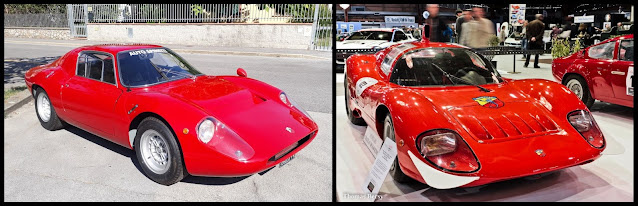
Showing posts with label Cosentino. Show all posts

Monday, December 1, 2025

Tiny but Mighty: the Abarth 500-595-695

Younger people today, familiar only with the specifications of contemporary/recent cars, may well wonder if someone is joking if they take a glance at this set of numbers which define a newly launched compact saloon: Engine capacity: 479 cc; Engine power output: 13 bhp; Kerb weight: 470 Kg; Length: 2970 mm; Width: 1320 mm; 0-60 mph: 1 minute or thereabouts; Top speed: 53 mph.  Now that launch was way back in 1957, so that explains a lot, but even that long ago the majority of potential buyers did not find themselves attracted by those performance numbers.  The situation did however provide Carlo Abarth with an exciting opportunity and he seized it speedily and with enthusiasm.  As a result, the Abarth version of the Fiat 500 Nuova was ready for presentation within a few short months.  With the two cylinder engine’s compression ratio raised, a Weber 26 IMB carburettor fitted and a sports exhaust, the Fiat Abarth 500 had 21.5 bhp to play with.  But both Fiat and Abarth’s initial vision of a 500 cc car struggled to achieve the sales volumes that had been anticipated.  Fiat tried two countermeasures – 1) Cutting the price of the basic model and introducing an improved specification, ‘Normale,’ and, 2) Introducing a ‘Sport’ model in mid-’58 which featured a 499 cc engine with similar performance to the Abarth’s, and some cosmetic enhancements including a metal roof.  Abarth went a touch more radical, introducing a new cylinder head with hemispherical combustion chambers and further upping the compression ratio.  Together with attention to gas flow optimisation, 26 bhp was extracted from the little two cylinder.  All good stuff, but the really clever move was to run such upgraded 500s at Monza in February ’58.  They achieved noteworthy speed/distance records which attracted a good deal of press attention.  But, even more significantly, note was taken by Fiat’s top management, leading to a new level of talks with Abarth.  And those talks culminated in the ‘win bonus’ agreement which became so important to Abarth throughout the Sixties – see here

Left: Presentation of Fiat 500 Nuova, Turin, July ’57  Courtesy FCA Heritage; Centre: ’57 Fiat 500 Nuova  Courtesy Cymon Taylor/RM Auctions; Right: Fiat Abarth 500, Monza record, February ’58  Courtesy Stellantis


With the Fiat version able do more than just permit its driver to chug around in discomfort, its commerciality was established and customer approval progressively improved.  Through the Sixties it was regularly improved and established itself as a respected model in the Fiat range, even if the 600 was seen as more successful.  It remained in production until ’75, by when 3.7 million had been manufactured.  In the early years of the Sixties, with a model designation, ‘D,’ the car’s doors remained rear hinged.
 
For Abarth, the ‘difficult’ years extended to ’63, when the 595 1st Series was launched that January.  This bigger engine capacity version, along with the 695 which emerged the following year, found much more sales success, largely founded on how well both variants performed in motorsport.  The Fiat 500 engine had been based on a separate cylinders format, but, along with the increase of capacity to 594 cc, Abarth decided to reconfigure it, with the two cast iron barrels conjoined.  Thus there was provision for further enlargement and with potential additional power outputs for better accommodation of higher operating temperatures.  A reprofiled camshaft and upgraded valve springs figured, along with domed pistons, (facilitating a 9.5:1 compression ratio), while internal polishing for enhanced gas flow and a change of carburettor – to the Solex C28 PBJ – all contributed towards a 27 bhp output.  With weight still around 470 Kg, the 595 could do 0-60mph in 28.3 seconds – though not exactly electrifying, that’s half the time it took the original Fiat 500 to do that.  For the period, the 75 mph top speed was considered more than acceptable for such a diminutive car.  As can be seen in the photograph below, being based on the Fiat 500 D, this 595 still featured the ‘suicide’ door rear hinges.

’63 595 #575584  Courtesy Bonhams Cars

One year on, Abarth’s ongoing quest for incremental performance resulted in the announcement of the 695.  This time the capacity increase was to 689 cc, enabling the delivery of 30 bhp.  At the same time, just in case any prospective buyers might think a mere 3 bhp not much of an increase over the 1st Series 595, further variants, the 595 SS and 695 SS, were presented.  With a higher compression ratio and a bigger Solex carburettor, the 695 SS deployed 38 bhp.  Able to turn 87 mph flat out, it was worthy of its Super Sport designation – confirmed by an ‘esse-esse’ script badge on the engine deck lid.  A ‘64-made 695 SS is seen below, left, with points to note: Lesmo aluminium wheels; engine deck lid badge is ‘SS’ version; Campione del Mondo badge on the rear quarter panel; rear hinged doors.  Below, right, is a ’64 595 SS, which runs on CMR/Borrani steel wheels.  When auctioned in 2023, the lot description stated that the car has been ‘upgraded’ to 695 SS specification.

Left: ’64 695 SS #0866463  Courtesy Peter Bovyn Fotografie; Right ’64/65 595 SS #785002  Courtesy Iconic Auctioneers


During ’65, Fiat introduced a revised 500, known as the ‘F’ model which was equipped with front hinged doors.  Accordingly, from June of that year, there were 2nd Series versions of the 595, 695 and 695 SS.  The engine power output of all three models was increased by 2 bhp.  The 595 SS 2nd Series was rated at 32 bhp.

’66 595 2nd Series

’65 595 2nd Series, #0862866  Courtesy RM Sotheby’s

Below is a ’67 595 SS, #1399557, with the engine bay and front trunk interiors shown.

’67 595 SS #1399557  Courtesy RM Sotheby’s

In the mid-sixties, Abarth felt a particular challenge to its 4 cylinder 850/1000 Berlina models’ competitiveness in Touring Car racing.  Consideration was given to converting the 200 series engine’s cylinder head to a twin cam format to facilitate further increased power outputs.  Eventually, however, it was decided to meet the objective by redesigning the single cam head’s combustion chambers and valve gear layout.  The result was the ‘Radiale’ head which enabled improved gas flow and combustion thanks to the combustion chamber form and the orientation of the valves.  Each combustion chamber comprised two overlapping hemispheres, the slightly larger encapsulating the inlet valve, the smaller housing the exhaust valve.  As additional measures of unconventionality, each pair of valves was inclined towards one another and were aligned transversely in relation to the cylinder head.  A similar project was approved for the two cylinder unit.  According to Sotheby’s, five 695s were built with Radiale-headed engines.  One of these was offered for sale in 2024 and is shown below.  The auction catalogue refers to this car as ’65-built, something I have not been able to verify and may be a doubtful attribution given that other sources do not date the two cylinder Radiale project prior to ’68, though Alfred Cosentino’s Abarth Guide includes a picture of a Radiale-head engine with a ’67 date attribution!

695 with Radiale head engine  Courtesy RM Sotheby’s
 
The two cylinder version of the Radiale head was a successful project for Abarth’s engines designer Luciano Fochi in terms of meeting the company’s power increase objective.  Its completion was not, however, as swift as Carlo would have desired.  Some of this no doubt stemmed from the difficulty in balancing the new basic elements – valve gear, manifold, twin choke 45 mm Weber carburettor and uprated cooling system – and this demanded prolonged and intensive testing/experimentation.  In consequence, it was not FIA homologated until mid-’71, meaning that the benefits of its availability to the racing programme could not be gained until after Abarth had ceased to exist as a marque in its own right. 

In September ’66 the production version of the 695 SS Berlina Corsa 1st Series made its debut.  The model is often tagged as 695 SS Assetto Corsa, (race trim), but the factory itself did not use the term, though there is sometimes reference to it being a ‘Competizione’ version.  It certainly was a car worthy of track use, with 42 bhp being delivered by the 689 cc engine.  A slightly more powerful 2nd Series appeared in January ’68. 

Culmination of the development programme came in January ‘70 with the 695 SS Berlina Corsa 3rd Series, a 45 bhp, 90 mph rocket.  Performance had this time been improved by incorporating a separate cylinder head intake channel for each cylinder   The car was priced at Lit 900,000 at launch.  The example seen below was sold by Bonhams in 2023 for €42,550.  The auction lot description states that 100 of these were made and that around half that number have survived.  It also notes that the car has a modified-in-period engine rated at 48 bhp.

’70 695 SS Berlina Corsa 3rd Series #2497485  Courtesy Bonhams Cars

On the car in the factory PR image below, the wheelarches (polyester) and lower side areas were finished, distinctively, in red:

Courtesy Registro Fiat Italiano

The 695 SS Berlina Corsa 3rd Series Tipo 206-A/D engine was fed by a Solex 34 PBIC carburettor and had a 10.5:1 compression ratio.  The car’s weight, at 480 Kg, was only very slightly heavier than the first version of the 695.

The 500, 595 and 695 scored many victories, attracting win bonus payments from Fiat in the years ’60-’71 – a total of 528.  Things began to really pick up in ’64 after the advent of the 595 and 695 models.  An early landmark was Franco Patria’s taking of the Jolly Club Trophy (600 cc class) at Monza in March ’64.  An important win came at the end of that season when a 595 headed the 600 cc class at the Monza Coppa F.I.S.A.  ’65 saw Leo Durst become Italian Touring Car Champion in the 600 cc class driving a 695.  The same feat was achieved in ’66, this time with Raffaele Pinto at the wheel, while Maurizio Zanetti took the 700 cc class in a 695.  Pinto was also victorious at Monza in the Touring class of the F.I.S.A. cup at Monza.  The ’67 Italian Touring Car Champions were again Abarth drivers, Marco Magri (595) in the 600 cc class, and Giovanni Brancadori (695) in the 700 cc class.

The 600 cc class of the Italian Touring Car Championship of ’68 was once again won by an Abarth 595 driver, this time Piergiorgio Poggi.  Expectations for the season were boosted by internal talk about the possibility of a Radiale head for the two cylinder engine, but, as mentioned above, this enhancement would not be homologated until ’71.  In March ’69, Abarth apparently demonstrated ongoing superiority at Vallelunga where 695s were 1-2-3 in the 700 cc class and Raimondo De Sanctis was the 600 cc class winner.  At the end of the season Abarth saw victory in the Touring Trophy once more – Piergiogio Poggi in the 600 cc class and Liberatore Cestra in the 700 cc class. 

The ’70 season opened with Abarth 595 and 695 class wins in the European Touring Car Championship round at Monza, so ‘business as usual.’  That was further confirmed by good performances on the hillclimb courses, where both 595s and 695s remained capable of class victory.  Renato Mazzeschi and Santo Famaso finished the season as Italian Touring Car Champions in their 595 and 695, respectively.  However, as an indication of what was to happen the following year, Abarth set up a new race department away from Corso Marche and under the care of Vincenzo Osella. 

’71, Abarth’s swansong year saw customary hillclimbing success with both 595s and 695s recording wins.  But as the season progressed past the midpoint, the in-house Abarth race operation was wound down and cars/parts/equipment was progressively relocated to the Osella workshop.  In its final guise as the Abarth factory team and as reconstituted at Osella, concentration was on the SE-designation sports racing cars, with a drop-off of focus on the 595/695/850 TC/1000 TC Touring cars.

A few years back I found myself attracted to the current ‘Abarth’ 595 and 695 models.  By today’s standards they are not unnecessarily big, have distinctive styling/a funky interior and a choice of engines offering good performance.  But a test drive soon deterred me, despite the aesthetically pleasing interior, some not over-suppressed exhaust noises and good nimbleness at slower speeds.  The original 595/695 models were designed on a customer centric basis and with a sports enthusiast/race driver in mind.  For such a person now the contemporary versions do not fit the bill.  My biggest concern was about how the seating position/ride height feels – I can best describe my unease in these cars as I sense that I’m sitting on the car rather than within it as you do in those cars where the machine feels as though it’s a seamless extension of your own body.  I have tried another this year, this time with the Sabelt optional seats, and the non-integrated sensation remains.  Performance of the Competizione is good – 0-60 mph in 6.5 seconds, but how much better could it be if the car’s kerb weight was less than its 1170 Kg – the sixties versions weighed in at less than half that!  And the engine that generates the 180 bhp involved is a three cylinder 1.4 turbocharged unit driving through a 5 speed (surely 6 ratios would be expected in a car of this type) gearbox  - a configuration that you know will not be delivering much in the way of really sweet drivability, linear power flow and pleasing noises, (though the Monza exhaust option would be worth having).  So I say that here’s another example of ‘progress’ that takes us backward and that less is more!


Tuesday, August 20, 2024

Abarth Doppia Bolla - I dettagli. Part 1

Carlo Abarth’s company, founded in 1949 following the collapse of the Cisitalia team he had been managing, grew steadily in its first six years of existence.  From its initial office in Bologna, its operational base was swiftly relocated to Via Trecate, Turin.  At the outset, the main focus of effort was in upgrading and running the Cisitalia 204A roadsters and this was largely successful.  There was however quite a setback as autumn set in, when the Madrid Grand Prix went badly for the team.  But this served to reinforce the view Carlo had for some time held – that reliance on racing as a primary activity could be commercially ill-advised, there being too many extraneous influencing factors involved.  So, seeking to ensure that his new enterprise would be financially sound – and thus be able to fund its ongoing competitive involvement in motor sport – he began to apply both his business acumen and his engineering expertise to the development of automotive ‘accessory’ products targeted at consumers wishing to upgrade the performance of their cars.

Abarth was highly adept and energetic in identifying specific ‘needs,’ designing relevant component kits and marketing them effectively.  Recognising the large market opportunity represented by the number of Fiat-owners in Italy, the early products included an improved gear shift lever and uprated water pump.  The most significant addition to the Abarth catalogue however soon proved to be exhaust pipes/silencers, with improved intake manifolds then following – the exhausts made cars like the Fiat 500 sound sporty, while the manifolds could make them actually faster!  The success of such a simple but effective ‘recipe’ was confirmed by steadily increasing sales, such that additional factory capacity was necessary by 1954 when a secondary premises was taken over at Via Pacchiotti in order to make the kits which had come to be characterised under a ‘brand,’ autotelaio e motore per Fiat 600 derivazione Abarth 750.  At the same time, with a long term vision, Abarth was hard at work to establish a potentially grander scale/high profit business strand – the production of special/modified complete vehicles with an emphasis on high performance, distinctive style and exclusivity.  Thus, there was a series of attention-grabbing sports car collaborations which raised the recognition and reputation of the Abarth marque:  In 1952, the Abarth 1500 – Fiat 1400-based, with a striking Bertone coupe body, styled by Franco Scaglione; the following year, with classy Ghia two-seater bodywork, Abarth’s version of the new 1100-103 not only looked good and futuristic, but also boasted nearly twice the horsepower of the standard Fiat product on which it was based; also in 1953, Abarth created a modular-construction body for the Ferrari 166 MM.  Ultra lightweight, this was another extremely good-looking vehicle, but in this instance the focus was on functionality in motorsport terms; 1954 saw Abarth turning to Alfa Romeo for the next style-and-speed project.  Based on the Portello-made 1900 Super, the Abarth-Alfa Romeo 2000’s Ghia-designed lightweight aluminium body combined with engine modifications giving a power output of 135 bhp resulted in another stylish, real high performance coupe; at the end of that year, reverting to the Fiat 1100-103, Abarth struck up a working relationship with Mario Boano’s carrozzeria, working to styling designs by Michelotti, to create three highly elegant sports cars – the racing 207A, two-seater barchetta 208A and the 209A coupe; Boano became further involved that same year when Abarth was commissioned by Alfa Romeo to build a new Prototype racer utilising a 1500 cc version of the Giulietta’s twin cam engine – the resulting 750 Competizione did not get beyond the prototype stage, but was yet another exciting example of Abarth’s expertise in designing/developing such vehicles.

It was not surprising therefore that Carlo Abarth was ready to capitalise on the business’s learnings from this sequence of special projects.  His ambition was to find a partner and related synergies in order to produce higher value cars in volumes that would in turn boost his company’s profitability.  Late in 1955, Carlo made contact with Elio Zagato specifically to discuss an idea he’d been mulling over – that Abarth should combine a Fiat chassis featuring the derivazione Abarth 750 enhancements with a small, lightweight coupe body made by Zagato in a series production offering.  The Milan-based carrozzeria had already constructed such a car in the Spring of 1955 and was not only interested in Abarth’s proposition, it was swift in response, with early examples of the formula appearing in the Spring of 1956 at Monza and at the Mille Miglia.  That year saw a process of refinement of the way in which the aluminium bodies were constructed and then mounted on the chassis as completed vehicles.  Within this process the roofline was reconfigured with the headroom requirements of taller drivers in mind, to feature the double humps which soon led to the model’s nickname, ‘Double Bubble.’  The earliest 750 Zagatos – made before March/April 1956 – have chassis numbers below 150XXX.  Double Bubbles, in production from late Spring onwards, tend to carry chassis numbers in the range 200XXX.

The model first appears in Abarth internal records as Project #17, June ’55, FIAT ABARTH 633-750 Coupe Zagato 1st Series.  Data includes: Tipo 219-A/S engine, giving 47 bhp @ 6000 rpm; 4 speed Fiat 600 gearbox; weight – 605 kg.  The specifications remained in place until the following February (1956), with minor revisions, (a very small increase (3 kg) in weight, for example), attributed to Project #21, and designation as 2nd Series.  A little confusingly, this was soon followed up, in April, by Project #24, which referred again to ‘1st Series,’ for which an increased compression ratio is noted, together with a Weber 32 IMPE carburettor in place of the previously employed 32 DRNP.

It is logical that a substantial proportion of orders were for a car with race-ready specification.  Referring to #248883, Bonhams in recent times included the following in its auction sale lot description: ‘(The car) was manufactured to Corsa specification with Plexiglas side and rear windows.’  However, the 750 Zagato authority, John de Boer, has said, ‘It has become popular in recent times to describe a certain batch of cars that exhibit certain characteristics specifically as "Corsa" versions.  I am unaware of a "corsa" designation being any kind of official moniker for these cars.  Some cars were built in batches sharing certain characteristics that seem more likely to imply racing intent or actual use.  

John de Boer’s long term, in-depth work on data defining individual cars and the production history of the 750GT model family is an essential reference source, with unique insight into certain aspects which are largely undocumented elsewhere, especially the early chassis completed without the involvement of Abarth, the batch of cars built for Abarth by the Turin carrozzeria, MECAT, and the U.S.-specific Sestrière model.  But, notwithstanding his assertion above, a 2008 H&H auction description for #383101 includes this:  (The ‘Corsa’) often benefited from plexiglass side/rear windows, reinforced C-posts, alloy rear window frames and smaller front indicators, not to mention a close-ratio gearbox, enlarged fuel tank, tuned engine (thin walled sump, pancake air filter etc) and higher marked rev counter.  Smaller, lighter and faster than its purely road-going sibling, the ‘Corsa’ could also be had with an optional auxiliary radiator (mounted underneath the car).  However, as each one was prepared for a specific client some boasted more of the aforementioned features than others.  . . . (This car) it was confirmed to me by Guy Moerenhout Racing of Belgium – an acknowledged specialist in all things Abarth – as having one of the twenty-one ‘Corsa’ type bodies.

Guy has been kind enough to further elaborate on the subject of the Corsa.  Especially helpful was the provision of a list of features:  47 bhp Mille Miglia engine with highly polished rods/crank (lightweight) and alloy 5 quart finned sump; Alloy drum air cleaner; Aluminium rimmed Plexiglass door and quarter windows; Plexiglass rear window; 10 gallon fuel tank; Bendix electric front mounted fuel pump; Record Monza-type bucket seats; Nardi wood-rimmed steering wheel; European 5.25” Marchal headlights; Italian licence plate frames, front and rear; Large, finned alloy front brake drums; Early Fiat 600 tail-light or Lucas lenses; Alfa 750-type, small front indicator lenses; Mille Miglia badge on dashboard; No flank badges except The Zagato ‘Z’ to the rear of the front wing; No front air ducts under the nose; Underbelly auxiliary radiator; Single 1956/57  Champion of Italy badge on rear deck; Small round badge above the front grille, (no Fiat script); Small Fiat Derivation 750 badge on decklid (6” long).

In the 2008 Bonham’s sale mentioned above, #248883, is described as a 1956 Fiat-Abarth 750 Zagato Corsa.  This car was I think actually manufactured in early-mid ’57.  Photographs attached to the auction lot details show compliance with several of the features noted in the paragraph above, notably: No flank badges except the Zagato ‘Z’ to the rear of the front wing; No front air ducts under the nose; Small Fiat Derivation 750 badge on decklid.

Double Bubble Corsa (?) - #248883 (early-mid-‘57):

This is a simplified timeline outlining the production history from 1955 through to conclusion.  Reference sources are:  (Greggio) The Man, the Machines by Luciano Greggio;  (Secc) Abarth, The Scorpion’s Tale 1949-1972 by Sergio Seccatore;  (DegRiz) Abarth. All The Cars by Elvio Degamello and Arturo Rizzoli;  (GastSecc) Abarth. Memories by Luca Gastaldi and Sergio Seccatore;  (Cos) Abarth Guide by Alfred Cosentino;  (BoSt) Abarth Racing Cars Collection, 1949-1974 by Stefan Bogner and Franz Steinbacher.
 
’55       Derivazione 750 - Fiat 600 conversion kit. Bore 60>61 mm, stroke 56>64 mm – 633 cc>747 cc.  Inlet manifold, Weber 32 IMPE (Fiat = 22 IM), compression ratio 7.8>9:1, Abarth exhaust, 21.5 bhp>41.5 bhp. (Greggio).
 
04-’55   Turin Motor Show – Abarth proposes a deal to Elio Zagato to create a 750 GT. (Greggio).
 
06-’55   Tipo 219-A/S Series 1 750 Coupe Zagato 47 bhp, 605 kg.  In Vol 1 Summary of Projects table – 217-A.  (Secc).
 
02-’56   Tipo 219-A/S Series 2 750 Coupe Zagato 608 kg.  In Vol 1 Summary of Projects table – 217A. (Secc)
 
03-’56   Zagato coupe with 750 mechanicals ran at Monza. (Greggio).
 
03-’56   Geneva Motor Show – launch of Abarth 750GT Zagato . (the following month, at the Turin Show, Abarth showed two Bertone 750GTs, but neither were greatly liked and very few were built).  (Though empathy between Carlo and Nuccio led to the Bertone-bodied 750 Record).  (Greggio).
 
03-’56   First wins – 19-03-’56, Enrico Carini, Monza, Trofeo Vigorelli, 2nd overall, 1st GT 750.  (Racingsportscars.com)  25-03, E. Carini, Trofeo Torricella hillclimb (Greggio) and, same date, ?Harris, Course de cote de la Roche hillclimb (Greggio).
 
04-’56   10 cars entered in Mille Miglia, ‘Abarth derived Fiat saloons, one of which won the 750 cc GT prod class, driven by Domenico Ogna.’ (Greggio).
 
04-’56   Tipo 219-S Series 1 750 Coupe Zagato 47 bhp, 535 kg (Secc)
 
09-’56   02-09-’56 Enrico Carini, Monza, Coppa Inter Europa (GT 750 class)
 
10-’56   21-10-’56 Mario Poltronieri, Castelfusano, GP Roma (GT 750/T 750 class)
 
’56 season – according to Greggio, had 5 victories in GT 750
 
05-’57   Tipo 219-C Series 2 750 Coupe Zagato 43 bhp, 535 kg (Secc) Changed features: Rear optical group, bumpers (Greggio)  (rally?) (?’58 Sestriere Rally winner?)  Rear optical group, bumpers
 
07-’57   Tipo 219-C Series 1 750 Spider Zagato 43 bhp, 505 kg (Secc)
 
07-57    105/CZ Fiat 500 modificato Abarth 479 cc, 20 bhp, 465 kg (Secc)
 
10-’57   500 GT first showing at Turin Motor Show
 
10-57    ‘Definitive double hump’ roof on 750GT shown at Turin Motor Show' (Greggio)
 
10-’57   Bialbero engine, 61 bhp, in Record 750GT (Greggio)  Greggio says the first version (no date given) 57 bhp
 
02-’58   ES 01, Tipo 222 700 Coupe Record Monza Zagato 66 bhp, 565 kg (Secc)
 
02-’58   ES 01, Tipo221 750 Coupe Record Monza Zagato 57 bhp, 568 kg (Secc)  Greggio says smooth roof, 3 pane rear window, horizontal wraparound bumpers, ‘ample’ central intake vent in bonnet, rounded rear end, no little tails on the far end of the wings. 540 kg.  Production run of 100 for GT homologation.
 
(https://www.no-speedlimit.it/index.html): “By the time of the appearance of the Abarth Zagato Record Monza 750 Bialbero, the bodywork had been unified into a separate model with a rather large hump on the engine lid, made necessary by the taller twin-cam motor. There were then three distinct models: 750 "Double Bubble," 750 "Record Monza", and 750 "Sestrière."
 
03-58    (Following high success of Abarth 500 Nuova) Agreement by Fiat to the payment per race victory to Abarth and production of alleggerita 600 for supply to Abarth begins.
 
Late-’58 Corso Marche opens
 
03-’59   USA debut - 4 x Record Monza 750s run at Sebring
 
04-’59   Tipo 215 750 Coupe Sestrière Zagato 52 bhp, 555 kg (Secc).  Several sources say run of 25 cars built ‘mostly’ for the USA.  https://hypercars.io/listing?id=412871 says: “It is not known how many were produced, some say 25+, my information suggests the number is higher, possibly more than 32.  Fiat Abarth 
750GT Zagato Forum  says steel body/no roof bubbles and either 215 engine (748 cc) or 213A (785 cc).”  Bonhams: A special model named the "Sestrière", as seen here, had upright fixed headlights and was built normally in steel with aluminium doors*other sources, with two prominent air scoops atop the tail for better engine cooling.  No Speed Limit: the majority were built with a steel body, a very small number of alloy cars, and there is one aluminium car known to exist today.
 
06-’59   ES 02, Tipo 220 850 Record Monza Zagato 70 bhp, 570 kg (Secc)
 
01-’60   ES 02 Tipo 214-B 850 Coupe Stradale Zagato 52 bhp, 590 kg (Secc)

I suspect that this will forever be an ongoing work-in-progress.  By virtue of the type of vehicle this is, and the sort of enthusiasts that typically own examples, cars seen/photographed today may well display features which have been added/modified over the years, long after they left the factory – such customisation is especially commonly seen in regard to badging, trims and wheels.  And, as regards the details of any 750GT as it left Corso Marche, such is the accuracy/completeness/availability of the contemporaneously-recorded data concerning production of the cars, that there will be many aspects of their specifications which will remain uncertain/disputed.  I do not pretend to have access to any magic bullet processes or data sources which would resolve such issues.  All I have done here is to collect together and systematically organise existing information with what I hope is an appropriate level of discretion.  But, even so, I’m sure there will be readers with far greater first hand knowledge of the cars than I have who will perceive misunderstandings/anomalies in what I’ve written.  That being the case, I’m very keen to receive appropriate feedback so that the document can be refined and improved – so please don’t hold back!

Part 2 will cover details of the cars' bodywork, badging and trim.

Friday, May 3, 2024

Differing Fortunes: The Abarth 1300 OT and The1600 OT Sport Coupe

 
Left: Abarth 1300 OT (1st Series). Courtesy Autoemotodepoca.com; Right: Abarth 1600 OT Sport Coupe. Courtesy Thomas Bersy

Abarth’s extraordinary run of sportscar racing success, taking a World Championship for six consecutive years in the Sixties, is summarised in https://davidbuckdenlooksback.blogspot.com/2022/05/the-magnificent-six-abarths-60s-world.html .  Initially, it was the 1000 Bialbero GT which brought home the victories, but in ’63-’65 the mantle passed to the Simca-based 1300 GT.  With the lapse of the agreement between Abarth and the French manufacturer, a priority at Corso Marche became the creation of a new model to contest the championship from ’66.  A prototype coupe emerged in ’64.  A Mario Colucci-owned project, the car was mid-engined and built around a tubular chassis, very distinctive in appearance and dynamically promising.  But on this occasion Carlo Abarth stuck to his guns regarding the configuration, his concern about the relative costs of construction reinforced by the fact that the Simca platform had provided a simple, inexpensive basis.  Thus he halted ongoing development at an early stage, insisting that the car be disposed of – which it was, to Scuderia Lufthansa.  The German team in effect ‘finished’ the car, but without notable success.  Though designated at Corso Marche as the 1300 OTC, the car became known simply as the ‘Lufthansa.’ 

A new Omologata Turismo (OT) line began to take shape in early ’65.  Being based on the Fiat 850 platform, the new models not only fulfilled Carlo’s simplicity/reduced-cost objectives, but also signified a reconsolidation of the ‘traditional’ alliance with Fiat following the flirtation with Simca.  The first results of the programme were Sport Spider models, offered in both 1600 cc and 2000 cc form.  In short order the new coupe, Tipo 137/C, followed – in March – powered by the 1288 cc, 147 bhp, Tipo 237 engine.  Though Colucci was no doubt disappointed by Carlo’s axing of the tubolare/mid-engine format, the boss had given him the freedom to design a glass fibre body which he did with considerable aplomb, the 1300 OT’s styling receiving general acclaim for its aesthetic quality.  And as well as looking good, the 1300 OT’s performance was enhanced by the aerodynamic efficiency of the Sibona & Basano-built body.  A feature which many consider fundamental to the car’s distinctive visual attractiveness was the roof mounted air intake, (for cabin comfort purposes), which gave rise to the sobriquet, ‘Periscopia.’  This, however, was not seen on the launch version, not being introduced until the advent of the Series 2 1300 OT.  Indeed, there was a series of updates for this model, summarised by Sergio Seccatore in ‘The Scorpion’s Tale’: Series 2, ’66;  (‘Sport Coupe’) ‘World Champion,’ September ’66, 148 bhp 237-C engine;  ‘Longnose,’ September ’66, 147 bhp; ‘World Champion,’ June ’67, 157 bhp 237-B engine;  ‘World Champion,’ January ’68, 157 bhp 237-B engine and coil-over suspension.
OT 1300 Series 1 and 2 compared in profile. From Seccatore’s The Scorpion’s Tail. Courtesy Registro Fiat Italiano

There is some confusion in the factory records regarding these iterations as in the summary, ‘Vetture Abarth Da Competizione’ the 2nd Series version is dated ’66, while in the list, ‘Riepilogo Progetti Abarth,’ the June ’67 version is tagged as ‘1st Series.’  In his ‘Abarth Guide,’ Alfred Cosentino records the 2nd Series as a ’66 development and comments: ‘It wasn’t until the last two championship races in 1966 that the basic body design was established for the OT 1300.  There were four types of nose sections with different air intakes, headlight covers and aerodynamic body shapes tested . . . since September 1965.’  Cosentino also documented a further ’66 variant, the Longtail.  The photograph of this reproduced in the book is captioned: Udo Schutz driving a factory Fiat Abarth OT 1300 Longtail at the Nurburgring 500 km in 1966.  Ing. Colucci redesigned the front nose section of this OT 1300 and the top speed increased by 17 km per hour.  A technician of Alpine Renault redesigned the rear section which increased the top speed by only 4 km per hour.

Udo Schutz’s OT 1300, Nurburgring 500, ’66.  Courtesy Alfred Cosentino Books

The car’s early competitive outings required entry in the Prototype category.  At the Nurburgring for the 500 Kms on 5th September ’65, Klaus Steinmetz took 3rd place both overall and in the P 1.3 class.  For the Group 4 Sport category, homologation depended on the completion of 50 examples, and this was achieved in May ’66.

Karl Steinmetz, 1300 OT, Nurburgring 500 kms, September ’65.  Courtesy Registro Fiat Italiano

A little later, in September that year, a new model, the 1600 OT Sport Coupe, was unveiled.  It represented a speculative venture on the part of Abarth.  The firm’s Spiders had been successful in attracting a substantial and loyal cadre of hill-climbing enthusiast owner/drivers.  However, there were only so many such clients, and it became reasonable by the decade’s mid-point to assume that very few if any of them not already Abarth-equipped would be stopping by at Corso Marche to make a purchase.  At the same time, an opportunity was perceived to increase Abarth’s penetration of the market for similar competitors whose penchant was for circuit racing in the Sport and Prototype categories.  With the objective of appealing to such prospective buyers, a prototype closed car was built on the previous year’s OT 1600 Spider.  It certainly looked the part – attractively curvaceous and sophisticated, with clamshell front and rear sections and gullwing doors.  Designated Tipo 139/C, the 235-C engine was specified.  This 1592 cc, 172 bhp unit was a higher-revving development based on that utilised in the ‘63 Abarth Simca 1600 GT Coupe Stradale, rated in that form at 155 bhp.
1600 OT Sport Coupe. Courtesy Registro Fiat Italiano

1600 OT Sport Coupe. Courtesy Giorgio Nada Editore

By the time the 139/C was being shown and promoted, the 1300 had completed a very successful debut full season, instrumental in Abarth once again being crowned World Champion in the Sport, Division 1 class.  Victories had been scored by the model at the Nurburgring 1000 Kms, Mugello GP, Coppa Citta di Enna, Nurburgring 500 Kms and at Zeltweg.  1-2-3 finishes had been recorded at the ‘Ring 1000 Kms and at Pergusa (Enna).  The car was an all-round success and this was reflected in ready marketability and good sales profitability.
 
Meanwhile, the performance of the 1600 Coupe on-track – further evaluated at Abarth’s multi-model testing at Vallelunga in late January ’67 - was nothing like as encouraging.  Initially the car was run with a 1600 cc engine and the 6 speed Tipo 132 transmission – about which concern had been building in regard to its durability as engine outputs continued to increase.  In comparison with the Sport Spider in 2 litre form and equipped with the new Tipo 139, 5 speed transmission, its lap times were disappointing – around 4% slower.  A new 16 valve 1.6 engine was on hand and this was tried in the Coupe, but there was no conclusive outcome from this experiment.  It was therefore decided – and there was a certain inevitability about this – to try a 2 litre unit, and this enabled the Coupe to near-match the lap times of the Spider. 

As is usually the case with what are hoped to be ‘private’ test sessions, news of the performance of the various models leaked out by word of mouth.  This left the circuit racer community unimpressed.  Aware of this, Abarth revised its marketing expectations and attempted to interest hill-climbers in the car.  But, here again, the reception was lukewarm at best.  Whilst the Coupe had the agility and performance with some potential for this specialist form of competition, the visibility restrictions imposed by the coupe body were a very significant downside.  By the end of the ’67 season it was all too apparent that the car had virtually no commercial appeal and it was decided to abandon the project with just the single chassis completed.

Fortunately, Abarth had a hill-climb specialist customer, Eris Tondelli – who did see some potential.  As Eris recalls, after he tested the Coupe he called for a replacement, 2 litre, engine to be installed because the weight of the car was greater than had been expected and was significantly inhibiting performance.  Previously it has been asserted in print that Tondelli purchased the Coupe, but I recently heard from another source that it was simply entrusted to him by the factory – Abarth itself retaining ownership.  Tondelli – who also campaigned the 1000 SP, 1300 OT and 2000 Sport models – drove the car at a number of hill-climbs, notably the ’68 Bologna-Raticosa; three photographs of the car on that event are reproduced in Deganello and Rizzoli’s ‘Abarth, All The Cars.’  Subsequently, it was purchased by Michel Pont.  As recently posted on Tondelli’s Facebook,  the car was a high profile feature at an event in ’89 at Château de Savigny-lès-Beaune, accompanied by Abarth personalities, Renzo Avidano, Mario Colucci and Vincenzo Osella.  It remains as an exhibit at Musée de la voiture de course Abarth, at the Château.

1600 OT Sport Coupe (nearest camera) at Abarth group test, Vallelunga, January ’67. Courtesy Giorgio Nada Editore

Eris Tondelli testing the 1600 OT Sport Coupe. Courtesy Giorgio Nada Editore

Colucci (left) and Tondelli (right) in the 1600 OT Sport Coupe, Beaune, ’89. Courtesy Eris Tondelli 

The ’67 season saw the 1300 OT fully dominant in the World Championship events, winning the Sport, Division 1 Class, up to 1.3 litre at Hockenheim, (1-2-3-4 finish for the model), Mugello, Pergusa, (1-2-3 finish), Zeltweg, (1-2-3 finish), Ollon Villars and Nurburgring 500.  At the Targa Florio, Guido Garufi and Giuseppe Ferlito came home first in the Sport 1.0-1.3 class, 19th overall.  Ecurie du Maine entered a 1300 OT for Marcel Martin and Jean Mesange who took it to the finish 16th overall and victorious in class.  The model in this second full season was clearly well sorted and reliable, but also benefitted from attracting a number of top line drivers of the period, among them Toine Hezemans, Ernst Furtmayr and Jo Ortner.  In the end of season championship class table, Abarth boasted 45 points, with a huge gap to Diva in second place – the Camberwell, London-based marque accumulating just 12 points.

The following year was to be first since ’61 that World Championship honours could not be trumpeted from Corso Marche.  However, 28 major event (mainly hill-climbs) class wins were taken by the 1300 OT at: 

Avola, Coppa Belmonte (Gambero)

Arezzo, Pieve St. Stefano Passo dello Spino (“Drason)

Brescia, Scalata al Colle Sant’Eusebio (Pilone) and Autoscalata della Maddalena (Becchetti) and Trofeo Valle Camonica (Presenti)

Parma, Castione Baratti-Neviano Arduini (Boeris)

Volterra, Coppa Citta di Volterra (Zuccoli)

Piacenza, Castell’Arquato-Vernasca (Presenti)

Rieti, Coppa Bruno Carotti (Ramoino)

Bassano del Grappa (Becchetti)

Livorno, Antignano-Monteburrone (Ungelli)

Reggio Calabria, Santo Stefano-Gambarie (Benini)

Cortona, Coppa Citta di Cortona (Mugelli)

Vallelunga, Coppa Gallenga (Ramoiono)

Cosenza, Coppa della Sila (Gambero)

Trento-Bondone (Federhofer)

Sestriere, Cesana-Sestriere (Federhofer)

Freiberg, ADAC Bergpreis Freiberg-Schauinsland (Federhofer)

Pescara (Cronoscalata Svolte di Popoli (“Mici”)

Ascoli Piceno, Ascoli-Colle San Marco (Ramoino)

Nurburgring 500 Kms (Walton)

Verona, Caprino Veronese-Spiazzi di Monte Baldo (Pilone)

Bergamo, Castione-Passo della Persolana (Presenti)

Ragusa, Coppa dei Monti Iblei (Gambero)

Aosta-Pila (Ramoino)

Gubbio, Coppa Mengara (Fabroni)

Siracusa, Coppa Val d’Anapo-Sortino (Gambero)

Orvieto, Trofeo Citta di Orvieto (Fabroni)


Gratifyingly, the 1300 OT remained competitive right through to the end of Abarth’s independent era, with the victories counts being: ’69: 19; ’70: 31; ’71: 30.  In that period, two drivers in particular excelled in the model:
 
Karl Federhofer, (1927-1990).  The German driver competed in the early Sixties in Porsche 356s.  In ’65 he campaigned an Abarth Simca 1300 Bialbero, switching to a 1300 OT the following season and he remained with the model up to and including 1970.  The stand-out achievement was outright victory at the ’68 running of the prestige Trento-Bondone hillclimb event.

Karl Federhofer, Abarth 1300 OT, ’70 ADAC-Bergpreis Freiburg-Schauinsland Hillclimb. Courtesy www.forum-auto.com

Luigi Moreschi, (1947 - ).  A Mantuan, Moreschi developed a passion for motorsport at an early age, entering races even before he held a driving licence.  Though most of the great many races in which he competed were at club level, he also acquitted himself well in Sportscar World Championship races, including the Targa Florio, an event in which he participated on six occasions, his best result on the Circuito Piccolo delle Madonie coming in ’73 when he finished 4th – and first in class in a Chevron B21 – partnered with Francesco Matteo.  Two other significant victories came in ’77 at the Vallelunga 6 hours, (Porsche 935), and, ’78, Misano, this time in an Osella PA6.  More recently, and for over 30 years now, Moreschi has run a motorsport sales and service/parts business in his home town of Quingentole: https://www.moreschi.info/veteran/index_en.htm  Moreschi’s victory count, ’69-’71 in the 1300 OT was eight.

Moreschi’s contemporary business has notable Abarth focus – this is a Tipo 237 engine. Courtesy Luigi Moreschi Motorsport

Also repetitively successful in the 1300 OT were Münchner, Peter Stutz, and Klaus Brand.

So, we have one car – the 1300 OT – with results in competition which signify it as one of the very best Corso Marche products.  And, from the same era, a car – the 1600 OT Sport Coupe – which disappointed statistically, but which is no failure, as it is, arguably, the most aesthetically pleasing machine to emerge from that same factory.  Certainly, its creator, Mario Colucci, was of that view, saying in an interview, recorded twenty years on, that it was his most beautiful design. Indeed, not only was it a superb example of mid-Sixties Italian automotive styling, but it also provides us in the 2020s with a glimpse of how the elusive T140 might have looked in fully developed form . . . as I’ve often said before; if only . . .

Sunday, March 17, 2024

Piccolo ma Potente - Abarth 1000 SP


Courtesy of Tony Berni

Carlo Abarth’s manager of mechanical, chassis and body development, Mario Colucci, joined from Alfa Romeo following the collaborative Abarth-Alfa 1000 project which culminated in November ’58 with the presentation of a Scaglione-styled version at the Turin Motor Show.  This model featured a tube frame chassis, the preference of both Alfa Romeo corporately, and Colucci personally.  Following on from this, despite his own contrary chassis construction and engine location principles, Carlo Abarth gave Colucci the opportunity to design and develop a new line of lightweight spiders, initially with the Fiat 600-based 748 cc #221 engine.  By ’62, 1300, 1450 and 2000 cc versions had evolved, utilising the Simca-based engine.  However, these models did not achieve competitive successes to an extent which could attract an ongoing/increasing cohort of racing customers.  In addition, Carlo’s retained prejudices re-emerged in an edict which contended that the expense involved with the tubular chassis and mid engine location further undermined the cars’ marketability.  Thus, the series was discontinued for the ’65 season.  Effort and focus was transferred to bigger capacity spiders designated OT (Omologato Turismo).  As well as being available in both 1600 and 2000 cc versions, the OTs were distinctive in being Abarth’s first all-glassfibre bodied models.  Buoyed also by on-track success of a sister coupe model, the 1300 OT, Abarth relented in regard to a smaller capacity Spider and gave Colucci the go-ahead to create a new 1000 Sport Prototype version for ‘66.  It was a ‘brave’ decision since Carlo had to allow Colucci once again to specify a tubular chassis and central engine.  Furthermore, it only made sense to produce the new model in Group 6-compliant form, and that meant committing to a production run of 50 cars for homologation purposes.  The resulting 1000 SP, also known internally as the SE04, was ready in the Spring, making its racing debut at the 14th Coppa della Collina at Pistoia, (May, ’66).
 
In Alfred Cosentino’s Abarth Guide, he refers to the 1000 SP as the 1965 Fiat Abarth 1000 SP Barchetta Tubolare, also citing earlier (‘63/’64) versions as bearing the SE04 designation.  In his note about the model, he suggests 25 were initially built in ’65 and all were readily sold, prompting a second run of 25, dates unspecified.  However, all other sources relate the SE04 tag to cars known simply as 1000 SP.  An SE (Speciale Esecuzione) internal model code incidentally was applied to some Abarth racing models produced from the mid-Sixties, beginning with SE08, conferred on the ‘64 Formula 2 single seater.  SE025 was the highest code number used up to the end of ’71.  During the subsequent ‘Fiat’ period when Abarth was involved in the development of the new Lancia rally car, an SE designation, 037, identified the project and this became used as the car’s ‘public’ model name.  The Lancia Delta S4 bore the last designated SE code – 038, in ’85.

Courtesy 2015 Registro Fiat Italiano


The SE04 as launched, was powered by the #229A (dry sump), 4 cylinder, twin cam, 982 cc engine on twin Weber 40 DCOE2s, rated at 105 bhp @ 8000 rpm.  As coupled with the #A.102 5 speed gearbox and in a vehicle with a kerb weight of just 480 kg, it was both an agile and fast package, capable of over 135 mph.
 
The FIA eventually conferred Group 4/up to 1000 cc Class homologation on the 1000 SP in March ’68 – sample pages from the document, #241, are shown below:


Luciano Greggio’s ‘Abarth the Man, the Machines’ lists all (though the author indicates that some data may be missing for the years ’68 and ‘69) the outright/class victories scored by the marque from 1949 to 1971.  For the period ’66-’71, the list includes 150 victories for the 1000 SP, the peak year being ’68, when 66 first places were recorded.  Throughout the whole period, the great majority of successes was achieved at hillclimb events, at which multiple entries were frequently run in both the Sport and Sport Prototype categories.  Most events were in Italy, but the 1000 SP saw success also on hills/tracks in France, Germany and Switzerland.
 
The most successful driver- by a considerable margin - was Salvatore Calascibetta, who triumphed 15 times in a 1000 SP.  Calascibetta ran a workshop and parts store in Sicily but was also employed for several years by Abarth both as a test and a racing driver.  His driving career extended from the late Fifties to the mid Seventies.  Also known as ‘Toto,’ he resided and traded in Palermo, and this was convenient for his many participations in the Targa Florio – 13 in all, with the final outing (’71), in partnership with Paolo Monti, yielding a 1st in the GT 2.0 class, 9th overall.  On that occasion he was driving an Opel GT 1900 for Conrero Squadra Corse.  Eight years earlier, he had taken the class honours at the Targa in an Alfa Giulietta SZ.  For Abarth – in a 1000 SP entered by Scuderia Pegaso – he shared the Sport 1.3 class victory in ‘69 with Vincenzo Ferlito.  Their car was placed 11th overall.

Left: Salvatore Calascibetta (Targapedia2); Right: Calascibetta’s 1000 SP at the ’68 Targa Florio

Next most successful multiple winner was Luigi Tommasi with 9 victories.  He was active from the early Sixties through to ’79 and appeared at several high profile circuit races, though all his 1000 SP exploits were at hillclimb meetings in ’67 and’68, subsequently trying his hand at Formula 3.  His 1000 SP class wins were taken at, (’67): Sorrento, Rieti, Monopoli, Pescara,  and Ascoli Piceno, (’68): Rieti, Cosenza, Avezzano and Pescara.

Paolo Lado took the chequered flag in first place 6 times behind the wheel of a 1000 SP.  He was successful on circuits as well as hillclimbs, especially in ’68, when he won twice at Vallelunga and also at Imola.

Paulo Lado, (at Trento-Bondone hillclimb, July ’68)

Other notable drivers who enjoyed multiple wins in a 1000 SP were: Enzo Buzzetti (5 wins), Gianni Varese (4 wins) and Giuseppe Vergilio (4 wins).

     Left: Enzo Buzzetti, ’67 Targa Florio;                                               Right: Gianni Varese, ’68 Cesana-Sestriere

The agility possessed of this little barchetta is clearly demonstrated by its excellent run of Targa Florio results – up against generally more constructionally robust and higher powered opposition - in the years ’67-’72:
 

Year

Race #

Entrant

Drivers

Place

Class

67

142

Buzzetti

Enzo Buzzetti - Secondo Ridolf

22

2nd P1

68

96

Scuderia Pegaso

Salvatore Calascibetta - Vincenzo Ferlito

44

2nd S1

69

122

Scuderia Pegaso

Salvatore Calascibetta - Vincenzo Ferlito

11

1st S1.3


126

Buzzetti

Enzo Buzzetti - Walter Donà

16th

3rd S 1.3


124

Scuderia Nord-Ovest

Eris Tondelli - Marco Crosina

31st

4th S 1.3


202

Jolly Club

Ugo Locatelli – Mario Zanetti

5 laps only


70

262

Scuderia Nord-Ovest

Renzo Ruspa - Pier Giorgio Pelegrin

16th

1st P1


254

Scuderia Etna

Francesco Patanè - Orazio Scalia

DNF


71

82

Barone

Maurizio Campanini – Mario Barone

14th

1st P1.0


83

Scuderia Brescia Corse

Giovanni Boeris - Maurizio Roasio

15th

2nd P1.0


77

Scuderia Nettuno

Giuseppe Bargotti - Sergio Guibar

DNF


79

Patane

Francesco Patanè - Orazio Scalia

DNF


72

70

Scuderia St Paul

Francesco Patanè – Orazio Scalia

DNF


It’s been said that perhaps around 25 of the 50-70ish originally built 1000 SPs are extant.  One of the most familiar in recent times is #0038, which was sold by Hyman, St. Louis, MO, US: https://hymanltd.com/vehicles/7351-1966-abarth-1000sp/ .  It had previously been offered on Bring a Trailer in April 2023, https://bringatrailer.com/listing/1966-abarth-1000sp/ and was bid to $210,000, (reserve not met).  (At that time Sports Car Digest published an illustrated feature on the car: https://sportscardigest.com/car-of-the-day-1966-abarth-1000-sp/ )

#0038. Courtesy of Sports Car Digest


#0024 was presented in November 2014 by Bonhams, https://cars.bonhams.com/auction/21904/lot/8/from-the-maranello-rosso-collection1966-fiat-abarth-1000sp-tipo-se04-racing-sports-prototype-chassis-no-se04024/ selling for £135,900.

#0024. Courtesy of Bonhams


#0049. Courtesy of Radical Mag.com


The SE04 proved to be an especially important car for Abarth, not only because it remained competitive in 1 litre form for several years, but also as it was an excellent base for the development of new versions and reconfigurations which emerged as ‘new’ models.  The ’67 SE04/L identified a 2 litre version with a longer (by 60 mm) wheelbase.  That same year, SE04 FB appeared, this time with the wheelbase re-dimensioned in the other direction.  This was necessary because of the car’s ‘real’ distinguishing feature – relocation of the engine to Carlo’s preferred rearward position; FB = fuoribordo – ‘outboard.’  The following year saw a further developed version of the 2 litre Sport with sufficient updating to warrant a new SE number: 10.  The SE010 itself was the basis of a new Prototype, SE014, launched in ’69.  And all that had been learnt with the SE04 and its successors, SE010 and SE014, informed the similar competition cars for the new decade, the SE018 (outboard, 1 litre) and SE019 (available in either mid or outboard form).  Though Abarth would cease to be an independent marque the following year, this was a period of intense activity, further substantiating the perception of the Corso Marche firm as a major player in international motor sport.