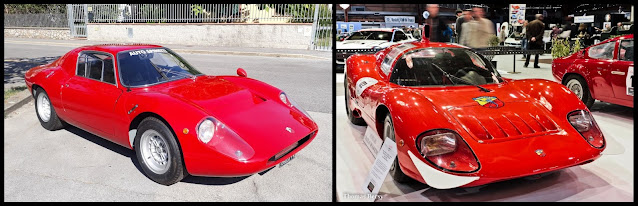
Left: Abarth 1300 OT
(1st Series). Courtesy Autoemotodepoca.com; Right: Abarth 1600 OT
Sport Coupe. Courtesy Thomas Bersy
Abarth’s extraordinary run of sportscar
racing success, taking a World Championship for six consecutive years in the
Sixties, is summarised in https://davidbuckdenlooksback.blogspot.com/2022/05/the-magnificent-six-abarths-60s-world.html . Initially, it was the 1000 Bialbero GT which
brought home the victories, but in ’63-’65 the mantle passed to the Simca-based
1300 GT. With the lapse of the agreement
between Abarth and the French manufacturer, a priority at Corso Marche became
the creation of a new model to contest the championship from ’66. A prototype coupe emerged in ’64. A Mario Colucci-owned project, the car was
mid-engined and built around a tubular chassis, very distinctive in appearance
and dynamically promising. But on this
occasion Carlo Abarth stuck to his guns regarding the configuration, his
concern about the relative costs of construction reinforced by the fact that
the Simca platform had provided a simple, inexpensive basis. Thus he halted ongoing development at an
early stage, insisting that the car be disposed of – which it was, to Scuderia Lufthansa. The German team in effect ‘finished’ the car,
but without notable success. Though
designated at Corso Marche as the 1300 OTC, the car became known simply as the
‘Lufthansa.’
A new Omologata Turismo (OT) line began to
take shape in early ’65. Being based on
the Fiat 850 platform, the new models not only fulfilled Carlo’s simplicity/reduced-cost
objectives, but also signified a reconsolidation of the ‘traditional’ alliance
with Fiat following the flirtation with Simca.
The first results of the programme were Sport Spider models, offered in both
1600 cc and 2000 cc form. In short order
the new coupe, Tipo 137/C, followed – in March – powered by the 1288 cc, 147
bhp, Tipo 237 engine. Though Colucci was
no doubt disappointed by Carlo’s axing of the tubolare/mid-engine format, the
boss had given him the freedom to design a glass fibre body which he did with
considerable aplomb, the 1300 OT’s styling receiving general acclaim for its
aesthetic quality. And as well as
looking good, the 1300 OT’s performance was enhanced by the aerodynamic
efficiency of the Sibona & Basano-built body. A feature which many consider fundamental to
the car’s distinctive visual attractiveness was the roof mounted air intake, (for
cabin comfort purposes), which gave rise to the sobriquet, ‘Periscopia.’ This, however, was not seen on the launch
version, not being introduced until the advent of the Series 2 1300 OT. Indeed, there was a series of updates for
this model, summarised by Sergio Seccatore in ‘The Scorpion’s Tale’: Series
2, ’66; (‘Sport Coupe’) ‘World Champion,’
September ’66, 148 bhp 237-C engine; ‘Longnose,’ September ’66, 147 bhp; ‘World
Champion,’ June ’67, 157 bhp 237-B engine; ‘World Champion,’ January ’68, 157 bhp 237-B
engine and coil-over suspension.
OT
1300 Series 1 and 2 compared in profile. From Seccatore’s The Scorpion’s
Tail. Courtesy Registro Fiat Italiano
There is some confusion in the factory records
regarding these iterations as in the summary, ‘Vetture Abarth Da Competizione’
the 2nd Series version is dated ’66, while in the list, ‘Riepilogo
Progetti Abarth,’ the June ’67 version is tagged as ‘1st Series.’ In his ‘Abarth Guide,’ Alfred Cosentino
records the 2nd Series as a ’66 development and comments: ‘It
wasn’t until the last two championship races in 1966 that the basic body design
was established for the OT 1300. There
were four types of nose sections with different air intakes, headlight covers
and aerodynamic body shapes tested . . . since September 1965.’ Cosentino also documented a further ’66
variant, the Longtail. The photograph of
this reproduced in the book is captioned: Udo Schutz driving a factory Fiat
Abarth OT 1300 Longtail at the Nurburgring 500 km in 1966. Ing. Colucci redesigned the front nose
section of this OT 1300 and the top speed increased by 17 km per hour. A technician of Alpine Renault redesigned the
rear section which increased the top speed by only 4 km per hour.
Udo
Schutz’s OT 1300, Nurburgring 500, ’66.
Courtesy Alfred Cosentino Books
The
car’s early competitive outings required entry in the Prototype category. At the Nurburgring for the 500 Kms on 5th
September ’65, Klaus Steinmetz took 3rd place both overall and in
the P 1.3 class. For the Group 4 Sport
category, homologation depended on the completion of 50 examples, and this was achieved
in May ’66.
Karl
Steinmetz, 1300 OT, Nurburgring 500 kms, September ’65. Courtesy Registro Fiat Italiano
A
little later, in September that year, a new model, the 1600 OT Sport Coupe, was
unveiled. It represented a speculative
venture on the part of Abarth. The
firm’s Spiders had been successful in attracting a substantial and loyal cadre
of hill-climbing enthusiast owner/drivers.
However, there were only so many such clients, and it became reasonable
by the decade’s mid-point to assume that very few if any of them not already
Abarth-equipped would be stopping by at Corso Marche to make a purchase. At the same time, an opportunity was
perceived to increase Abarth’s penetration of the market for similar
competitors whose penchant was for circuit racing in the Sport and Prototype
categories. With the objective of
appealing to such prospective buyers, a prototype closed car was built on the previous
year’s OT 1600 Spider. It certainly
looked the part – attractively curvaceous and sophisticated, with clamshell
front and rear sections and gullwing doors.
Designated Tipo 139/C, the 235-C engine was specified. This 1592 cc, 172 bhp unit was a
higher-revving development based on that utilised in the ‘63 Abarth Simca 1600
GT Coupe Stradale, rated in that form at 155 bhp.

1600 OT Sport Coupe.
Courtesy Registro Fiat Italiano
1600 OT Sport Coupe.
Courtesy Giorgio Nada Editore
By the time the 139/C was being shown and
promoted, the 1300 had completed a very successful debut full season,
instrumental in Abarth once again being crowned World Champion in the Sport,
Division 1 class. Victories had been
scored by the model at the Nurburgring 1000 Kms, Mugello GP, Coppa Citta di
Enna, Nurburgring 500 Kms and at Zeltweg.
1-2-3 finishes had been recorded at the ‘Ring 1000 Kms and at Pergusa (Enna). The car was an all-round success and this was
reflected in ready marketability and good sales profitability.
Meanwhile, the performance of the 1600 Coupe
on-track – further evaluated at Abarth’s multi-model testing at Vallelunga in
late January ’67 - was nothing like as encouraging. Initially the car was run with a 1600 cc
engine and the 6 speed Tipo 132 transmission – about which concern had been building
in regard to its durability as engine outputs continued to increase. In comparison with the Sport Spider in 2
litre form and equipped with the new Tipo 139, 5 speed transmission, its lap
times were disappointing – around 4% slower.
A new 16 valve 1.6 engine was on hand and this was tried in the Coupe,
but there was no conclusive outcome from this experiment. It was therefore decided – and there was a
certain inevitability about this – to try a 2 litre unit, and this enabled the
Coupe to near-match the lap times of the Spider.
As is usually the case with what are hoped to
be ‘private’ test sessions, news of the performance of the various models
leaked out by word of mouth. This left
the circuit racer community unimpressed.
Aware of this, Abarth revised its marketing expectations and attempted
to interest hill-climbers in the car.
But, here again, the reception was lukewarm at best. Whilst the Coupe had the agility and
performance with some potential for this specialist form of competition, the
visibility restrictions imposed by the coupe body were a very significant
downside. By the end of the ’67 season
it was all too apparent that the car had virtually no commercial appeal and it
was decided to abandon the project with just the single chassis completed.
Fortunately, Abarth had a hill-climb
specialist customer, Eris Tondelli – who did see some potential. As Eris recalls, after he tested the Coupe he called for a replacement, 2 litre, engine to be
installed because the weight of the car was greater than had been expected and
was significantly inhibiting performance.
Previously it has been asserted in print that Tondelli purchased the
Coupe, but I recently heard from another source that it was simply entrusted to
him by the factory – Abarth itself retaining ownership. Tondelli – who also campaigned the 1000 SP, 1300
OT and 2000 Sport models – drove the car at a number of hill-climbs, notably
the ’68 Bologna-Raticosa; three photographs of the car on that event are
reproduced in Deganello and Rizzoli’s ‘Abarth, All The Cars.’ Subsequently, it was purchased by Michel Pont. As
recently posted on Tondelli’s Facebook, the
car was a high profile feature at an event in ’89 at Château de
Savigny-lès-Beaune, accompanied by Abarth personalities, Renzo Avidano, Mario
Colucci and Vincenzo Osella. It remains
as an exhibit at Musée de la voiture de course Abarth, at the Château.
1600 OT Sport Coupe
(nearest camera) at Abarth group test, Vallelunga, January ’67. Courtesy Giorgio
Nada Editore
Eris Tondelli testing
the 1600 OT Sport Coupe. Courtesy Giorgio Nada Editore
Colucci (left) and
Tondelli (right) in the 1600 OT Sport Coupe, Beaune, ’89. Courtesy Eris
Tondelli
The ’67 season saw the 1300 OT fully dominant
in the World Championship events, winning the Sport, Division 1 Class, up to
1.3 litre at Hockenheim, (1-2-3-4 finish for the model), Mugello, Pergusa,
(1-2-3 finish), Zeltweg, (1-2-3 finish), Ollon Villars and Nurburgring 500. At the Targa Florio, Guido Garufi and Giuseppe
Ferlito came home first in the Sport 1.0-1.3 class, 19th
overall. Ecurie du Maine entered a 1300
OT for Marcel Martin and Jean Mesange who took it to the finish 16th
overall and victorious in class. The
model in this second full season was clearly well sorted and reliable, but also
benefitted from attracting a number of top line drivers of the period, among
them Toine Hezemans, Ernst Furtmayr and Jo Ortner. In the end of season championship class table,
Abarth boasted 45 points, with a huge gap to Diva in second place – the Camberwell,
London-based marque accumulating just 12 points.
The following year was to be first since ’61
that World Championship honours could not be trumpeted from Corso Marche. However, 28 major event (mainly hill-climbs)
class wins were taken by the 1300 OT at:
Avola,
Coppa Belmonte (Gambero)
Arezzo,
Pieve St. Stefano Passo dello Spino (“Drason)
Brescia,
Scalata al Colle Sant’Eusebio (Pilone) and Autoscalata della Maddalena
(Becchetti) and Trofeo Valle Camonica (Presenti)
Parma,
Castione Baratti-Neviano Arduini (Boeris)
Volterra,
Coppa Citta di Volterra (Zuccoli)
Piacenza,
Castell’Arquato-Vernasca (Presenti)
Rieti,
Coppa Bruno Carotti (Ramoino)
Bassano
del Grappa (Becchetti)
Livorno,
Antignano-Monteburrone (Ungelli)
Reggio
Calabria, Santo Stefano-Gambarie (Benini)
Cortona,
Coppa Citta di Cortona (Mugelli)
Vallelunga,
Coppa Gallenga (Ramoiono)
Cosenza,
Coppa della Sila (Gambero)
Trento-Bondone
(Federhofer)
Sestriere,
Cesana-Sestriere (Federhofer)
Freiberg,
ADAC Bergpreis Freiberg-Schauinsland (Federhofer)
Pescara
(Cronoscalata Svolte di Popoli (“Mici”)
Ascoli
Piceno, Ascoli-Colle San Marco (Ramoino)
Nurburgring
500 Kms (Walton)
Verona,
Caprino Veronese-Spiazzi di Monte Baldo (Pilone)
Bergamo,
Castione-Passo della Persolana (Presenti)
Ragusa,
Coppa dei Monti Iblei (Gambero)
Aosta-Pila
(Ramoino)
Gubbio,
Coppa Mengara (Fabroni)
Siracusa,
Coppa Val d’Anapo-Sortino (Gambero)
Orvieto,
Trofeo Citta di Orvieto (Fabroni)
Gratifyingly, the 1300 OT remained competitive right through to the end of Abarth’s independent era, with the victories counts being: ’69: 19; ’70: 31; ’71: 30. In that period, two drivers in particular excelled in the model:
Karl Federhofer, (1927-1990). The German driver competed in the early
Sixties in Porsche 356s. In ’65 he
campaigned an Abarth Simca 1300 Bialbero, switching to a 1300 OT the following
season and he remained with the model up to and including 1970. The stand-out achievement was outright victory
at the ’68 running of the prestige Trento-Bondone hillclimb event.
Karl Federhofer,
Abarth 1300 OT, ’70 ADAC-Bergpreis Freiburg-Schauinsland Hillclimb. Courtesy www.forum-auto.com
Luigi Moreschi, (1947 - ). A Mantuan, Moreschi developed a passion for
motorsport at an early age, entering races even before he held a driving
licence. Though most of the great many
races in which he competed were at club level, he also acquitted himself well
in Sportscar World Championship races, including the Targa Florio, an event in
which he participated on six occasions, his best result on the Circuito Piccolo
delle Madonie coming in ’73 when he finished 4th – and first in
class in a Chevron B21 – partnered with Francesco Matteo. Two other significant victories came in ’77
at the Vallelunga 6 hours, (Porsche 935), and, ’78, Misano, this time in an
Osella PA6. More recently, and for over
30 years now, Moreschi has run a motorsport sales and service/parts business in
his home town of Quingentole: https://www.moreschi.info/veteran/index_en.htm Moreschi’s victory count, ’69-’71 in the 1300
OT was eight.
Moreschi’s
contemporary business has notable Abarth focus – this is a Tipo 237 engine.
Courtesy Luigi Moreschi Motorsport
Also
repetitively successful in the 1300 OT were Münchner, Peter Stutz, and Klaus Brand.
So, we have one car – the 1300 OT – with
results in competition which signify it as one of the very best Corso Marche
products. And, from the same era, a car
– the 1600 OT Sport Coupe – which disappointed statistically, but which is no
failure, as it is, arguably, the most aesthetically pleasing machine to emerge
from that same factory. Certainly, its
creator, Mario Colucci, was of that view, saying in an interview, recorded
twenty years on, that it was his most beautiful design. Indeed, not only was it
a superb example of mid-Sixties Italian automotive styling, but it also provides
us in the 2020s with a glimpse of how the elusive T140 might have looked in
fully developed form . . . as I’ve often said before; if only . . .