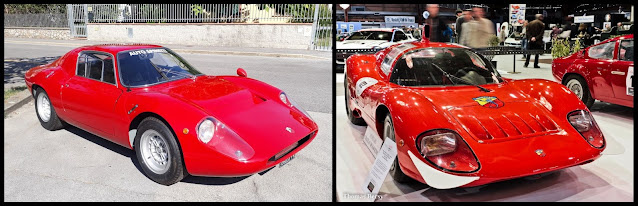
Showing posts with label Vallelunga. Show all posts

Monday, March 10, 2025

De Tomaso Takes to the Road - the Vallelunga

 
A Vallelunga at the De Tomaso factory, Modena  Courtesy Sports Car Digest
 
You won’t often catch me saying anything complimentary about Japanese cars – though I did love the Honda CRX I bought for my wife long ago – but it’s difficult to be too shirty about the Mazda MX5/Miata.  It’s often been said that Tom Matano, key figure in the creation of the Miata, was much influenced by the De Tomaso Vallelunga, a car he was very pleased to own himself, (#0134).  An interview with Matano was featured on the website of PI Motorsports, which includes the following passage: 

PI:        We know that you own a Vallelunga.  Have you ever found out who designed it? Norbert MacNamara says it was Mario Fissore.

Matano: I spoke with Trevor Fiori who worked on the Elva BMW with Fissore about the same time the Vallelunga was in the works.  He said that Mr. De Tomaso himself was working with Fissore and he didn’t see any other designer was involved.

PI:        Do you think De Tomaso was trying to do a mini 250LM?

Matano: The original alloy bodied Vallelunga had a more 250 LM-like front end than the production fiberglass bodied car. It also had an entire rear half of the car which opens up for engine service just like the 250 LM.  But, the similarity stops there. The side view profile of the Vallelunga is unique for a mid-ship layout car.

PI:        What parts of the design do you like and what parts would you do over if you were updating it?

Matano: I like the 360-degree visibility the best, thanks to its low engine location.  It is still very contemporary.  It hasn’t dated at all in my opinion.
 
Making allowance for the passage of about three decades, you may find echoes of the Vallelunga in the Miata’s overall form, as seen below:

Left, Vallelunga, courtesy Bonhams Cars. Right, Miata, courtesy Dond90 (BaT)

If there are some visual similarities, the relative production numbers certainly diverged, bringing to mind the old saying, ‘less is more.’ 

But, to linger right in the middle of mainstream thinking, we need to acknowledge the Miata’s debt to the Lotus Elan in terms of concept, style and footprint.  And while there, we can trace a connection back to the Vallelunga, since it too followed a Chapman lead in being built on a backbone chassis and powered by a Ford 4 cylinder engine.  Notwithstanding the considerable circuit motorsport heritage already banked at Lotus by the mid-Sixties, the Vallelunga could be seen as more closely based on a pure racing car than the Elan.  As well as the chassis form, the De Tomaso utilised the Ford block as an integral structural component, front suspension by wishbones with the rear controlled by multi-links, and disc brakes on all four corners – all much as had been seen on the Marque’s single seater race cars – F1, F2, F3 and Formula Junior, (called ‘Isis’) - constructed since ‘59.  Possibly inspired by the Ferrari formula of dedication to motorsport but with funding flowing from the production/sale of road cars, De Tomaso crystalised his ambitions by embarking on the design and creation of a prototype stradale sports barchetta in ’62.  This was put on show at the following year’s Turin Show, but drew no serious interest.  Resilient as he was – some said ‘pig-headed!' -  Alejandro gave Carrozzeria Fissore an order to rebody the chassis as a coupe.  The Turin Show – one year on - was once again chosen to launch the resulting car, with design credited to the Carrozzeria’s stylist, Franco Maina.  Reception was more positive this time and Fissore was contracted to undertake a production run of 15 aluminium bodies.  A surviving prototype was restored in England in 2021 by the specialist workshop of Three Point Four.  Excellent photographs of the car undergoing the renovation process can be seen here.  Head of Business there, Roger Brotton, has told me that all the Fissore prototypes were identified with the same chassis number - #1606Fissore, apparently, scrapped its own prototype in-period.

#1606 under restoration in ’21, courtesy Three Point Four

Fissore fulfilled the initial batch order in late ‘64/early ’65, though De Tomaso had already had some ‘developmental’ ideas which led to not all these bodies being used.

At least two ’64-made Vallelungas exist today, the earliest being chassis #0103.  At this point I have to observe that, not unexpectedly, some of what’s been written previously and/or ‘loose’ record keeping at the factory, (in the Italy of the Sixties, surely not!), undermines the certainty with which I can write this narrative.  In ’97, Thoroughbred and Classic Car published this: 

The Vallelunga coupe was built from early 1964 by Fissore of Savigliano, but after three (some say five, but just one survivor is known) had been made De Tomaso transferred the contract to Ghia over whom he had begun to exercise influence, assuming control by 1967. The Ghia cars were 'productionized' with a one-piece fiberglass body and were on sale from July '65. Engine access was now via a lift-up Perspex rear window and a removable plywood deck lid. . .

Probably the anomaly here is over the understanding of the production date.  This car is recorded as being first registered in the UK on 31st December ’64.  #0103 is a glass fibre car with opening rear window, whereas other sources suggest that no Ghia production occurred before ’65.  The revised rear is a key feature which differentiates the Maina-designed coupes from the prototype barchetta, including the revised rear quarters where an opening glazed (Plexiglass) screen gave access to the engine rather than the original clamshell format.  This car is also a very ‘pure’ De Tomaso, being to Competizione specification and thus a racing car that might occasionally serve purpose on normal roads.  As such, its kerb weight was low, at around 700 Kg, while the stradale version is usually quoted at 726 Kg.

Courtesy Cottingham Blue Chip London

The car’s description for sale by DK Engineering notes engine power at 135 bhp, ‘thanks to the Cosworth enhanced cylinder head . . .  The Hewland 4-speed transmission is mounted in a VW housing, rotated around for mid-engine placement.’ 

A standard Vallelunga had considerably less bhp on tap.  Contrary to some accounts, the OE engine was the Ford Kent 1498 cc, pushrod unit, not the Lotus twin cam.  However, the engines, on receipt at the De Tomaso factory in Modena, were modified to the extent of an upgraded cylinder head which facilitated a 24% increase in the compression ratio.  Together with twin Weber 40DCOE2s, this enabled a power output of 104 bhp, one third up on its delivery in its original Cortina GT application. 

Chassis #1611 is another Competizione example, equipped with a 1558 cc engine and Colotti five speed gearbox.  Seen in period below:


#1611 Courtesy Bonhams Cars


Repainted in yellow, the car was offered for sale by Bonhams in June 2014.  The description referred to this as being one of only two right-hand drive Vallelungas built by De Tomaso, (other sources say there was only one). It was initially in Colonel Ronnie Hoare’s care when he was considering adding the De Tomaso franchise to his operations best known for the UK Ferrari import business, Maranello Concessionaires.  He decided against this initiative after establishing that it would be impractical to incorporate the Lotus twin cam engine as a series upgrade, and he sold the car to racing driver, Robs Lamplough.  However, #1611 does today benefit from having such a power plant nestling under its rear screen – see centre photograph below.

#1611 Courtesy Bonhams Cars

Made in ’65, #0101, located in Holland, was sold on Bring a Trailer in 2024 for $260,000. The vendor asserted that this is the first glass fibre bodied Vallelunga made by Ghia after De Tomaso had halted construction of the aluminium version at Fissore. A reasonable claim, given the chassis number, which should be read in conjunction with the type number 807DT. Shown below are Vallelunga characteristic features, model-bespoke 13” magnesium alloy Campagnolo road wheels, chassis number stamping, and branded De Tomaso-modified cylinder head:

and drive Vallelungas built by De Tomaso, (other sources say there was only one). It was initially in Colonel Ronnie Hoare’s care when he was considering adding the De Tomaso franchise to his operations best known for the UK Ferrari import business, Maranello Concessionaires.  He decided against this initiative after establishing that it would be impractical to incorporate the Lotus twin cam engine as a series upgrade, and sold the car to racing driver, Robs Lamplough. 

0101 Courtesy ImageStreetClassics


#1612 is said to have been delivered to its first owner in ’66, but it is likely a ’65 build.  A ‘VL’ designation is associated with the chassis number and the car’s recent vendors, Artcurial, claims this confirms it as a Competizione version.  With this spirit in mind, a previous owner had installed a Lotus twin cam engine.  The Artcurial auction – held in Monaco in July 2020 – resulted in a sale price of €313,200.  Referring back to the Vallelunga’s limited sales success when new, Artcurial pointed out that it was priced the same as a Lancia Flaminia Zagato, causing many to find it poor value given the Lancia’s size, sophistication, including a 2.5 or 2.8 V6 engine, and the prestige/motorsport pedigree associated with Carrozzeria Zagato.

#1612 Courtesy Artcurial

 
Artcurial also handled the sale – for €226,480 - of a France-located, ’66 Vallelunga, (registered 801PL68), in 2015.  At that time, it was in unrestored condition and reported to have had light, spasmodic use over the near half century since its original sale.  The auction lot description includes a chassis number - 4236620 - which is not formatted in any similarity with those of other examples and is likely not a reading in error of the engine number.  (This value on a Vallelunga OE block would be 10 position, (8 digits/2 characters), I believe).  I subsequently discovered that Ruote Vecchie had in reporting on the sale, attributed the chassis number #0115 to this car.  However . . . that chassis number appeared again, in October 2017, associated to a red “‘67” Vallelunga, (registered TON41126), on offer by Bonhams at Padova.  I have been unable to contact the author of Ruote Vecchie, so I do not know the basis of their attribution of #0115 to the Artcurial-sold vehicle.  Meanwhile, the latter is shown below, left, with the Bonhams-offered car to the right.    

Left, “#4236620” Courtesy Artcurial; right, #0115 Courtesy Bonhams Cars

Lou Costabile shot a YouTube video of John Weinberger’s Vallelunga, #0134, in ’17.  He reported that John had owned the car long term in company with several other rare vehicles.  John died in 2020 after a long career in automotive retailing and motorsport.  Latterly he had been President and CEO of Illinois-located Continental Motors Group for over half a century.  As seen below, his Vallelunga was fitted with a VIN plate to confirm compliance with required U.S. import technical regulations.  Scott Martin‘s Vallelunga Registry records this as having been owned by Ricci (son of Dean) Martin, Dick Carr and Tom Matano.

#0134 Courtesy John Weinberger/Lou Costabile

€168,560 was the winning bid for #0106 when it was offered at a Belgian Bonham’s sale in June 2024.  The lot description highlights the sporting upgrades featuring on this Vallelunga, including extended wheel arches/wider wheels and an ex-F3 engine with induction by big (48 mm) Webers and a supercharger. Views into the engine bay and of the cockpit are seen below:

#0106 Courtesy Bonhams Cars


Though apparently to standard specification, #0128 was raced in the Sixties by its original owner.  Subsequently it was imported to the U.S. and from’10-’18 it was subject to a full restoration project.  The car featured in Gooding & Company’s Pebble Beach auction in ’18.  It was offered with an estimate of at $400,000-$475,000 but did not sell.

#0128 Courtesy Gooding & Company


Badges: 

A rectangular De Tomaso marque badge is mounted centrally on the upper surface of the front panel:

On the rear panel, centrally pinned on the horizontal plane, are two script badges, ‘VALLELUNGA,’ and, usually above, ‘de tomaso.’  On at least two extant cars, the ‘VALLELUNGA’ script is missing, and, on #0101, the relative positions of the two badges is inverted.

A Ghia ‘BUILT BY’ marque flank badge is applied to both front wings between the trailing edge of the front wheel arch and the leading edge of the front door.  (These are not extant on all surviving cars).


The marque badge features again on the wheel centre caps.


#0101 is fitted with a leather bound Ferrero sports wheel.  Ferrero was a noted supplier to De Tomaso and is possibly also the manufacturer of this wood rimmed example, style and spokes detail very much as typical for the era.  For more on Ferraro see here.  Though an aftermarket fitment, a Momo 'Jackie Stewart' seems a very appropriate wheel for a Vallelunga.  The rotation by 90° of the stripes on the horn button is also seen on some other versions of this component.


Literature:

Brochures:

Lower image is of a '65 edition

The consensus is that by the end of production, a total of 45-60 Vallelungas had been built.  It may be that most of this number were made as a batch, mainly in ’65, though not all sales were completed until ’68.  If, as seems confirmed, #0101 was the first Ghia-built chassis number, and #0146 the last known, 45 would be the built count.  The most likely breakdown was: Aluminium prototypes, (including Spyder): 4; Ghia production, (including Competiziones):45.

As a ‘first attempt’ the Vallelunga had established De Tomaso as a maker of road cars and facilitated a great deal of learning about the management of series production.  It thus was a positive factor in the company’s next development phase involving the creation of a considerably more complex model, the Mangusta.  With a Ford 4.7 litre V8 engine and imposing coachwork by Giorgio Giugiaro, it was well received on its launch in ’67 and was in production until ’71, with 400 units sold.  In turn, the Mangusta was followed by the Pantera – a car that gave De Tomaso a serious presence in the American market and was in production for over 20 years.  Over 7,000 had been built by ’92, so De Tomaso’s progress in terms of manufacturing volume was impressive. But, more importantly from my viewpoint, all three models were charismatic beauties!


Friday, May 3, 2024

Differing Fortunes: The Abarth 1300 OT and The1600 OT Sport Coupe

 
Left: Abarth 1300 OT (1st Series). Courtesy Autoemotodepoca.com; Right: Abarth 1600 OT Sport Coupe. Courtesy Thomas Bersy

Abarth’s extraordinary run of sportscar racing success, taking a World Championship for six consecutive years in the Sixties, is summarised in https://davidbuckdenlooksback.blogspot.com/2022/05/the-magnificent-six-abarths-60s-world.html .  Initially, it was the 1000 Bialbero GT which brought home the victories, but in ’63-’65 the mantle passed to the Simca-based 1300 GT.  With the lapse of the agreement between Abarth and the French manufacturer, a priority at Corso Marche became the creation of a new model to contest the championship from ’66.  A prototype coupe emerged in ’64.  A Mario Colucci-owned project, the car was mid-engined and built around a tubular chassis, very distinctive in appearance and dynamically promising.  But on this occasion Carlo Abarth stuck to his guns regarding the configuration, his concern about the relative costs of construction reinforced by the fact that the Simca platform had provided a simple, inexpensive basis.  Thus he halted ongoing development at an early stage, insisting that the car be disposed of – which it was, to Scuderia Lufthansa.  The German team in effect ‘finished’ the car, but without notable success.  Though designated at Corso Marche as the 1300 OTC, the car became known simply as the ‘Lufthansa.’ 

A new Omologata Turismo (OT) line began to take shape in early ’65.  Being based on the Fiat 850 platform, the new models not only fulfilled Carlo’s simplicity/reduced-cost objectives, but also signified a reconsolidation of the ‘traditional’ alliance with Fiat following the flirtation with Simca.  The first results of the programme were Sport Spider models, offered in both 1600 cc and 2000 cc form.  In short order the new coupe, Tipo 137/C, followed – in March – powered by the 1288 cc, 147 bhp, Tipo 237 engine.  Though Colucci was no doubt disappointed by Carlo’s axing of the tubolare/mid-engine format, the boss had given him the freedom to design a glass fibre body which he did with considerable aplomb, the 1300 OT’s styling receiving general acclaim for its aesthetic quality.  And as well as looking good, the 1300 OT’s performance was enhanced by the aerodynamic efficiency of the Sibona & Basano-built body.  A feature which many consider fundamental to the car’s distinctive visual attractiveness was the roof mounted air intake, (for cabin comfort purposes), which gave rise to the sobriquet, ‘Periscopia.’  This, however, was not seen on the launch version, not being introduced until the advent of the Series 2 1300 OT.  Indeed, there was a series of updates for this model, summarised by Sergio Seccatore in ‘The Scorpion’s Tale’: Series 2, ’66;  (‘Sport Coupe’) ‘World Champion,’ September ’66, 148 bhp 237-C engine;  ‘Longnose,’ September ’66, 147 bhp; ‘World Champion,’ June ’67, 157 bhp 237-B engine;  ‘World Champion,’ January ’68, 157 bhp 237-B engine and coil-over suspension.
OT 1300 Series 1 and 2 compared in profile. From Seccatore’s The Scorpion’s Tail. Courtesy Registro Fiat Italiano

There is some confusion in the factory records regarding these iterations as in the summary, ‘Vetture Abarth Da Competizione’ the 2nd Series version is dated ’66, while in the list, ‘Riepilogo Progetti Abarth,’ the June ’67 version is tagged as ‘1st Series.’  In his ‘Abarth Guide,’ Alfred Cosentino records the 2nd Series as a ’66 development and comments: ‘It wasn’t until the last two championship races in 1966 that the basic body design was established for the OT 1300.  There were four types of nose sections with different air intakes, headlight covers and aerodynamic body shapes tested . . . since September 1965.’  Cosentino also documented a further ’66 variant, the Longtail.  The photograph of this reproduced in the book is captioned: Udo Schutz driving a factory Fiat Abarth OT 1300 Longtail at the Nurburgring 500 km in 1966.  Ing. Colucci redesigned the front nose section of this OT 1300 and the top speed increased by 17 km per hour.  A technician of Alpine Renault redesigned the rear section which increased the top speed by only 4 km per hour.

Udo Schutz’s OT 1300, Nurburgring 500, ’66.  Courtesy Alfred Cosentino Books

The car’s early competitive outings required entry in the Prototype category.  At the Nurburgring for the 500 Kms on 5th September ’65, Klaus Steinmetz took 3rd place both overall and in the P 1.3 class.  For the Group 4 Sport category, homologation depended on the completion of 50 examples, and this was achieved in May ’66.

Karl Steinmetz, 1300 OT, Nurburgring 500 kms, September ’65.  Courtesy Registro Fiat Italiano

A little later, in September that year, a new model, the 1600 OT Sport Coupe, was unveiled.  It represented a speculative venture on the part of Abarth.  The firm’s Spiders had been successful in attracting a substantial and loyal cadre of hill-climbing enthusiast owner/drivers.  However, there were only so many such clients, and it became reasonable by the decade’s mid-point to assume that very few if any of them not already Abarth-equipped would be stopping by at Corso Marche to make a purchase.  At the same time, an opportunity was perceived to increase Abarth’s penetration of the market for similar competitors whose penchant was for circuit racing in the Sport and Prototype categories.  With the objective of appealing to such prospective buyers, a prototype closed car was built on the previous year’s OT 1600 Spider.  It certainly looked the part – attractively curvaceous and sophisticated, with clamshell front and rear sections and gullwing doors.  Designated Tipo 139/C, the 235-C engine was specified.  This 1592 cc, 172 bhp unit was a higher-revving development based on that utilised in the ‘63 Abarth Simca 1600 GT Coupe Stradale, rated in that form at 155 bhp.
1600 OT Sport Coupe. Courtesy Registro Fiat Italiano

1600 OT Sport Coupe. Courtesy Giorgio Nada Editore

By the time the 139/C was being shown and promoted, the 1300 had completed a very successful debut full season, instrumental in Abarth once again being crowned World Champion in the Sport, Division 1 class.  Victories had been scored by the model at the Nurburgring 1000 Kms, Mugello GP, Coppa Citta di Enna, Nurburgring 500 Kms and at Zeltweg.  1-2-3 finishes had been recorded at the ‘Ring 1000 Kms and at Pergusa (Enna).  The car was an all-round success and this was reflected in ready marketability and good sales profitability.
 
Meanwhile, the performance of the 1600 Coupe on-track – further evaluated at Abarth’s multi-model testing at Vallelunga in late January ’67 - was nothing like as encouraging.  Initially the car was run with a 1600 cc engine and the 6 speed Tipo 132 transmission – about which concern had been building in regard to its durability as engine outputs continued to increase.  In comparison with the Sport Spider in 2 litre form and equipped with the new Tipo 139, 5 speed transmission, its lap times were disappointing – around 4% slower.  A new 16 valve 1.6 engine was on hand and this was tried in the Coupe, but there was no conclusive outcome from this experiment.  It was therefore decided – and there was a certain inevitability about this – to try a 2 litre unit, and this enabled the Coupe to near-match the lap times of the Spider. 

As is usually the case with what are hoped to be ‘private’ test sessions, news of the performance of the various models leaked out by word of mouth.  This left the circuit racer community unimpressed.  Aware of this, Abarth revised its marketing expectations and attempted to interest hill-climbers in the car.  But, here again, the reception was lukewarm at best.  Whilst the Coupe had the agility and performance with some potential for this specialist form of competition, the visibility restrictions imposed by the coupe body were a very significant downside.  By the end of the ’67 season it was all too apparent that the car had virtually no commercial appeal and it was decided to abandon the project with just the single chassis completed.

Fortunately, Abarth had a hill-climb specialist customer, Eris Tondelli – who did see some potential.  As Eris recalls, after he tested the Coupe he called for a replacement, 2 litre, engine to be installed because the weight of the car was greater than had been expected and was significantly inhibiting performance.  Previously it has been asserted in print that Tondelli purchased the Coupe, but I recently heard from another source that it was simply entrusted to him by the factory – Abarth itself retaining ownership.  Tondelli – who also campaigned the 1000 SP, 1300 OT and 2000 Sport models – drove the car at a number of hill-climbs, notably the ’68 Bologna-Raticosa; three photographs of the car on that event are reproduced in Deganello and Rizzoli’s ‘Abarth, All The Cars.’  Subsequently, it was purchased by Michel Pont.  As recently posted on Tondelli’s Facebook,  the car was a high profile feature at an event in ’89 at ChĂ¢teau de Savigny-lès-Beaune, accompanied by Abarth personalities, Renzo Avidano, Mario Colucci and Vincenzo Osella.  It remains as an exhibit at MusĂ©e de la voiture de course Abarth, at the ChĂ¢teau.

1600 OT Sport Coupe (nearest camera) at Abarth group test, Vallelunga, January ’67. Courtesy Giorgio Nada Editore

Eris Tondelli testing the 1600 OT Sport Coupe. Courtesy Giorgio Nada Editore

Colucci (left) and Tondelli (right) in the 1600 OT Sport Coupe, Beaune, ’89. Courtesy Eris Tondelli 

The ’67 season saw the 1300 OT fully dominant in the World Championship events, winning the Sport, Division 1 Class, up to 1.3 litre at Hockenheim, (1-2-3-4 finish for the model), Mugello, Pergusa, (1-2-3 finish), Zeltweg, (1-2-3 finish), Ollon Villars and Nurburgring 500.  At the Targa Florio, Guido Garufi and Giuseppe Ferlito came home first in the Sport 1.0-1.3 class, 19th overall.  Ecurie du Maine entered a 1300 OT for Marcel Martin and Jean Mesange who took it to the finish 16th overall and victorious in class.  The model in this second full season was clearly well sorted and reliable, but also benefitted from attracting a number of top line drivers of the period, among them Toine Hezemans, Ernst Furtmayr and Jo Ortner.  In the end of season championship class table, Abarth boasted 45 points, with a huge gap to Diva in second place – the Camberwell, London-based marque accumulating just 12 points.

The following year was to be first since ’61 that World Championship honours could not be trumpeted from Corso Marche.  However, 28 major event (mainly hill-climbs) class wins were taken by the 1300 OT at: 

Avola, Coppa Belmonte (Gambero)

Arezzo, Pieve St. Stefano Passo dello Spino (“Drason)

Brescia, Scalata al Colle Sant’Eusebio (Pilone) and Autoscalata della Maddalena (Becchetti) and Trofeo Valle Camonica (Presenti)

Parma, Castione Baratti-Neviano Arduini (Boeris)

Volterra, Coppa Citta di Volterra (Zuccoli)

Piacenza, Castell’Arquato-Vernasca (Presenti)

Rieti, Coppa Bruno Carotti (Ramoino)

Bassano del Grappa (Becchetti)

Livorno, Antignano-Monteburrone (Ungelli)

Reggio Calabria, Santo Stefano-Gambarie (Benini)

Cortona, Coppa Citta di Cortona (Mugelli)

Vallelunga, Coppa Gallenga (Ramoiono)

Cosenza, Coppa della Sila (Gambero)

Trento-Bondone (Federhofer)

Sestriere, Cesana-Sestriere (Federhofer)

Freiberg, ADAC Bergpreis Freiberg-Schauinsland (Federhofer)

Pescara (Cronoscalata Svolte di Popoli (“Mici”)

Ascoli Piceno, Ascoli-Colle San Marco (Ramoino)

Nurburgring 500 Kms (Walton)

Verona, Caprino Veronese-Spiazzi di Monte Baldo (Pilone)

Bergamo, Castione-Passo della Persolana (Presenti)

Ragusa, Coppa dei Monti Iblei (Gambero)

Aosta-Pila (Ramoino)

Gubbio, Coppa Mengara (Fabroni)

Siracusa, Coppa Val d’Anapo-Sortino (Gambero)

Orvieto, Trofeo Citta di Orvieto (Fabroni)


Gratifyingly, the 1300 OT remained competitive right through to the end of Abarth’s independent era, with the victories counts being: ’69: 19; ’70: 31; ’71: 30.  In that period, two drivers in particular excelled in the model:
 
Karl Federhofer, (1927-1990).  The German driver competed in the early Sixties in Porsche 356s.  In ’65 he campaigned an Abarth Simca 1300 Bialbero, switching to a 1300 OT the following season and he remained with the model up to and including 1970.  The stand-out achievement was outright victory at the ’68 running of the prestige Trento-Bondone hillclimb event.

Karl Federhofer, Abarth 1300 OT, ’70 ADAC-Bergpreis Freiburg-Schauinsland Hillclimb. Courtesy www.forum-auto.com

Luigi Moreschi, (1947 - ).  A Mantuan, Moreschi developed a passion for motorsport at an early age, entering races even before he held a driving licence.  Though most of the great many races in which he competed were at club level, he also acquitted himself well in Sportscar World Championship races, including the Targa Florio, an event in which he participated on six occasions, his best result on the Circuito Piccolo delle Madonie coming in ’73 when he finished 4th – and first in class in a Chevron B21 – partnered with Francesco Matteo.  Two other significant victories came in ’77 at the Vallelunga 6 hours, (Porsche 935), and, ’78, Misano, this time in an Osella PA6.  More recently, and for over 30 years now, Moreschi has run a motorsport sales and service/parts business in his home town of Quingentole: https://www.moreschi.info/veteran/index_en.htm  Moreschi’s victory count, ’69-’71 in the 1300 OT was eight.

Moreschi’s contemporary business has notable Abarth focus – this is a Tipo 237 engine. Courtesy Luigi Moreschi Motorsport

Also repetitively successful in the 1300 OT were MĂ¼nchner, Peter Stutz, and Klaus Brand.

So, we have one car – the 1300 OT – with results in competition which signify it as one of the very best Corso Marche products.  And, from the same era, a car – the 1600 OT Sport Coupe – which disappointed statistically, but which is no failure, as it is, arguably, the most aesthetically pleasing machine to emerge from that same factory.  Certainly, its creator, Mario Colucci, was of that view, saying in an interview, recorded twenty years on, that it was his most beautiful design. Indeed, not only was it a superb example of mid-Sixties Italian automotive styling, but it also provides us in the 2020s with a glimpse of how the elusive T140 might have looked in fully developed form . . . as I’ve often said before; if only . . .

Sunday, March 17, 2024

Piccolo ma Potente - Abarth 1000 SP


Courtesy of Tony Berni

Carlo Abarth’s manager of mechanical, chassis and body development, Mario Colucci, joined from Alfa Romeo following the collaborative Abarth-Alfa 1000 project which culminated in November ’58 with the presentation of a Scaglione-styled version at the Turin Motor Show.  This model featured a tube frame chassis, the preference of both Alfa Romeo corporately, and Colucci personally.  Following on from this, despite his own contrary chassis construction and engine location principles, Carlo Abarth gave Colucci the opportunity to design and develop a new line of lightweight spiders, initially with the Fiat 600-based 748 cc #221 engine.  By ’62, 1300, 1450 and 2000 cc versions had evolved, utilising the Simca-based engine.  However, these models did not achieve competitive successes to an extent which could attract an ongoing/increasing cohort of racing customers.  In addition, Carlo’s retained prejudices re-emerged in an edict which contended that the expense involved with the tubular chassis and mid engine location further undermined the cars’ marketability.  Thus, the series was discontinued for the ’65 season.  Effort and focus was transferred to bigger capacity spiders designated OT (Omologato Turismo).  As well as being available in both 1600 and 2000 cc versions, the OTs were distinctive in being Abarth’s first all-glassfibre bodied models.  Buoyed also by on-track success of a sister coupe model, the 1300 OT, Abarth relented in regard to a smaller capacity Spider and gave Colucci the go-ahead to create a new 1000 Sport Prototype version for ‘66.  It was a ‘brave’ decision since Carlo had to allow Colucci once again to specify a tubular chassis and central engine.  Furthermore, it only made sense to produce the new model in Group 6-compliant form, and that meant committing to a production run of 50 cars for homologation purposes.  The resulting 1000 SP, also known internally as the SE04, was ready in the Spring, making its racing debut at the 14th Coppa della Collina at Pistoia, (May, ’66).
 
In Alfred Cosentino’s Abarth Guide, he refers to the 1000 SP as the 1965 Fiat Abarth 1000 SP Barchetta Tubolare, also citing earlier (‘63/’64) versions as bearing the SE04 designation.  In his note about the model, he suggests 25 were initially built in ’65 and all were readily sold, prompting a second run of 25, dates unspecified.  However, all other sources relate the SE04 tag to cars known simply as 1000 SP.  An SE (Speciale Esecuzione) internal model code incidentally was applied to some Abarth racing models produced from the mid-Sixties, beginning with SE08, conferred on the ‘64 Formula 2 single seater.  SE025 was the highest code number used up to the end of ’71.  During the subsequent ‘Fiat’ period when Abarth was involved in the development of the new Lancia rally car, an SE designation, 037, identified the project and this became used as the car’s ‘public’ model name.  The Lancia Delta S4 bore the last designated SE code – 038, in ’85.

Courtesy 2015 Registro Fiat Italiano


The SE04 as launched, was powered by the #229A (dry sump), 4 cylinder, twin cam, 982 cc engine on twin Weber 40 DCOE2s, rated at 105 bhp @ 8000 rpm.  As coupled with the #A.102 5 speed gearbox and in a vehicle with a kerb weight of just 480 kg, it was both an agile and fast package, capable of over 135 mph.
 
The FIA eventually conferred Group 4/up to 1000 cc Class homologation on the 1000 SP in March ’68 – sample pages from the document, #241, are shown below:


Luciano Greggio’s ‘Abarth the Man, the Machines’ lists all (though the author indicates that some data may be missing for the years ’68 and ‘69) the outright/class victories scored by the marque from 1949 to 1971.  For the period ’66-’71, the list includes 150 victories for the 1000 SP, the peak year being ’68, when 66 first places were recorded.  Throughout the whole period, the great majority of successes was achieved at hillclimb events, at which multiple entries were frequently run in both the Sport and Sport Prototype categories.  Most events were in Italy, but the 1000 SP saw success also on hills/tracks in France, Germany and Switzerland.
 
The most successful driver- by a considerable margin - was Salvatore Calascibetta, who triumphed 15 times in a 1000 SP.  Calascibetta ran a workshop and parts store in Sicily but was also employed for several years by Abarth both as a test and a racing driver.  His driving career extended from the late Fifties to the mid Seventies.  Also known as ‘Toto,’ he resided and traded in Palermo, and this was convenient for his many participations in the Targa Florio – 13 in all, with the final outing (’71), in partnership with Paolo Monti, yielding a 1st in the GT 2.0 class, 9th overall.  On that occasion he was driving an Opel GT 1900 for Conrero Squadra Corse.  Eight years earlier, he had taken the class honours at the Targa in an Alfa Giulietta SZ.  For Abarth – in a 1000 SP entered by Scuderia Pegaso – he shared the Sport 1.3 class victory in ‘69 with Vincenzo Ferlito.  Their car was placed 11th overall.

Left: Salvatore Calascibetta (Targapedia2); Right: Calascibetta’s 1000 SP at the ’68 Targa Florio

Next most successful multiple winner was Luigi Tommasi with 9 victories.  He was active from the early Sixties through to ’79 and appeared at several high profile circuit races, though all his 1000 SP exploits were at hillclimb meetings in ’67 and’68, subsequently trying his hand at Formula 3.  His 1000 SP class wins were taken at, (’67): Sorrento, Rieti, Monopoli, Pescara,  and Ascoli Piceno, (’68): Rieti, Cosenza, Avezzano and Pescara.

Paolo Lado took the chequered flag in first place 6 times behind the wheel of a 1000 SP.  He was successful on circuits as well as hillclimbs, especially in ’68, when he won twice at Vallelunga and also at Imola.

Paulo Lado, (at Trento-Bondone hillclimb, July ’68)

Other notable drivers who enjoyed multiple wins in a 1000 SP were: Enzo Buzzetti (5 wins), Gianni Varese (4 wins) and Giuseppe Vergilio (4 wins).

     Left: Enzo Buzzetti, ’67 Targa Florio;                                               Right: Gianni Varese, ’68 Cesana-Sestriere

The agility possessed of this little barchetta is clearly demonstrated by its excellent run of Targa Florio results – up against generally more constructionally robust and higher powered opposition - in the years ’67-’72:
 

Year

Race #

Entrant

Drivers

Place

Class

67

142

Buzzetti

Enzo Buzzetti - Secondo Ridolf

22

2nd P1

68

96

Scuderia Pegaso

Salvatore Calascibetta - Vincenzo Ferlito

44

2nd S1

69

122

Scuderia Pegaso

Salvatore Calascibetta - Vincenzo Ferlito

11

1st S1.3


126

Buzzetti

Enzo Buzzetti - Walter DonĂ 

16th

3rd S 1.3


124

Scuderia Nord-Ovest

Eris Tondelli - Marco Crosina

31st

4th S 1.3


202

Jolly Club

Ugo Locatelli – Mario Zanetti

5 laps only


70

262

Scuderia Nord-Ovest

Renzo Ruspa - Pier Giorgio Pelegrin

16th

1st P1


254

Scuderia Etna

Francesco Patanè - Orazio Scalia

DNF


71

82

Barone

Maurizio Campanini – Mario Barone

14th

1st P1.0


83

Scuderia Brescia Corse

Giovanni Boeris - Maurizio Roasio

15th

2nd P1.0


77

Scuderia Nettuno

Giuseppe Bargotti - Sergio Guibar

DNF


79

Patane

Francesco Patanè - Orazio Scalia

DNF


72

70

Scuderia St Paul

Francesco Patanè – Orazio Scalia

DNF


It’s been said that perhaps around 25 of the 50-70ish originally built 1000 SPs are extant.  One of the most familiar in recent times is #0038, which was sold by Hyman, St. Louis, MO, US: https://hymanltd.com/vehicles/7351-1966-abarth-1000sp/ .  It had previously been offered on Bring a Trailer in April 2023, https://bringatrailer.com/listing/1966-abarth-1000sp/ and was bid to $210,000, (reserve not met).  (At that time Sports Car Digest published an illustrated feature on the car: https://sportscardigest.com/car-of-the-day-1966-abarth-1000-sp/ )

#0038. Courtesy of Sports Car Digest


#0024 was presented in November 2014 by Bonhams, https://cars.bonhams.com/auction/21904/lot/8/from-the-maranello-rosso-collection1966-fiat-abarth-1000sp-tipo-se04-racing-sports-prototype-chassis-no-se04024/ selling for £135,900.

#0024. Courtesy of Bonhams


#0049. Courtesy of Radical Mag.com


The SE04 proved to be an especially important car for Abarth, not only because it remained competitive in 1 litre form for several years, but also as it was an excellent base for the development of new versions and reconfigurations which emerged as ‘new’ models.  The ’67 SE04/L identified a 2 litre version with a longer (by 60 mm) wheelbase.  That same year, SE04 FB appeared, this time with the wheelbase re-dimensioned in the other direction.  This was necessary because of the car’s ‘real’ distinguishing feature – relocation of the engine to Carlo’s preferred rearward position; FB = fuoribordo – ‘outboard.’  The following year saw a further developed version of the 2 litre Sport with sufficient updating to warrant a new SE number: 10.  The SE010 itself was the basis of a new Prototype, SE014, launched in ’69.  And all that had been learnt with the SE04 and its successors, SE010 and SE014, informed the similar competition cars for the new decade, the SE018 (outboard, 1 litre) and SE019 (available in either mid or outboard form).  Though Abarth would cease to be an independent marque the following year, this was a period of intense activity, further substantiating the perception of the Corso Marche firm as a major player in international motor sport.