Showing posts with label De Tomaso. Show all posts

Monday, March 10, 2025

De Tomaso Takes to the Road - the Vallelunga

 
A Vallelunga at the De Tomaso factory, Modena  Courtesy Sports Car Digest
 
You won’t often catch me saying anything complimentary about Japanese cars – though I did love the Honda CRX I bought for my wife long ago – but it’s difficult to be too shirty about the Mazda MX5/Miata.  It’s often been said that Tom Matano, key figure in the creation of the Miata, was much influenced by the De Tomaso Vallelunga, a car he was very pleased to own himself, (#0134).  An interview with Matano was featured on the website of PI Motorsports, which includes the following passage: 

PI:        We know that you own a Vallelunga.  Have you ever found out who designed it? Norbert MacNamara says it was Mario Fissore.

Matano: I spoke with Trevor Fiori who worked on the Elva BMW with Fissore about the same time the Vallelunga was in the works.  He said that Mr. De Tomaso himself was working with Fissore and he didn’t see any other designer was involved.

PI:        Do you think De Tomaso was trying to do a mini 250LM?

Matano: The original alloy bodied Vallelunga had a more 250 LM-like front end than the production fiberglass bodied car. It also had an entire rear half of the car which opens up for engine service just like the 250 LM.  But, the similarity stops there. The side view profile of the Vallelunga is unique for a mid-ship layout car.

PI:        What parts of the design do you like and what parts would you do over if you were updating it?

Matano: I like the 360-degree visibility the best, thanks to its low engine location.  It is still very contemporary.  It hasn’t dated at all in my opinion.
 
Making allowance for the passage of about three decades, you may find echoes of the Vallelunga in the Miata’s overall form, as seen below:

Left, Vallelunga, courtesy Bonhams Cars. Right, Miata, courtesy Dond90 (BaT)

If there are some visual similarities, the relative production numbers certainly diverged, bringing to mind the old saying, ‘less is more.’ 

But, to linger right in the middle of mainstream thinking, we need to acknowledge the Miata’s debt to the Lotus Elan in terms of concept, style and footprint.  And while there, we can trace a connection back to the Vallelunga, since it too followed a Chapman lead in being built on a backbone chassis and powered by a Ford 4 cylinder engine.  Notwithstanding the considerable circuit motorsport heritage already banked at Lotus by the mid-Sixties, the Vallelunga could be seen as more closely based on a pure racing car than the Elan.  As well as the chassis form, the De Tomaso utilised the Ford block as an integral structural component, front suspension by wishbones with the rear controlled by multi-links, and disc brakes on all four corners – all much as had been seen on the Marque’s single seater race cars – F1, F2, F3 and Formula Junior, (called ‘Isis’) - constructed since ‘59.  Possibly inspired by the Ferrari formula of dedication to motorsport but with funding flowing from the production/sale of road cars, De Tomaso crystalised his ambitions by embarking on the design and creation of a prototype stradale sports barchetta in ’62.  This was put on show at the following year’s Turin Show, but drew no serious interest.  Resilient as he was – some said ‘pig-headed!' -  Alejandro gave Carrozzeria Fissore an order to rebody the chassis as a coupe.  The Turin Show – one year on - was once again chosen to launch the resulting car, with design credited to the Carrozzeria’s stylist, Franco Maina.  Reception was more positive this time and Fissore was contracted to undertake a production run of 15 aluminium bodies.  A surviving prototype was restored in England in 2021 by the specialist workshop of Three Point Four.  Excellent photographs of the car undergoing the renovation process can be seen here.  Head of Business there, Roger Brotton, has told me that all the Fissore prototypes were identified with the same chassis number - #1606Fissore, apparently, scrapped its own prototype in-period.

#1606 under restoration in ’21, courtesy Three Point Four

Fissore fulfilled the initial batch order in late ‘64/early ’65, though De Tomaso had already had some ‘developmental’ ideas which led to not all these bodies being used.

At least two ’64-made Vallelungas exist today, the earliest being chassis #0103.  At this point I have to observe that, not unexpectedly, some of what’s been written previously and/or ‘loose’ record keeping at the factory, (in the Italy of the Sixties, surely not!), undermines the certainty with which I can write this narrative.  In ’97, Thoroughbred and Classic Car published this: 

The Vallelunga coupe was built from early 1964 by Fissore of Savigliano, but after three (some say five, but just one survivor is known) had been made De Tomaso transferred the contract to Ghia over whom he had begun to exercise influence, assuming control by 1967. The Ghia cars were 'productionized' with a one-piece fiberglass body and were on sale from July '65. Engine access was now via a lift-up Perspex rear window and a removable plywood deck lid. . .

Probably the anomaly here is over the understanding of the production date.  This car is recorded as being first registered in the UK on 31st December ’64.  #0103 is a glass fibre car with opening rear window, whereas other sources suggest that no Ghia production occurred before ’65.  The revised rear is a key feature which differentiates the Maina-designed coupes from the prototype barchetta, including the revised rear quarters where an opening glazed (Plexiglass) screen gave access to the engine rather than the original clamshell format.  This car is also a very ‘pure’ De Tomaso, being to Competizione specification and thus a racing car that might occasionally serve purpose on normal roads.  As such, its kerb weight was low, at around 700 Kg, while the stradale version is usually quoted at 726 Kg.

Courtesy Cottingham Blue Chip London

The car’s description for sale by DK Engineering notes engine power at 135 bhp, ‘thanks to the Cosworth enhanced cylinder head . . .  The Hewland 4-speed transmission is mounted in a VW housing, rotated around for mid-engine placement.’ 

A standard Vallelunga had considerably less bhp on tap.  Contrary to some accounts, the OE engine was the Ford Kent 1498 cc, pushrod unit, not the Lotus twin cam.  However, the engines, on receipt at the De Tomaso factory in Modena, were modified to the extent of an upgraded cylinder head which facilitated a 24% increase in the compression ratio.  Together with twin Weber 40DCOE2s, this enabled a power output of 104 bhp, one third up on its delivery in its original Cortina GT application. 

Chassis #1611 is another Competizione example, equipped with a 1558 cc engine and Colotti five speed gearbox.  Seen in period below:


#1611 Courtesy Bonhams Cars


Repainted in yellow, the car was offered for sale by Bonhams in June 2014.  The description referred to this as being one of only two right-hand drive Vallelungas built by De Tomaso, (other sources say there was only one). It was initially in Colonel Ronnie Hoare’s care when he was considering adding the De Tomaso franchise to his operations best known for the UK Ferrari import business, Maranello Concessionaires.  He decided against this initiative after establishing that it would be impractical to incorporate the Lotus twin cam engine as a series upgrade, and he sold the car to racing driver, Robs Lamplough.  However, #1611 does today benefit from having such a power plant nestling under its rear screen – see centre photograph below.

#1611 Courtesy Bonhams Cars

Made in ’65, #0101, located in Holland, was sold on Bring a Trailer in 2024 for $260,000. The vendor asserted that this is the first glass fibre bodied Vallelunga made by Ghia after De Tomaso had halted construction of the aluminium version at Fissore. A reasonable claim, given the chassis number, which should be read in conjunction with the type number 807DT. Shown below are Vallelunga characteristic features, model-bespoke 13” magnesium alloy Campagnolo road wheels, chassis number stamping, and branded De Tomaso-modified cylinder head:

and drive Vallelungas built by De Tomaso, (other sources say there was only one). It was initially in Colonel Ronnie Hoare’s care when he was considering adding the De Tomaso franchise to his operations best known for the UK Ferrari import business, Maranello Concessionaires.  He decided against this initiative after establishing that it would be impractical to incorporate the Lotus twin cam engine as a series upgrade, and sold the car to racing driver, Robs Lamplough. 

0101 Courtesy ImageStreetClassics


#1612 is said to have been delivered to its first owner in ’66, but it is likely a ’65 build.  A ‘VL’ designation is associated with the chassis number and the car’s recent vendors, Artcurial, claims this confirms it as a Competizione version.  With this spirit in mind, a previous owner had installed a Lotus twin cam engine.  The Artcurial auction – held in Monaco in July 2020 – resulted in a sale price of €313,200.  Referring back to the Vallelunga’s limited sales success when new, Artcurial pointed out that it was priced the same as a Lancia Flaminia Zagato, causing many to find it poor value given the Lancia’s size, sophistication, including a 2.5 or 2.8 V6 engine, and the prestige/motorsport pedigree associated with Carrozzeria Zagato.

#1612 Courtesy Artcurial

 
Artcurial also handled the sale – for €226,480 - of a France-located, ’66 Vallelunga, (registered 801PL68), in 2015.  At that time, it was in unrestored condition and reported to have had light, spasmodic use over the near half century since its original sale.  The auction lot description includes a chassis number - 4236620 - which is not formatted in any similarity with those of other examples and is likely not a reading in error of the engine number.  (This value on a Vallelunga OE block would be 10 position, (8 digits/2 characters), I believe).  I subsequently discovered that Ruote Vecchie had in reporting on the sale, attributed the chassis number #0115 to this car.  However . . . that chassis number appeared again, in October 2017, associated to a red “‘67” Vallelunga, (registered TON41126), on offer by Bonhams at Padova.  I have been unable to contact the author of Ruote Vecchie, so I do not know the basis of their attribution of #0115 to the Artcurial-sold vehicle.  Meanwhile, the latter is shown below, left, with the Bonhams-offered car to the right.    

Left, “#4236620” Courtesy Artcurial; right, #0115 Courtesy Bonhams Cars

Lou Costabile shot a YouTube video of John Weinberger’s Vallelunga, #0134, in ’17.  He reported that John had owned the car long term in company with several other rare vehicles.  John died in 2020 after a long career in automotive retailing and motorsport.  Latterly he had been President and CEO of Illinois-located Continental Motors Group for over half a century.  As seen below, his Vallelunga was fitted with a VIN plate to confirm compliance with required U.S. import technical regulations.  Scott Martin‘s Vallelunga Registry records this as having been owned by Ricci (son of Dean) Martin, Dick Carr and Tom Matano.

#0134 Courtesy John Weinberger/Lou Costabile

€168,560 was the winning bid for #0106 when it was offered at a Belgian Bonham’s sale in June 2024.  The lot description highlights the sporting upgrades featuring on this Vallelunga, including extended wheel arches/wider wheels and an ex-F3 engine with induction by big (48 mm) Webers and a supercharger. Views into the engine bay and of the cockpit are seen below:

#0106 Courtesy Bonhams Cars


Though apparently to standard specification, #0128 was raced in the Sixties by its original owner.  Subsequently it was imported to the U.S. and from’10-’18 it was subject to a full restoration project.  The car featured in Gooding & Company’s Pebble Beach auction in ’18.  It was offered with an estimate of at $400,000-$475,000 but did not sell.

#0128 Courtesy Gooding & Company


Badges: 

A rectangular De Tomaso marque badge is mounted centrally on the upper surface of the front panel:

On the rear panel, centrally pinned on the horizontal plane, are two script badges, ‘VALLELUNGA,’ and, usually above, ‘de tomaso.’  On at least two extant cars, the ‘VALLELUNGA’ script is missing, and, on #0101, the relative positions of the two badges is inverted.

A Ghia ‘BUILT BY’ marque flank badge is applied to both front wings between the trailing edge of the front wheel arch and the leading edge of the front door.  (These are not extant on all surviving cars).


The marque badge features again on the wheel centre caps.


#0101 is fitted with a leather bound Ferrero sports wheel.  Ferrero was a noted supplier to De Tomaso and is possibly also the manufacturer of this wood rimmed example, style and spokes detail very much as typical for the era.  For more on Ferraro see here.  Though an aftermarket fitment, a Momo 'Jackie Stewart' seems a very appropriate wheel for a Vallelunga.  The rotation by 90° of the stripes on the horn button is also seen on some other versions of this component.


Literature:

Brochures:

Lower image is of a '65 edition

The consensus is that by the end of production, a total of 45-60 Vallelungas had been built.  It may be that most of this number were made as a batch, mainly in ’65, though not all sales were completed until ’68.  If, as seems confirmed, #0101 was the first Ghia-built chassis number, and #0146 the last known, 45 would be the built count.  The most likely breakdown was: Aluminium prototypes, (including Spyder): 4; Ghia production, (including Competiziones):45.

As a ‘first attempt’ the Vallelunga had established De Tomaso as a maker of road cars and facilitated a great deal of learning about the management of series production.  It thus was a positive factor in the company’s next development phase involving the creation of a considerably more complex model, the Mangusta.  With a Ford 4.7 litre V8 engine and imposing coachwork by Giorgio Giugiaro, it was well received on its launch in ’67 and was in production until ’71, with 400 units sold.  In turn, the Mangusta was followed by the Pantera – a car that gave De Tomaso a serious presence in the American market and was in production for over 20 years.  Over 7,000 had been built by ’92, so De Tomaso’s progress in terms of manufacturing volume was impressive. But, more importantly from my viewpoint, all three models were charismatic beauties!


Thursday, June 30, 2022

If Only . . . The OSCA GTs Had Been Made For Longer

Officine Alfieri Maserati SA ceased to be in the ownership of the family of that name in 1937.  From that date the Marque belonged to Adolfo Orsi.  After WWII the Maserati brothers set up a new business, Officine Specializzate Costruzione Automobili, ‘OSCA.’

During the late 1940s and 1950s, OSCA was focused on the production of cars for competition use.  From its initial model, the MT4 (1948), through to the SF 372 and 750 S types, (1959-60), OSCAs were barchettas.  In the latter era OSCA engines were utilised in De Tomaso Formula 1 cars. 

With the new decade, OSCA turned its attention to the fashionable, burgeoning GT market, making cars of this type from 1960 to 1967 when, by then owned by Domenico Augusta, the Marque became defunct.  The 1600 (1568 cc) GTs became available in 1961, after some initial 1500s (in both coupe and spider form) had been introduced in 1959. 

OSCA 1600 GTs were available in 5 performance versions – GT (95 bhp), GT2 (105 bhp), GTS (138 bhp), GTV (125 bhp), and SP (140 bhp), with bodywork by 4 carrozzieri – Zagato, Fissore, Boneschi and Touring.  With the customary caution advisable regarding the veracity of data from the era, it is believed that 128 1600s were built, of which, 98 were by Zagato, 24 by Fissore, 4 by Boneschi and 2 by Touring. Michelotti also created 3 proposals on the 1500/1600, and it has been suggested that one of these was an anticipation of the form developed for the Lancia Fulvia Coupe.

1600 GT

#0078.  Bodywork is by Zagato featuring the Carrozziere’s signature dual hump roof with light alloy panels over tubular frame construction.  Characteristically Zagato, the car was light, at 835 kgs, facilitating a 9.2 secs 0-60 mph time on the basic engine’s 95 bhp:

Courtesy of Ruote da Sogno

The chassis plate for this car shows the standard layout and extent of information:

Courtesy of Ruote da Sogno


OSCA was able to incorporate its own branded engine as a result of an arrangement with Fiat.  The Maserati brothers had in 1957 been contracted to develop a higher performance power unit for Fiat’s Spider.  The resulting bialbero motor was built by Fiat in Turin, with a proportion subsequently, in very basic form, being shipped to OSCA.  At its San Lazzaro di Savena base OSCA ‘finished’ these units for use in GTs.  The OSCA ‘enhancements’ – examples being forged reciprocating components, alloy heads/sump and uprated lubrication circuit - resulted in an engine of better all round quality and capable of considerably greater power outputs. 

The standard rear badge was mounted on the boot lid, above the number plate panel, and a Zagato ‘Z’ was applied to the front wings, just forward of the indicator repeater lenses:

Courtesy of The Classic Motor Hub

Courtesy of The Classic Motor Hub


On the Touring version, in addition to the Carrozziere’s Superleggera script, model badges are mounted on both the upper face and the rear surface of the back panel, (to the right of the number plate):

Courtesy of Ultimatecarpage.com

#0019 is a Touring model:

Courtesy of Ultimatecarpage.com


The Boneschi version is represented by #0072:

Courtesy of Carrozzieri-Italiani.com

Distinctly angular, this is referred to with the supplementary model designation, ‘Swift.’  It was the work of Rodolfo Bonetto, a designer of considerable repute and responsible for several celebrated models of the Maserati and Lancia marques.  I believe that #0011 and #0018 also were Swifts. 

1600 GT2

#0097 is the chassis number assigned to this 1963 GT2 Zagato.  It is powered by the 105 bhp engine version:

Courtesy of Supercars.net

The car was subject to a thorough body/interior/mechanical restoration just before the millennium – the results being good enough to secure multiple concours honours.  It made £162,400 when sold by RM Sotheby’s in 2012. 

Detail aspects of this car in 40 excellent photographs can be seen at https://www.classic-trader.com/uk/cars/listing/o-s-c-a/1600/1600-gt2/1963/286665 

There was a variant rear badge for this model:


A Fissore example of the GT2 is chassis #0103:

Courtesy of Bonham's

1600 GTS

The GTS designation indicates an engine initially rated at 138 bhp.  This version featured twin 42DCOE Webers with maximum power generated at 8000 rpm.  This example in chassis #0094, delivered in 1963:

Courtesy of Christie's


Notable on this car are the faired headlamps, indicative of a competizione variant.  Indeed the Christie’s lot notes accompanying the car’s sale in 1999 include reference to race/hillclimb use by its first owner, Alberto Luti.

#0036 clearly demonstrates that the GTS was an overtly competizione variant – it was prepared for the 1962 running of the Le Mans 24 Hours.  It is featured in a superbly illustrated article: http://classicmotorhub.com/showroom/osca-1600-gts-zagato-le-mans-car/  Driven by Americans, John Bentley and John Gordon, the car was retired after only 13 laps with an engine failure.  (A sister car, #0007, shared by George Arents and Jose Behra was also a DNF, though it ran 227 laps before succumbing to gearbox failure.)

Courtesy of Petrolicious.com

The car benefits from the twin spark head version of the engine:

Courtesy of VeloceToday.com

Also cited – I believe in error – as a GT2, this car is notable for having a simple roof line without the characteristic ‘double bubble’ form. 

1600 GTV

This Zagato-bodied 1961 example is chassis #006.  Weighing 862 kgs, and with 125 bhp on tap, it boasted an 0-60 mph time of 8.4 secs:

Courtesy of Conceptcarz.com

On this example of the 1568 cc engine, both cam covers feature the OSCA name prominently; (whilst those on some engines are plain.):

Courtesy of Conceptcarz.com

Also seen on some engines is a small plate mounted on the right-hand bank cam cover, this example being found on #0140:

Courtesy of Ultimatecarpage.com

1600 SP

Unfortunately, OSCA built only a single example of this model - #0140.  Its introduction in 1963 coincided with the company’s change of ownership, (to Augusta), and an early decision within the new regime was to can the Automobili Osca ‘works’ racing programme for which the SP was created.  It utilised the GTS engine – with a little uprating, to 140 bhp – but featured a revised and upgraded chassis and suspension/braking configuration.  As specified, it clearly had considerable potential to improve on the GTSs’ performance at the previous year’s Le Mans, but the intended entry for the event was withdrawn.  The body was developed within the OSCA Officine itself, though there was obvious Zagato influence, notably in the ‘look’ of the Kamm tail as also seen on Alfa Romeo Giulia TZ.  #0140 has survived, having been for many years within the Maserati family’s ownership.

Courtesy of Ultimatecarpage.com


Tuesday, January 25, 2022

Not Just a Pretty Face

In the years 1965-66, Bob Dylan recorded 3 albums which embody one of the most astonishing streaks of sustained creative brilliance of all time.  Bringing it all Back Home, Highway 61 Revisited and Blonde on Blonde showcased thirty four tracks, not a single one less than first rate, and, astonishingly, nine are genuinely classifiable as ‘masterpieces.’  Talking about what he was striving to achieve, Dylan said: The closest I ever got to the sound I hear in my mind was on the Blonde on Blonde album.  It’s that thin, wild mercury sound.  It’s metallic and bright gold, with whatever that conjures up.  It brings to me, in a visual aesthetic analogy, the sharp – yet harmoniously integrated – angular forms that are the automobile bodies created in 1970-73 by Marcello Gandini in a mid-‘60s Dylan-like purple patch.  Limbering up in 1967-69 with sharp-lined ‘concept’ cars such as the Lamborghini Marzal and the Alfa Romeo Carabo, Gandini’s razor-like shapes appeared on the road as the Lamborghini Jarama, Urraco and Countach, Lancia Stratos HF, FIAT X1/9, Maserati Khamsin and Ferrari/Dino 308 GT4.  This substantial cadre of cars, with a shared visual mood, represents the very best of early Seventies style, except . . . there was one more such contemporary model that was not envisaged on Gandini’s drawing board.  Theoretically, perhaps, it could have taken shape on one nearby Gandini’s, since it is comprised to a considerable extent of the angular lines and forms he himself constructed so successfully.  And, somehow, its creator had also been able to incorporate – at a hinted, subtle level – some curvilinear elements that contributed to a balance of supreme litheness at the front end with a muscular heft characterising the rear quarters.  This hybrid theme extends to the product ‘package’ – Italian coachbuilding/American power unit; to marque ownership – Argentinian/Italian, and to styling authorship: Tom Tjaarda, an American, (whose father was Dutch-born), based at Carrozzeria Ghia in Turin.

Alejandro de Tomaso founded his marque in Modena in 1959.  When his focus turned from his initial interest in racing cars to sports cars for the road, De Tomaso embarked on the production of a series of GTs, culminating in the Guarà, made from 1993 to 2004, (at which date the company failed).  The Pantera model preceded the Guara, with a production run begun in 1971, of some 7,000 units.  A conventional monocoque, the Pantera was powered by a Ford 5.8 litre V8 coupled to a ZF transaxle.  Performance was quoted as 0-60 mph in 5.5 secs and a top speed of 159 mph.  Successive iterations included a GTS model with higher output engine, and a Si version late in the production run.
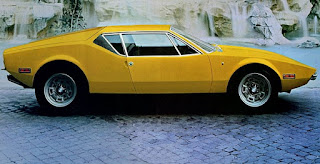
Early standard De Tomaso Pantera

Ford was closely involved, not only as the car’s engine supplier, but also, until 1975, with a distribution agreement which made the car available in the U.S. though the Lincoln Mercury dealer network.  This provided Ford with a ‘European’ style sports car ostensibly within its product range, serving not only as an incremental profit opportunity for its dealers, but also as a halo model to draw interest and prospective buyers to the Blue Oval brand.  And Ford, with its expertise in savvy marketing, was quick to introduce, in the GTS, a ‘premium’ version, enabling a boosted profit margin and additional performance-image charisma. 

The Pantera was not just eye candy.  Ford was enjoying the glow that its success in motor sport had generated through the late Sixties.  Four consecutive Le Mans victories, 1966-69 and the dominance in Formula One of the Ford-badged Cosworth DFV engine had done wonders for image building and marketing.  Dearborn management was keen to add to its new exotic GT’s customer appeal by ensuring that it was highly visible and achieved success on American race circuits.  As a first step, in early 1972, a Group 3-compliant version was made available.  As such, because it was a class allowing only very limited modifications, it was really just a mild upgrading of the GTS variant.  Most significant was an increase in engine power, from 330 bhp for the standard car, to 345 bhp, achieved with a higher compression ratio, better breathing and freer exhaust gas flow.  Also notable, were wider wheels, (Campagnolo alloys), 8 inch at the front, 10 inch rear.

Early Group 3 Pantera

The first batch of Group 3 Panteras were built between December 1971 and April 1972.  It is commonly given that 34 Group 3 Panteras were manufactured, but former De Tomaso director, Giorgio Montagnani, has been quoted as saying that the number was 36.  Further, he recalled that 6 of these were full ‘works’ racecars and 4 rally versions of a similar status.  The prototype, chassis #1070, was purchased in March 1972 by Auto Club Roma.  This car was raced extensively in Italy throughout the decade, by Auto Club and its subsequent owners, Ital Atlantic Express, and then Marco Curti.  Racingsportscars.com records a career of 7 years, with 19 events entered, and 3 class wins.  (This tally does not, however, include results for the initial two seasons.)


#1070 at Magione, 1974

The FIA class regulations of the time offered a greater potential for success in the Group 4 category.  This allowed for modifications to aspects of the car that constituted its weaker aspects: weight, suspension, steering and braking.  The standard engine was not such a feature, but still was the subject of upgrading, (mainly around gas flow optimisation), taking output up to around 450 bhp.  This increase in power, together with a reduction of weight by around 300kg, enabled good potential class competitiveness.  However, a set-back occurred when an unexpected revised regulation minimum weight was announced, this being some 150 kg above that achieved by development work including the use of aluminium in substitution for steel in major panels, fibreglass wing extensions, plastic ‘glass’ and stripped out interior.  A further issue arose during testing as engine reliability became a concern.  This would eventually be addressed by the adoption of lower compression values.  Various sources indicate that De Tomaso built 14 Group 4 Panteras.

At the La Sarthe event, a Claude Dubois-entered car, chassis #2860, crewed by Jean-Marie Jacquemin/Yves Deprez finished 16th, 2nd in class.  Three other Panteras were entered, two for Escuderia Montjuich, the other for Societé Franco-Brittanic, but they were all early retirements with blown cylinder head gaskets.


#2860 at Le Mans, 1972

The following month, Herbert Muller took his Pantera to a Group 4 win in the Euro GT series at Nivelles.  He followed this up in August with another victory in the Deutsche Automobil Rundstrecken Meisterschaft meeting at the Norisring.

#2859 at Nivelles, 1972

In 1973 reliability improved and in June works-entered #2873 won in Euro GT at Imola in the hands of Mike Parkes.  This was a particularly satisfying victory for De Tomaso, as Parkes had been hard at work in ’72 developing the Group 4 version of the Pantera.

#2873 at Imola, 1973

Two months later another ‘big name’ – Clay Regazzoni – took the same car to victory at the Hockenheim round.

#2873 at Hockenheim, 1973

That car certainly earned its keep that season – in October it was a winner once again, this time in the Giro d’Italia with Mario Casoni and Rafaelle Minganti at the wheel.

#2873 Giro d’Italia start, 1973

Casoni was apparently fully au-fait with the Pantera by late season, having achieved another first-place, this time in #2872, the previous month at Casale.  Other Pantera victories in 1973 included Croix-en-Ternois, by Patrick Metral, and at Varano, by Ugo Locatelli. 

1974 saw a substantial number of race entries for Panteras.  Odoardo Govoni scored 3 victories in the Spring at Magione and (twice) at Varano.  A repeat win in the Giro d’Italia was missed, but Govoni and Vincenzo Angelelli's was the best placed of 7 Panteras entered, finishing 3rd.  Four cars ran in the Targa Florio, that of Alex Pesenti-Rossi and Alvaro Valtellina being the highest finisher, in 13th.  At Le Mans, Wicky Racing Team intended to run two cars, but only that of Max Cohen-Olivar and Philippe Carron started, and was out early with timing gear failure.

Wicky Racing Team at Le Mans, 1974

Once again, in 1975, Panteras covered a great many racing miles, but no victories are on record.  Govoni was again a prominent exponent at the wheel, and he was the most successful driver, scoring 2nd places at both the September and November GT events at the Magione circuit.  Partnering Ruggero Parpinelli, he also finished 8th, (and 5th in class), at the Targa Florio.  Four cars ran at Le Mans, but only the early chassis, #2860, still run by Team Claude Dubois and now driven by Pierre Rubens and Paolo Bozzetto, made it to the finish, in 16th place, (8th in class), just as it had done in ’72.

#2873 at the Targa Florio, 1975
 

#2860 at Le Mans, 1975

No less than 10 Panteras were entered for the Giro d’Italia, with the Jolly Club car, driven by Bozzetto and Marco Martinenghi taking 5th place, (3rd in class). 

Highlights of the 1976 season were victories for Pierre Rubens (Team Willeme) at both Zolder and Colmar-Berg, four other podium positions in Europe, and three in Australia.  Although there was a greatly reduced participation at Le Mans and the Targa Florio, seven Panteras ran in the Giro d’Italia, with Govoni and Valentino Balboni finishing 6th.

#2873 Giro d’Italia, 1976

In the early stages of the 1977 season, Rene Tricot, (Team Willeme), took three victories in Belgium, while in November, Maurizio Micangeli and Carlo Pietromarchi scored a significant win in the Group 4/5 event at Vallelunga.  Four cars took part in the Giro d’Italia, Pietromarchi and Giancarlo Naddeo coming 3rd.

Carlo Pietromarchi/Giancarlo Naddeo, Giro d’Italia, 1977

For the remainder of the Seventies, Panteras continued to feature in numbers in national/European series racing, but results were mediocre, with just the occasional win/podium finish.  During the Eighties, participation fell to lower levels, with the cars being considerably less competitive.  This trend persisted in the Nineties, except that in 1995 Thorkild Thyrring was a major force for ADA Engineering in the British GT series, winning the GT1 class championship.

Thorkild Thyrring, British GT, Silverstone, 1995

Today – and in recent times – Panteras are to be seen competing with verve in Historic meetings.  Excellent video is available of the Group 4 example of Luigi Moreschi on the 2018 Vernasca Silver Flag event.  To enjoy the sight and sound of a Group 3 car running at Spa recently, have a look at this video.  A Group 4 Pantera, #2598, is currently offered for sale, having been competing with considerable success in Romania.

#2598, racing in Romania

You may have wondered why I opened this piece with an encomium to Marcello Gandini in relation to a car actually styled by rival, Tom Tjaarda.  Much as I admire Gandini’s work, I’m sorry to say that I think he despoiled Tjaarda’s masterpiece:  In 1989, Alejandro de Tomaso insisted that the job of facelifting the Pantera for 1990 be awarded to Gandini’s consultancy.  What resulted was the Si.

The main focus of the exercise was on the front end.  A ‘heavier,’ more curvy, character was conferred by redesigned/rescaled front wings and bumper.  The effect on the car’s overall form and stance was a loss of the pleasing balanced contrast between a svelte front and a burly centre/rear section.  To some eyes this may have resulted in a more consistent, cohesive design, but, as such, the Pantera’s body was no longer a physical analogy of its hybrid nature – Latin style and dynamic flair combined with American motive heft.


I have derived much information from the excellent www.racingsportscars.com.  This is an invaluable source of data for anyone researching motor sport history.  For the De Tomaso Pantera, refer here: https://www.racingsportscars.com/type/archive/De%20Tomaso/Pantera.html

Other essential resources are:

http://www.detomasoregistry.org/

http://panterainternational.org/detomaso_history/europes_pantera.html

https://detomasodc.co.uk/

https://australianmotorheritagefoundation.org/2021/08/28/the-making-of-the-de-tomaso-pantera-by-gautam-sen/