Showing posts with label Muller. Show all posts

Tuesday, August 8, 2023

Ollon Villars in the Sixties

Ollon is a small Swiss town with a population of about 8,000. Situated near and to the west of the River Rhone,  it is a little to the south of the western end of Lake Geneva, about 400 metres above sea level.  Heading west, mountainous topography is encountered, including the notable peak of Les Diablerets.  In this direction, after some 5 miles and at an elevation of 1,260 metres, Villars sur Ollon is reached, a village inhabited by around 2,000 people.  The connecting road, with several hairpin turns, was first used as a hill-climb course in 1951.  Every other year, (with some exceptions), for the following two decades it served as one of the most popular hill-climb venues.  By 1958 the event’s status was good enough to allow it to feature as a round of the European Mountain Championship, regulated and governed by the FIA.


At the start of the decade pure racing cars were dominant at the head of the results table.  In 1960 this can be seen in the list of the ten fastest times:

Barth’s fastest time was 4 minutes, 52.7 seconds – he was the only driver to get below 5 minutes – next up, Heini Walter, was 11.6 seconds ‘slower.’  The RSK-based 718/2, launched in Spring 1959, had benefited during the 1960 season from subsequent development informed by feedback from Stirling Moss.  Porsche had successfully interested Moss in driving the 718 in Formula 2 in 1960 by loaning a car to the Rob Walker team.  It was hoped that this would lead to a works drive in the new Formula 1 in 1961.

The Heini Walter RS60 had run as a works car at Le Mans, following which it had its modified rear bodywork, (purpose-made to enhance top speed capability on the Mulsanne straight), removed, and the engine replaced with a larger (1,700 cc) unit.  It was then loaned to Walter for hill-climb entries under his own name.  He was happy enough with this car to retain it for ’61 and was rewarded by a series of good results which secured for him that year’s Championship. 

Brabham competed at Ollon Villars as the reigning Formula 1 World Champion, his Cooper T51-Climax clearly demonstrating that everyone would have to make the move from front- to rear-engined cars.  For Ollon Villars he was equipped with the improved T53 chassis powered by a smaller 1,475 cc FPF Coventry Climax engine.  Using the T53 with the 2,497 cc version of the engine, Brabham would finish 1960 as Formula 1 Champion for a second successive season.
 
Below, left: Edgar Barth in the winning Formula 2 Porsche. (Courtesy Arthur Fenzlau).  Right: Jack Brabham in the 3rd placed Cooper T53.


While there had been 129 competitors recording completed/timed runs in 1960, the number was much reduced in 1962 – down to just 56, (through it’s possible that there was a failure to record/preserve lower order competitors’ times).  Porsches were again prolific in the top ten:


An important development for Porsche in its quest to maintain the 718 series cars’ competitiveness was the utilisation of a 210 bhp version of the Formula 1 eight cylinder engine.  In this form the cars were designated as 718/8 W-RS Spyder. 

The event was further distinguished in 1962 by Jim Clark’s participation.  Already considered an outstanding talent and potential future World Champion, and with the ill feelings from the previous season’s tragic Monza accident fading, Clark arrived at Ollon Villars as the subject of much expectation.  Some thought that he might be fastest in the smaller capacity Racing class.  Unfortunately however, the Lotus team was unable to put a really suitable and competitive car at his disposal.  All that could be drummed up was the loan of a Scuderia Filipinetti Lotus 21.  Its dynamic attributes proved to be beyond even Clark’s prodigious talents, leaving documented reports of his performance limited to mention of an ‘off’ in practice and the absence of any record of the best time achieved. 

The photographs seen below are credited to Kuno Zimmermann.  They were found on the website, smallcar.ch, a wonderful resource which I would greatly recommend.  Left to right: Heini Walter, Porsche 718/8W-RS Spyder; near the start, #185 Walter, #184 Scarfiotti, (#186 unidentified); Jim Clark #31.


1963 saw some familiar names at the top of the results table.  Porsche supplied three of the top ten runners, but competition was more in-depth and diverse than in the first two events of the decade.  The best-placed Porsche was 2nd, 7 seconds behind the winner:

Especially notable cars were Bonnier’s Ferguson, Brabham’s Brabham and Muller’s Porsche ‘missing link.’  The Ferguson was a very distinctive machine, it being not only 4 wheel drive, but also the last car built for Formula 1 with a front-engined powertrain.  In addition to this victory in Switzerland, the 2.5 litre car was further successful in capturing the 1964 British Hillclimb Championship.  The Brabham BT4 was introduced in 1962, primarily to be raced in the Tasman series ‘down under.’  Its agility, however, made it very suitable for hill-climbing and the third (of three) chassis constructed was sold to Charles Vögele specifically for European hill-climbing campaigns – and in 1963 he was dominant in the car in the Swiss national championship. 

As I outlined in The Dream Hybrid - Conceived in the Fifties!, the ‘Dreikantschaber’ was created to bridge the gap between the Porsche GTL and the 904: Porsche had readily appreciated since the latter part of 1962 that it would need something more radical than the GTL if it was to retain its competitiveness in the GT racing classes – threatened as that would be by new/improved rival models such as the Alfa Romeo TZ and the Abarth Simca 2000.  Thus, while the GTL would continue through 1963, the 1,966 engine and better brakes began also to be utilised in a new bodied, 718, RS61-based, ‘GS-GT.’  The two examples of this made – also known as ‘Dreikantantschaber’/DKS* – ran in parallel with the GTLs, from the Targa Florio onwards.  This model would serve as a steppingstone to the ultimate requirement, a mid-engine GT, which was realised in November 1963 with the initial presentation of Butzi Porsche’s rapidly-developed 904/Carrera GTS.  *This is the German name for a sharp, triangular-pointed scraping tool – the visual reference being to the ‘sharp’ form of the car’s nose/front end. 

Both images below courtesy of Automobile Sport.  Left: Hans Herrmann claiming 3rd in the Abarth Spider Sport; right: Jo Bonnier with the Ferguson P99.


The 1965 event was the 17th (of 20) round of the World Sportscar Championship, which that season was two-pronged: 1) International Championship for GT Manufacturers, and, 2) International Trophy for GT Prototypes.  The former, in its Division 1 class, was dominated and won by Abarth, the marque’s fourth consecutive World Championship triumph.  Ferrari was clearly in the ascendancy in the Prototypes competition and would finish the season with almost double the points scored by runner-up, Porsche.  Within the European Mountain Championship, Ludovico Scarfiotti’s scoring had been underlining Ferrari’s strength, with his Sant Ambroeus-entered, (works-backed), Dino 206 SP being the winning car at Ollon Villars, as it had been at Trento Bondone, Cesana-Sestrieres and Fribourg. 

Scarfiotti's car was an open-top version of the Dino 166 P with a bigger (2.0 V6) engine, giving 218 bhp.  For his part, Scarfiotti was an extremely accomplished and versatile driver, having won the European Hillclimb Championship in ’62, Le Mans the following year, and he was an Italian Grand Prix winner.  His main opposition in ’65 came from the works Porsche 904/8s of Gerhard Mitter and Herbert Muller and Abarth 2000 OT of Hans Herrmann.  Also able to challenge were, for example, 904 GTS Porsches in the hands of drivers such as Herbert Muller, Rolf Stommelen and Michel Weber, while Herbert Demetz could also turn rapid ascents in the 2.0 Abarth.  The ten fastest in ’65 were:


The model designation of Mitter’s car (chassis #906-010) was enigmatic and quite confusing.  Firstly, though referred to as 904s, the Bergspyders used for sportscar racing and hill-climbing in ’65 had chassis numbers configured 906-0xx, all with an eight cylinder engine.  To compound potential misunderstandings, #010 was used for a chassis which appeared at the Rossfeld hill-climb meeting in June but was then promptly junked and the number re-used for the chassis Mitter debuted at Ollon Villars.  This was itself distinctive as it was an even lighter Bergspyder – at 488 kg – thanks to a new tubular spaceframe construction, one of the first outcomes of Ferdinand Piech’s involvement in the works racing organisation.  Thus, this car was virtually a 906, a model type which would long remain emblematic of Piech’s influence and achievements.  Crucially, the 906 allowed a huge scope for development, in contrast to the limitations of the 904, being more of a road car modified for the track. 

Alongside Mitter’s 904/8 as a Porsche System Engineering Ltd. (i.e. works) entry, was an Elva Mk.7, driven by Anton Fischhaber.  This was powered by the same Type 771 1,991 cc flat 8 engine used in #906-010.  The Elva chassis, as proven in other applications, was effective and enabled Fischhaber to finish 16th, his best time being 4 min. 36.3 sec, 24 seconds greater than Mitter’s.  For further comparison, the similar, but BMW M10-engined Mk.8 Elva of Sidney Charpilloz was 5.4 seconds slower. 

With his World Championship successes of the era, Carlo Abarth was keen to add the European Mountain title to the brand’s the honours list.  His problem however was the lack of a multi-cylinder engine of the level of capability at the disposal of  the Porsche and Ferrari marques.  Of the several coupe and barchetta type cars being built at Corso Marche mid-decade, the most suitable for the hills were the OT (Omologata Turismo) Spiders.  There was however an underlying compromise in so much as the Fiat 850-based chassis was relatively heavy.  A positive feature however was the first use by Abarth of glass fibre for fabrication of the whole body structure.  Designated as Tipo 139, the car, as driven at Ollon Villars by Demetz, utilised the 1,946 cc version of the Abarth 4 cylinder Bialbero, good for 209 bhp.  In simple terms the Abarth’s main disadvantage against the Porsche and the Ferrari was its weight – quoted as 710 kg.  Thus, it was bound to struggle with performance, given that its 209 bhp compared with 218 for the Ferrari and at least 250 from the Porsche unit. 
Images below, left: Peter Ettmuller’s Shelby Cobra, finished 19th; centre: winner, Scarfiotti’s Ferrari 206P. (Copyright GPL – Geoff Goddard); right: Ferrari 275 of Giampiero Biscaldi. (Courtesy Alamy).


The meeting in 1967 – also known as the Swiss Mountain Grand Prix - was the last which enjoyed the status of being a round of the International Manufacturers Championship, (also known previously as the World Sportscar Championship, and, subsequently as the International Championship for Makes.)  The change of status was no reflection on the venue – hill-climbing underwent a diminution of popularity through the sixties, and events became less well supported.  While there were four climbs in the 1965 Championship calendar, Ollon Villars was the only one in ‘67, and the category did not feature anywhere in subsequent years.  The European Hillclimb Championship would however continue, (through to the current day), and in ‘67 Ollon Villars was the penultimate of eight rounds.  The competitors arrived at the Vaud canton in late August, with Porsche assured of the Championship, its cars, running in the premier, Sportscar (Prototype), class, having been victorious at all six of the previous rounds.
 
The two Weissach works drivers were Gerhard Mitter and Rolf Stommelen.  Mitter was the reigning European champion having outscored the opposition in 1966 at the wheel of a Porsche 910 coupe.  The Porsche System Engineering team was keen to repeat that success and was conscious that an increased level of competition could be expected in ’67, especially in the shape of the Abarth 2000 SP, Ferrari 412P, Lola-BMW T110 and Alfa 33.  Thus it was decided to revert to the ultra-lightweight Bergspyder format as had been successful in ’65 (904/8).  This decision was facilitated by a regulations change which removed the minimum weight limit and reintroduced governance by the very liberal Group 7 technical stipulations.  Both using the resulting 910/8 Bergspyder, Mitter and Stommelen had won all the previous rounds, at Montseny/Trento-Bondone/Freiburg-Schauninsland and at Rossfeld/Mont Ventoux/Cesana-Sestriere, respectively.
 
Key specification features of the Spyders included the very low weight of just 499 kg at the beginning of the season.  And this was further reduced as development continued during the season, primarily on the car allocated to Mitter, the frame of which was rebuilt in aluminium, a measure that gave a one-third weight saving.  A variety of other modifications included a tiny fuel tank – 15 litres capacity – and some exotic materials: magnesium wheel rims, beryllium for the brake discs and titanium for the brake calipers and stub axles.  Bodywork was in very thin gauge glass-fibre with notably short side panels – prompting a ‘Mini-Skirt Spyder’ nickname.  By the time of the Ollon Villars event, the kerb weight was down to 418 kg.  A side benefit of the enhanced light weight was the feasibility of using ballast over the front axle in order to ‘calm’ the handling characteristics, contributing significantly to the car’s drivability.  As for the other crucial performance component, the type 771 engine delivered 260 bhp.  All this was good enough to allow Mitter to take first place with a time of 3 min. 55 sec, (for comparison, the eventual record time, achieved by Francois Cevert in ’71, being 3.47).  The top ten in ’67 were:


The Ollon Villars course was not generally thought to be especially hazardous, though following his outright record-establishing run in ’71, Francois Cevert is quoted as saying: ‘Never again will I indulge in such a dangerous adventure. I find the climb quite frightening, brushing guardrails at high speed and clipping trees. Circuit racing is much less demanding.’  Cevert’s opinion is validated by the fact that two drivers died at the ’67 event – Axel Perrenoud, driving a Shelby Cobra on the Friday, and Michel Pillet the following day at the wheel of a Ecurie La Meute Triumph Spitfire.

Images below, left: Peter Schetty’s Abarth 2000 SP, 4th fastest. (Courtesy Equipe Bergamote); centre: Sepp Greger’s Porsche 906. (Courtesy Zwischengas CZ); Porsche 910 of Rolf Stommelen. (Courtesy Karl Ludvisgen).


On 31st August 1969 the 7th round of the European Championship was again held at Ollon Villars.  Where ’67 had been a season of Porsche and Mitter/Stommelen domination, ’69 had proved to be a walkover for Ferrari and Peter Schetty.  He had mastered the 212E Group 7 barchetta and was very fast on all the ‘mountain’ courses.  In winning once again at Ollon Villars – making it a championship series clean sweep, (though he was not entered for the final round at Gaisberg) – Schetty set a fastest time of 3 min.47 sec, 8 seconds better than Mitter had managed in ’67 and a fraction slower than Cevert’s all time record.  The 212E was a development of the Dino 206S with various weight-saving modifications similar to those practised by Porsche on the Bergspyders.  But, as implemented at Maranello, such measures did not result in an equally lightweight car, the 212E weighing in at around 515 kg.   The Ferrari however benefited from a very high performance engine (Tipo 232) – a 2,000 cc flat 12 rated at over 300 bhp.


Images below; left: Schetty, Ferrari 212E, 1st place. (Courtesy SupercarNostalgia); centre: Alfa Romeo 33/2 as raced by Michel Weber to 5th place, (this photograph not taken at Ollon Villars); right: Arturo Merzario in the Abarth SE010.


The FIA-governed European Hillclimb Championship has continued through to the current day.  Since the last Ollon Villars-hosted round in 1971, various revival events have been held there, the first being in 1998 when 12,000 spectators attended the International Retrospective Hill-Climb.

Saturday, November 5, 2022

One Last Time


1973 saw the 57th running of the Targa Florio on the Piccolo Circuito delle Madonie, Sicily.  A battle for victory by the 3.0 Sports Prototypes, especially the Ferrari 312 PBs and Alfa Romeo T33/TT/12s, was expected.  As it turned out, however, the race was won by the Martini Racing Porsche 911 RSR of Herbert Muller and Gijs van Lennep. Sandro Munari and Jean Claude Andruet were second in the new Lancia Stratos, with another Martini 911 RSR of Leo Kinnunen and Claude Haldi third.  And this was to be the last Targa that served as a round of the World Sportscar Championship, the circuit being deemed unacceptably hazardous in the wake of a spate of accidents to drivers, and injuries sustained by several spectators. In a pre-race accident, Charles Blyth, whose Lancia Fulvia had failed scrutineering, sustained fatal injuries.  During the race, Ferruccio Deiana crashed his Renault Alpine A110, killing a spectator. 

This account however focuses on the wide and diverse range of entries for the race.  Whilst the 312 and the 33 were outstanding racing cars in their era, several other distinctive machines - if much less well known - ran in 1973.  Seven of these are celebrated in the survey below. 

Momo-Conrero Opel
#19 Giorgio Pianta and Pino Pica

Virgilio Conrero’s early career included several highlights – honing his engine development/tuning expertise at Fiat; a key engineer with the Cisitalia/Porsche 360 F1 project; with his own constructor workshop - Autotecnica Conrero - newly established, he created a Ghia-bodied Conrero-Alfa Romeo 1900 and ran this in the 1953 Mille Miglia; numerous victories in the late Fifties/early Sixties; success with a Conrero Formula Junior car and with Alfa Romeo specials based on the Giulietta; collaboration in 1961 with Alejandro De Tomaso on a Grand Prix car with an Alfa Romeo Giulietta-based engine. 

After expanding his business during the Sixties by establishing ‘approved tuner’ relationships with Renault, Triumph and the burgeoning Japanese manufacturers, Conrero secured a substantial contract with Opel to build/prepare/run cars in competition on its behalf.  Positive results soon flowed, with Conrero’s version of the Opel GT beginning to take class honours in 1970.  The following season saw a class victory in the Targa Florio – with this car, Conrero had developed a Porsche-beater, raising his stock further. 

Encouraged by the success achieved with the GT, Conrero then developed an open top Group 5/6 prototype in the style of the Chevron B19 S, Lola T212 and Abarth 2000 SP; (there was comment that the body styling appeared to be a copy of the Ferrari 312 PB).  The car was entered for the 1973 running of the Targa Florio, with drivers Giorgio Pianta and Pino Pica.  Designated as a Momo-Conrero, the car is seen below with Conrero himself (standing) on the left:


The Momo association seems very natural – the brand’s founder, Gianpiero Moretti, and Virgilio Conrero were both charismatic and entrepreneurial figures on the Italian sports car racing scene in the era.  However, their collaboration this time was unsuccessful, the car being retired after 4 laps.  Indications were that the car’s pneumatic suspension had caused stability issues and the brakes did not stand up well to the demands of the Madonie circuit.1  It had been competitive though, with a 26th fastest race lap of 42'35"2 and was running in 7th place overall on laps 1 and 4.

1.www.targapedia.com/biblioteca/riviste/automobile_historique/tf_R_AutomobileHistorique_2001_05_TargaFlorio1973.pdf

Daren Mk. 3
#12 Jack Wheeler and Martin Davidson 

One of the lesser-known British sportscar marques is Fairthorpe.  In business for just short of twenty years in the Fifties to the early Seventies, the Buckinghamshire-based manufacturer made a variety of small sportscars primarily based on Triumph chassis/mechanicals/engines and utilising glass fibre body construction.  An ex-Daimler man, John Green, joined Fairthorpe as General Manager in the late Fifties.  He set about developing a new model and this proved to be a significant step forward for the company.  Called the Electron Minor, it became the leading Fairthorpe product. 

Along with his expertise as a manager and an engineer, Green could boast ability behind the wheel of a racing car.  So, it was not unexpected that he designed and built a track car in parallel with his work for Fairthorpe.  But thus, he became associated with another obscure British racing name, even less familiar to most than Fairthorpe - the Daren.  It was successful until regulation spurred Green to develop a new, lighter car, known as the Daren Mk. 2.  This had a more sophisticated, semi-monocoque construction and lent itself to series production.  In 1971, a Mk.3 was made for well-known club racer, Jack Wheeler.  Wheeler intended the car for some serious racing on the European scene, and, accordingly specified a pretty serious engine: the BRM P56/60 V8, Endurance/Tasman, 2.0 specification.  Six Mk. 3s were built and several entries are recorded in the 1971/2/3 seasons.  Reliability was not especially good – from 35 starts there were only nine finishes and the best result was a second, (for Arthur Collier in a SMRC event at Ingliston). 

Partnered by Martin Davidson, Wheeler took the car to Sicily for 1972’s Targa Florio.  The effort/expense was not however very well rewarded, the Daren failing to complete the first lap as a result of ignition trouble.  Undaunted, they were back for the 1973 event, and, though  two laps down, were still running at the finish, classified as 29th overall, 7th in class.  It was an encouraging outcome and Wheeler must have been hopeful as he arrived in Germany two weeks later for the Nurburgring 1000 kms.  Initially in Practice, the car was competitive amongst the 2 litre opposition – RSR, Lola T290, Chevron B21/23, for example – qualifying 33rd in a 52 car field.  However, with only one lap completed, the engine was subject to a valve failure and had to be retired.

Scrutineering stickers on the Daren

The Daren Mk.3 driven by Wheeler/Davidson to 7th in class.  ©Bernard Cahier

In 2020 the car, unrun since that Nurburgring disappointment 47 years earlier, was sold as a rolling chassis by Bonhams at Goodwood for £18,400 – details here.


AMS 273

11 chassis - #43, #47, #63, #65, #68, #69, #82, #83, #84, #86, #87

At the outset of his engineering career, Tancredi Simonetti worked firstly at OSI, (Officine Stampaggi Industriali), the Ghia subsidiary in Turin.  This business, set up to build special small production volume models, primarily for Fiat and Ford, became defunct in 1967, prompting Simonetti to start constructing a car of his own design.  He based it on a prototype developed by the remnants of the ATS, (Automobili Turismo e Sport) business that had briefly blossomed as a breakaway of talent from Ferrari in 1962.  Simonetti formed a new company, Attrezzature Meccaniche Speciali (AMS) to produce his 1.0 car and Scuderia Autoracing to run it.  From 1969 to 1972 AMS ‘1000 SP’ chassis ran with a variety of engine makes and displacements, becoming successful and popular with owner/drivers and small teams.  An improved model, designated 273, was introduced in early 1973, and no fewer than 11 of these were to be seen on that year’s Targa Florio.  Quite an impressive representation for such a small/’young’ builder, especially in comparison with the numbers running for some of the heavy hitters: Porsche, 17; Alfa Romeo, 17; Lancia, 13.  Engines powering the 273s were: Alfa Romeo 1600; Ford Cosworth 1000, 1300 and 1600; Giliberti-Ford 1600; Giliberti-Alfa 1300; Giliberti-Fiat 1000 and 1300. 

Best result was for #65, the AMS-Ford of Pasquale Anastasio and Giovanni Lo Voi, 15th overall and 1st in class:

Anastasio/Lo Voi, 15th. Courtesy Piergiorgio Ferreri

#47, a Giliberti-Cosworth-engined 273 took Vito Veninata and Giuseppe Iacono to 38th overall, 5th in the 1.3-1.6 class.  #84, with Ford power, was driven to 40th, 2nd in the 1.0 class, by Stefano Sebastiani and Antonio Palangio:


Six of the AMS cars failed to finish – shown below, top row, left to right: #43 of Vimercati/Cocchetti; #63 of Di Cristoforo/Lo Piccolo; #69 of Manzo/Nicolosi.  Lower row, left to right: #82 of Verrocchio/De Antoni; #83 of DonĂ /Govoni; #86 of  Bartoli/"Jorkrysa."


Two driver pairings ran but were unable to qualify for the race:  Gianfranco La Mazza and Massimo Cavatorta in a Ford-engined example, and Salvatore Barraco and Giuseppe Virgilio, whose AMS was powered by a Giliberti-Fiat 1300. 

Only a couple of AMSs appeared at the following year’s emasculated Targa Florio.  The marque’s cars were active on the sports racing scene for the remainder of the decade, but the 277 model was the last of the line.

CR CDS 134B
#62 Salvatore Calascibetta and Alfonso Merendino

My earlier use of the term ‘less well known’ is inadequate in regard to this car!  Very little has been documented about the machine, though its lead driver has been celebrated for his persistence – he ran in the Targa Florio 13 times.  This was mainly on an amateur and largely self-financed basis, though he scored a class win driving an Opel for the Conrero-run factory team in 1971. 

I have been unable to find any trace of the ‘CR CDS 134B’ running in any other event.  As to its origin, the best clue is that in a couple of brief mentions, the car is described as ‘artisan-made’/’handcrafted.’  Since Salvatore ran a workshop in Palermo, my best guess is that he ‘designed’ and built the car from scratch.  As to nomenclature, C R perhaps stands for Calascibetta Racing and the prominent CDS sponsorship decals refer to the proprietary electronic ignition coil/unit - so it's likely that Salvatore derived some funding from this commercial source. 

The car was entered by ‘Krista Buchwald’ – this name is recorded only once and only in regard to the 1973 Targa Florio.  Motive power was provided by an Abarth-tuned Fiat 1300 engine.  It ran until the 7th lap, on which it broke down with fuel starvation and had to be retired.

CR CDS 134B of Calascibetta/Merendino. Courtesy Vittorio Giordano

GiGi P2 Speciale
#64 Antonio Riolo and Giuseppe Garofalo 

The Riolo family automotive retailing business expanded in its Palermo premises from a general garage to a multi-franchise dealership over the post-war years.  In the Sixties/Seventies, it was mainly a Lancia and Citroen representative.  Today its primary focus is with the Audi brand. 

Antonio’s 1973 Targa Florio adventure seems to have been a one-off – as was that of co-driver, Giuseppe Garofalo.  The same can be said for the car – it does not appear in any other race results database.  I understand – but have not so far confirmed – that it was eventually acquired by prominent Lancia enthusiast, Loris Giorgetti.  This would be logical as the GiGi was powered by a Lancia 1300 engine, (Fulvia spec I imagine). 

The P2 was entered by Scuderia Pegaso. The Palermo-based Scuderia had first tackled the Targa Florio in 1964, running a contingent of characterful cars: 2 Alfa Sprint Zagatos, an Alfa Giulietta SS and an Abarth Simca 1300 Bialbero.  The team added Lancia and Ferrari models for the following year and continued to make the Targa Florio its principal interest – with the occasional excursion to Mugello, Vallelunga and Monza – through to 1974. 

The car has a rather strange appearance in contemporary photographs as the ground clearance looks unusually large, there is a curious reverse rake and the tyres – especially the fronts – are less wide than might be expected.  Despite these possible disadvantages, Riolo/Garofalo brought it home 24th, 2nd in class.

Left to right: GiGi P2 in the pits; on its way to 2nd in class; the Riolo Palermo dealership


Bizzarrini 128P Fiat 

#66 Massimo Larini 

Giotto Bizzarrini’s consultancy became known as Bizzarrini S.p.A. after his spell working with Iso ended in 1966.  Under his own name Bizzarrini then produced the much lauded 5300 GT Strada model, but the engineering was more accomplished than the business management, and the company had failed by 1969.  His activities from then became spasmodic and fragmented, though still characterised by flashes of brilliance.  In 1971, as something of an indulgence, he set about designing and building a competition car specified on the basis of a personal ideal.  Thus, came about the 128P Barchetta.  Two chassis were constructed, the Targa Florio-running example being exhibited currently in Turin’s Museo Nazional dell’Automobile.1

Bizzarrini 128P as displayed in the Nazional dell’Automobile  Courtesy David Tarallo

The Fiat 128 engine was uprated to output around 130 bhp.  Given Bizzarrini’s reputation as a very accomplished suspension/steering tuner, much was expected of the car on the Circuitto Piccolo.  In the event, qualifying did not go too well, the car being 73rd of 81.  The race was even less kind – Larini having to retire it with accident damage on the first lap – thus neither Bizzarrini nor Antonio Finiguerra, who had been entered, actually drove it.


Bizzarrini 128P on the Targa Florio

A superb set of detail photographs of the sister car can be seen here  - they were posted at the time of its sale by auction in 2019.  Also reproduced is an illustrated Ruoteclassiche magazine article about that car’s ‘rescue’ and restoration.
Ruoteclassiche magazine article

Giotto Bizzarrini at work on the 128P

1. More photographs of the Museum installation of the 128P can be seen on David Tarello’s blog, Pit Lane Italia 

To round off this survey I’m including a car that evades my opening criterion regarding characterisation as being ‘less well known.’  This car would be making big news in the world of international motorsport throughout the decade.  It was wonderfully distinctive in its functional capability and both innovative and attention-grabbing in its looks.  It’s just that in May 1973 it was the new kid on the block, albeit one that would grow up very quickly . . 

. . . Lancia Stratos
   
#4 (and #4T) Sandro Munari and Jean-Claude Andruet

Lancia’s new flagship competition car broke cover in prototype guise in 1971.  However, it was not seen in its definitive form until 1973 by when the distinctive Marcello Gandini styling had been further refined and, after a period of indecision, the Ferrari Dino engine confirmed.  With production of the 500 examples required for FIA homologation ongoing, a Stratos was making its World Championship circuit racing debut at May’s Targa Florio.  The race-run car entered is said to have been #0002 and it wore race number 04, with Sandro Munari and Jean Claude-Andruet at the wheel.  A second chassis was used in practice, identified with race number 4T and Turin road-registered, PROVA TO 1098.  The car sustained damage to the left hand side. 

As well as looking sensational, #04, ran reliably, avoiding the suspension problems that had afflicted the car’s very first rally outings. And it’s 280 bhp V6 engine made it fully competitive with the 911 RSRs, despite the Porsches having about 35 more bhp on tap.  This was thanks to the car’s handling characteristics and its weight being around 60 kgs lighter than the 911’s 940 kgs.  It finished second, with a deficit of just 6 minutes, between the winning RSR of Muller/van Lennep and that of third-placed Kinnunen/Haldi.  Munari’s fastest race lap was quicker than all but one of the numerous Porsches, and was bettered only by Muller, the two Ferrari 312 PBs of Ickx and Merzario and the Alfa 33 of Stommelen.  The Stratos moved up to third place on Lap 3, second on the following tour, and remained there for the rest of the race.  So no fluke, and not a late-inherited position:  it must have been a very encouraging outcome for the Lancia Corse team.

Left, 2nd place for Stratos #4;  Centre, rear view. Courtesy Revs Institute for Automotive Research;  Right, T car. Courtesy Effe Model Cannata

Much of the information (and images reproduced) in this article has been derived from the excellent website, ‘Targapedia,’ the work of Enzo and Federica Manzo – I’m very grateful to them for all their work and diligence in creating and maintaining such a valuable motorsport history resource.

Tuesday, January 25, 2022

Not Just a Pretty Face

In the years 1965-66, Bob Dylan recorded 3 albums which embody one of the most astonishing streaks of sustained creative brilliance of all time.  Bringing it all Back Home, Highway 61 Revisited and Blonde on Blonde showcased thirty four tracks, not a single one less than first rate, and, astonishingly, nine are genuinely classifiable as ‘masterpieces.’  Talking about what he was striving to achieve, Dylan said: The closest I ever got to the sound I hear in my mind was on the Blonde on Blonde album.  It’s that thin, wild mercury sound.  It’s metallic and bright gold, with whatever that conjures up.  It brings to me, in a visual aesthetic analogy, the sharp – yet harmoniously integrated – angular forms that are the automobile bodies created in 1970-73 by Marcello Gandini in a mid-‘60s Dylan-like purple patch.  Limbering up in 1967-69 with sharp-lined ‘concept’ cars such as the Lamborghini Marzal and the Alfa Romeo Carabo, Gandini’s razor-like shapes appeared on the road as the Lamborghini Jarama, Urraco and Countach, Lancia Stratos HF, FIAT X1/9, Maserati Khamsin and Ferrari/Dino 308 GT4.  This substantial cadre of cars, with a shared visual mood, represents the very best of early Seventies style, except . . . there was one more such contemporary model that was not envisaged on Gandini’s drawing board.  Theoretically, perhaps, it could have taken shape on one nearby Gandini’s, since it is comprised to a considerable extent of the angular lines and forms he himself constructed so successfully.  And, somehow, its creator had also been able to incorporate – at a hinted, subtle level – some curvilinear elements that contributed to a balance of supreme litheness at the front end with a muscular heft characterising the rear quarters.  This hybrid theme extends to the product ‘package’ – Italian coachbuilding/American power unit; to marque ownership – Argentinian/Italian, and to styling authorship: Tom Tjaarda, an American, (whose father was Dutch-born), based at Carrozzeria Ghia in Turin.

Alejandro de Tomaso founded his marque in Modena in 1959.  When his focus turned from his initial interest in racing cars to sports cars for the road, De Tomaso embarked on the production of a series of GTs, culminating in the GuarĂ , made from 1993 to 2004, (at which date the company failed).  The Pantera model preceded the Guara, with a production run begun in 1971, of some 7,000 units.  A conventional monocoque, the Pantera was powered by a Ford 5.8 litre V8 coupled to a ZF transaxle.  Performance was quoted as 0-60 mph in 5.5 secs and a top speed of 159 mph.  Successive iterations included a GTS model with higher output engine, and a Si version late in the production run.
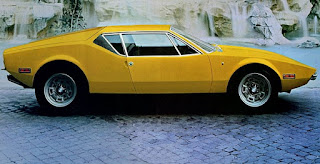
Early standard De Tomaso Pantera

Ford was closely involved, not only as the car’s engine supplier, but also, until 1975, with a distribution agreement which made the car available in the U.S. though the Lincoln Mercury dealer network.  This provided Ford with a ‘European’ style sports car ostensibly within its product range, serving not only as an incremental profit opportunity for its dealers, but also as a halo model to draw interest and prospective buyers to the Blue Oval brand.  And Ford, with its expertise in savvy marketing, was quick to introduce, in the GTS, a ‘premium’ version, enabling a boosted profit margin and additional performance-image charisma. 

The Pantera was not just eye candy.  Ford was enjoying the glow that its success in motor sport had generated through the late Sixties.  Four consecutive Le Mans victories, 1966-69 and the dominance in Formula One of the Ford-badged Cosworth DFV engine had done wonders for image building and marketing.  Dearborn management was keen to add to its new exotic GT’s customer appeal by ensuring that it was highly visible and achieved success on American race circuits.  As a first step, in early 1972, a Group 3-compliant version was made available.  As such, because it was a class allowing only very limited modifications, it was really just a mild upgrading of the GTS variant.  Most significant was an increase in engine power, from 330 bhp for the standard car, to 345 bhp, achieved with a higher compression ratio, better breathing and freer exhaust gas flow.  Also notable, were wider wheels, (Campagnolo alloys), 8 inch at the front, 10 inch rear.

Early Group 3 Pantera

The first batch of Group 3 Panteras were built between December 1971 and April 1972.  It is commonly given that 34 Group 3 Panteras were manufactured, but former De Tomaso director, Giorgio Montagnani, has been quoted as saying that the number was 36.  Further, he recalled that 6 of these were full ‘works’ racecars and 4 rally versions of a similar status.  The prototype, chassis #1070, was purchased in March 1972 by Auto Club Roma.  This car was raced extensively in Italy throughout the decade, by Auto Club and its subsequent owners, Ital Atlantic Express, and then Marco Curti.  Racingsportscars.com records a career of 7 years, with 19 events entered, and 3 class wins.  (This tally does not, however, include results for the initial two seasons.)


#1070 at Magione, 1974

The FIA class regulations of the time offered a greater potential for success in the Group 4 category.  This allowed for modifications to aspects of the car that constituted its weaker aspects: weight, suspension, steering and braking.  The standard engine was not such a feature, but still was the subject of upgrading, (mainly around gas flow optimisation), taking output up to around 450 bhp.  This increase in power, together with a reduction of weight by around 300kg, enabled good potential class competitiveness.  However, a set-back occurred when an unexpected revised regulation minimum weight was announced, this being some 150 kg above that achieved by development work including the use of aluminium in substitution for steel in major panels, fibreglass wing extensions, plastic ‘glass’ and stripped out interior.  A further issue arose during testing as engine reliability became a concern.  This would eventually be addressed by the adoption of lower compression values.  Various sources indicate that De Tomaso built 14 Group 4 Panteras.

At the La Sarthe event, a Claude Dubois-entered car, chassis #2860, crewed by Jean-Marie Jacquemin/Yves Deprez finished 16th, 2nd in class.  Three other Panteras were entered, two for Escuderia Montjuich, the other for SocietĂ© Franco-Brittanic, but they were all early retirements with blown cylinder head gaskets.


#2860 at Le Mans, 1972

The following month, Herbert Muller took his Pantera to a Group 4 win in the Euro GT series at Nivelles.  He followed this up in August with another victory in the Deutsche Automobil Rundstrecken Meisterschaft meeting at the Norisring.

#2859 at Nivelles, 1972

In 1973 reliability improved and in June works-entered #2873 won in Euro GT at Imola in the hands of Mike Parkes.  This was a particularly satisfying victory for De Tomaso, as Parkes had been hard at work in ’72 developing the Group 4 version of the Pantera.

#2873 at Imola, 1973

Two months later another ‘big name’ – Clay Regazzoni – took the same car to victory at the Hockenheim round.

#2873 at Hockenheim, 1973

That car certainly earned its keep that season – in October it was a winner once again, this time in the Giro d’Italia with Mario Casoni and Rafaelle Minganti at the wheel.

#2873 Giro d’Italia start, 1973

Casoni was apparently fully au-fait with the Pantera by late season, having achieved another first-place, this time in #2872, the previous month at Casale.  Other Pantera victories in 1973 included Croix-en-Ternois, by Patrick Metral, and at Varano, by Ugo Locatelli. 

1974 saw a substantial number of race entries for Panteras.  Odoardo Govoni scored 3 victories in the Spring at Magione and (twice) at Varano.  A repeat win in the Giro d’Italia was missed, but Govoni and Vincenzo Angelelli's was the best placed of 7 Panteras entered, finishing 3rd.  Four cars ran in the Targa Florio, that of Alex Pesenti-Rossi and Alvaro Valtellina being the highest finisher, in 13th.  At Le Mans, Wicky Racing Team intended to run two cars, but only that of Max Cohen-Olivar and Philippe Carron started, and was out early with timing gear failure.

Wicky Racing Team at Le Mans, 1974

Once again, in 1975, Panteras covered a great many racing miles, but no victories are on record.  Govoni was again a prominent exponent at the wheel, and he was the most successful driver, scoring 2nd places at both the September and November GT events at the Magione circuit.  Partnering Ruggero Parpinelli, he also finished 8th, (and 5th in class), at the Targa Florio.  Four cars ran at Le Mans, but only the early chassis, #2860, still run by Team Claude Dubois and now driven by Pierre Rubens and Paolo Bozzetto, made it to the finish, in 16th place, (8th in class), just as it had done in ’72.

#2873 at the Targa Florio, 1975
 

#2860 at Le Mans, 1975

No less than 10 Panteras were entered for the Giro d’Italia, with the Jolly Club car, driven by Bozzetto and Marco Martinenghi taking 5th place, (3rd in class). 

Highlights of the 1976 season were victories for Pierre Rubens (Team Willeme) at both Zolder and Colmar-Berg, four other podium positions in Europe, and three in Australia.  Although there was a greatly reduced participation at Le Mans and the Targa Florio, seven Panteras ran in the Giro d’Italia, with Govoni and Valentino Balboni finishing 6th.

#2873 Giro d’Italia, 1976

In the early stages of the 1977 season, Rene Tricot, (Team Willeme), took three victories in Belgium, while in November, Maurizio Micangeli and Carlo Pietromarchi scored a significant win in the Group 4/5 event at Vallelunga.  Four cars took part in the Giro d’Italia, Pietromarchi and Giancarlo Naddeo coming 3rd.

Carlo Pietromarchi/Giancarlo Naddeo, Giro d’Italia, 1977

For the remainder of the Seventies, Panteras continued to feature in numbers in national/European series racing, but results were mediocre, with just the occasional win/podium finish.  During the Eighties, participation fell to lower levels, with the cars being considerably less competitive.  This trend persisted in the Nineties, except that in 1995 Thorkild Thyrring was a major force for ADA Engineering in the British GT series, winning the GT1 class championship.

Thorkild Thyrring, British GT, Silverstone, 1995

Today – and in recent times – Panteras are to be seen competing with verve in Historic meetings.  Excellent video is available of the Group 4 example of Luigi Moreschi on the 2018 Vernasca Silver Flag event.  To enjoy the sight and sound of a Group 3 car running at Spa recently, have a look at this video.  A Group 4 Pantera, #2598, is currently offered for sale, having been competing with considerable success in Romania.

#2598, racing in Romania

You may have wondered why I opened this piece with an encomium to Marcello Gandini in relation to a car actually styled by rival, Tom Tjaarda.  Much as I admire Gandini’s work, I’m sorry to say that I think he despoiled Tjaarda’s masterpiece:  In 1989, Alejandro de Tomaso insisted that the job of facelifting the Pantera for 1990 be awarded to Gandini’s consultancy.  What resulted was the Si.

The main focus of the exercise was on the front end.  A ‘heavier,’ more curvy, character was conferred by redesigned/rescaled front wings and bumper.  The effect on the car’s overall form and stance was a loss of the pleasing balanced contrast between a svelte front and a burly centre/rear section.  To some eyes this may have resulted in a more consistent, cohesive design, but, as such, the Pantera’s body was no longer a physical analogy of its hybrid nature – Latin style and dynamic flair combined with American motive heft.


I have derived much information from the excellent www.racingsportscars.com.  This is an invaluable source of data for anyone researching motor sport history.  For the De Tomaso Pantera, refer here: https://www.racingsportscars.com/type/archive/De%20Tomaso/Pantera.html

Other essential resources are:

http://www.detomasoregistry.org/

http://panterainternational.org/detomaso_history/europes_pantera.html

https://detomasodc.co.uk/

https://australianmotorheritagefoundation.org/2021/08/28/the-making-of-the-de-tomaso-pantera-by-gautam-sen/