Showing posts with label Modena. Show all posts

Sunday, November 1, 2026

082 Gentiluomini che pranzano insieme


Sergio Scaglietti


To the North East of Modena, on the way to Lamborghini’s Sant’Agata base, is a hamlet, Tre Olmi.  It was in the early 20th Century the home of Ernesto Scaglietti, his wife, Gentilina and their six children.  The youngest was named Sergio who was born in January ’20.  Perhaps Sergio in his early years thought he might like to take after his father and grow up to be a bricklayer.  But the poor boy was still too young for that when Ernesto died in ’33.  Even though he really should have had a year or two more at school, the family finances dictated that he should become a wage earner right away, and this was achieved when he was taken on as general dogs body at the Carrozzeria of Dante Bertani in Modena.  Young Sergio must have shown initiative and interest as before long Bertani began to instruct him in the craft – and art – of reshaping and finessing damaged car panels and then, progressively, in creating new, replacement ones from sheet metal.  Within a few years Sergio had become highly skilled and his brother, Gino, persuaded him to come and join him in creating a new business in Modena in partnership with Renato Torricelli.  Carrozzeria Torcelli & Scaglietti was located on Viale Trento e Trieste, as was the premises of Scuderia Ferrari.  In some accounts it’s said that as a matter of simple expediency, the proximity led to the establishment of a relationship whereby Ferrari regularly looked to the carrozzeria to carry out repairs to the Alfa Romeo racing cars which Ferrari ran on behalf of the Portello factory.  However, there are varying versions of how Ferrari and Scaglietti became acquainted, some of these I’d guess as being the product of imaginative thinking by writers who liked the idea of some mythology as much as the recording of actual events.  In one narrative, Enzo simply strolled ‘across the road’ in ’39 to say ‘ciao,’ having heard that Sergio was a dab hand when it came to aluminium shaping and fabrication.  In another, it was not until ’53 that Scaglietti came to Ferrari’s attention because of a particularly skilful repair of a race 166 MM Barchetta.  In amongst such accounts, the uncertainty of research undertaken is notably demonstrated by some authors referring to the Scaglietti premises being ‘across the road in Maranello from Ferrari.’  This indicates considerable misunderstanding, since Ferrari moved from Modena to Maranello in ‘43, whereas the Scaglietti works remained in Modena.

Whether or not he’d recently become friendly with Ferrari, Scaglietti in ’40 enlisted for service and spent World War II in the Regio Esercito as a mechanic/driver.  Once hostilities had ceased and things began to get back to normal, Scaglietti determined to carry on with automotive work but as a business proprietor rather than an employee.  Both his technical and commercial skills developed as did his reputation, enough by ’51 for a workshop on Viale Trento to named, ‘Carrozzeria Scaglietti,’ and, yes, it was ‘just across the road’ from the former Ferrari premises.  In the summary below of ‘landmark’ Scaglietti-bodied Ferraris the focus is on their aesthetic aspects rather than on their mechanical details or competition histories.

In ’47 the very first machines bearing the maker’s name, Ferrari, were a pair of model 125 S open sports cars powered by a Columbo-designed 1.5 litre V12 engine.  The following year, the design was evolved to create a GT, the 166 Inter, and this was also made available in competition form as, 1) a Spyder Corsa - the 166 S;  2) with designation MM (Mille Miglia) in either berlinetta or barchetta form.  Most of the 166s were bodied at Touring or Vignale, though two had coachwork by Allemano.  There were also one-offs by Zagato and Pinin Farina and (in ’53) conversion of a 166 MM in collaboration with Abarth.  It had a further re-body in ’54, this time at the Scaglietti workshop.  The most significant interaction of Scaglietti with a 166 was however his repair of a competition model owned by an amateur driver.  This suffered serious damage in ’53 and was referred to Scaglietti for re-bodying – it has been written that Ferrari was impressed not only by the body’s basic quality, but also Scaglietti’s detail innovative features, and that this was what prompted him to ‘cross the road’ and have an introductory conversation with the Carrozzeria’s proprietor.  It is likely that the two men hit it off especially because they recognised themselves as two of a type – possessing supreme self-confidence, in particular to envisage engineering solutions and to direct subordinates to implement these.  Scaglietti, most notably had great intuitive capacity to perceive and design such solutions ‘on the hoof,’ avoiding the time-sapping conventional approach involving preparation at a desk or board of drawings and plans.  And there arose an additional, emotive aspect to Enzo and Sergio’s bonding when Alfredo, Ferrari’s cherished son started regularly to go into Modena and spend time with Scaglietti.  Just in his twenties, ‘Dino’ was interested in engineering and was keen to develop ideas for the enhancement of his father’s products.  But it’s not hard to imagine that Enzo’s presence might have been quite intimidating and tending to inhibit his son’s expression of concepts and confidence.  In contrast, Scaglietti’s personality allowed for a peer-type relationship in which the younger man could relax and devise design proposals whilst still benefitting from sympathetic mentoring from Scaglietti.  Eventually, the Sergio/Dino collaboration found expression in their presentation to Enzo of a design for a racing model, the ‘54 750 Monza Scaglietti.  Symbolic of Dino’s desire and ability to plan on a basis not constrained by his father’s principles, the car had innovative features, though not all were successful as the model proved a handful for most drivers by dint of its aerodynamics; (indeed, it is likely that lift was the underlying cause of Alberto Ascari’s fatal crash at Monza).  For his part, Scaglietti incorporated a headrest, faired on the rear deck behind the cockpit.  Apparently, Enzo did not care for this feature despite its advocation by his son.  According to Karl Ludvisgen, thirty one 750 Monzas were made, (another source suggests thirty five), most of which were Scaglietti-bodied.

Left: 750 Monza #0522 M  Courtesy Gooding & Co;  Right: 750 Monza prototype  Courtesy Sports Car Digest


The 750 Monza was followed up by the 410 S, a model developed specifically, initially at least, to run in the ’55 Carrera Panamericana, only for that event to be cancelled.  Thus, the car’s race debut occurred in Argentina for the Buenos Aires 1000 Km where the two works examples were fast but non-finishers.  Of the three 410 S Spiders built, two were mostly raced in the Americas with mixed success – certainly fast enough to win, but also prone to driveline failures and thus, retirement.  There were, however, no question marks as regards the aesthetics – Scaglietti designed and constructed a very attractive and characterful body as is evident in the photographs below (courtesy of Theo Pieper/RM Sotheby’s) of #0592 CM.  Note that this is an example of the application of Carrozzeria Scaglietti badging – as seen on the front wing, below the Cavallino Rampante shield.  RM Sotheby’s sold the car for $12,985,000 USD in 2024.  In addition to the Spiders, Scaglietti also made a 410S Berlinetta as a special favour for an ex-Ferrari executive.  This car, #0594 CM, sold in 2012 for $8,250,000 USD, (again by RM Sotheby’s) is shown below the Scaglietti badge.

410 S #0592 CM  Courtesy Theo Pieper/RM Sotheby’s


410 S Berlinetta #0594 CM  Courtesy RM Sotheby’s


The 410 S utilised the new Ferrari 5.0 litre V12 engine designed by Aurelio Lampredi.  The next significant Scaglietti Ferrari, the 250 GT California Spyder, was powered by the earlier, Gioacchino Colombo-designed, tipo 168, 3.0 litre V12.  It was a model specified and styled to appeal in the American market.  Based on the Pinin Farina-styled 250 GT, initially in long wheelbase form, and, later, with the shorter, 2,400 mm wheelbase.  It was in production from ’57 until ’63, with a total of around 105 built.

250 GT California Spyder  Courtesy Fiskens/RM Sotheby’s

The bodies of the stradale cars were partially of aluminium construction while racing versions used the material throughout.  The engine was good for 237 bhp and with a kerb weight of 1100 Kg, the Spyder had plenty of go as well as show - 0-60 mph in 7.2 secs and a top speed of 145 mph.  Examples were seen in long distance race events, including the 24 Hours of Le Mans, and it was shown to be competitive and reliable. 

Also originating in ’57 (November), the 250 Testa Rossa, emerged as a new competition model powered by the Colombo 3.0 litre V12, bodied by Scaglietti with a Pinin Farina ‘pontoon’ design.  But this was really a creation by ‘all the talents’: in addition to the Farina styling and Scaglietti craftsmanship, the 250 TR benefitted from design contributions by Fantuzzi, Bizzarrini and Chiti.  14 were built and raced as works cars and 19 examples were supplied to racing teams, including Luigi Chinetti (NART),  Ecurie Francorchamps, John von Neumann, Piero Drogo, Scuderia Askolin, Gotfrid Köchert, (Österreicher Automobil-Sport-Club) and Jaroslav Juhan (Equipe Los Amigos). 

The prototype was chassis #0666 TR, a car that was sold in recent times (2011) by Gooding’s for $16,390,000.  A detailed history – including a large number of photographs – can be seen at http://www.barchetta.cc/english/all.ferraris/detail/0666.250tr.htm

Ferrari 250 Testa Rossa prototype  Courtesy Ultimatecarpage.com
 

The 250 TR’s list of successes includes three World Championships, - ’58, ’60 and ’61 – and victory at the 24 Hours of Le Mans, - ’58, ’60, ’61 and ’62.

Ferrari 250 Testa Rossa #0728, ’58 Le Mans winner (Olivier Gendebien and Phil Hill)


It would not have been unreasonable to expect that the next high profile Ferrari/Scaglietti collaboration would be something of an anti-climax.  Far from it.  The ‘62 250 GTO is surely one of the very most iconic automobiles of all time.  Although financial value is not necessarily the defining metric, that #3765LM was sold by RM Sotheby’s for $51,705,000 in ’23 is a good indication that use of the term ‘iconic’ is not overdoing it!
 
The 250 GT Berlinetta in SWB form had already proven its competitive capabilities when in ’61 Giotto Bizzarrini headed a project to endow the bodywork with enhanced aerodynamic characteristics.  The result was the 250 GTO, Bizzarrini’s concepts having been realised ‘in the metal’ by Scaglietti.  34 first version cars, designated ’62, were made.  A second series, known as ‘1964,’ mainly the work of Mauro Forghieri and Mike Parkes, comprised 3 new cars and 4 updated ‘62s.  The latter included #3413GT, 4091GT and #4675GT.

Left:250 GTO Prototype;  Centre: 250 GTO Series1;  Right: 250 GTO Series 2, (‘1964’)


As expected, given the type of car and the era, there are some uncertainties about prototypes.  Mostly, the first, (with ‘T’ on the bonnet and doors), was #2643.  Also cited as a prototype is #0523GT, a Boano car which was initially used as Enzo Ferrari’s personal car.  A further suggestion is #2053GT, said originally to have been a ’60-built SWB which was subsequently rebodied as a 250 GT SWB Competizione.  However, one wonders if this is a confusion stemming from ‘numeric dyslexia’ – 0523-2053?  The original prototype was apparently tested at Monza by Moss and Mairesse.  However, #2053GT is the chassis number said in some sources to be that car. 

Regarding the subsequent series cars, notable differentiating points are: 

Series 1:  Very first few had a riveted-on rear spoiler, then with bolt fasteners; Slotted C pillar; Elliptical front aperture; 3 cooling intake openings, with integrated covers, near the leading edge of the bonnet; Two vertical cooling exit slots to the rear of both front wings. 

Series 2:  Lower/flatter body line, (similar to the 250LM); Windscreen rake increased; Longer/more integrated rear spoiler; Wider wheels; Wider rectangular front aperture/no bonnet leading edge intake openings; Three vertical cooling exit slots to the rear of both front wings. 

At another level of detail, there were numerous variations by individual car.  The excellent Barchetta.cc website lists details and images of GTOs in the chassis number range #3223GT – #5575GT.   Most cars were painted in Rosso Cina. 

With the success of Ferrari products such as the GTO, Scaglietti need expanded production facilities.  In March ’62, in collaboration with Domenico Rabino the premises were redesigned and effectively doubled in capacity on completion in ’64.  But this was not enough: four years later a frontal administrative building was added, this being the most visible element from the road. By the mid-Seventies, the ever growing scale of the business dictated a reorganization and thus Scaglietti became a division of Ferrari, and, eventually so under the ownership of Fiat.

Ferrari/Scaglietti premises in Modena

Ferrari 365 GTB4s in production at Scaglietti  Courtesy Neill Bruce


Dino 246GT production at Scaglietti, 1973  Courtesy Neill Bruce


Enzo was loyal in consistently looking out for Sergio’s best interests, particularly in taking care that as he negotiated the sale of Ferrari to Fiat, he agreed to no terms or conditions which would have disadvantaged Scaglietti.  Moreover, in ’73, once the Fiat acquisition had settled down, Scaglietti’s business was bought out and became an integral part of Ferrari.  The two men’s friendship was not, however, without conditions.  Having discovered in ‘61 that Scaglietti was working on the rebodying of Chevrolet Corvettes for Carrol Shelby, Gary Laughlin and Jim Hall, Ferrari is said to have asked how many were to be made – ‘three’ was Scaglietti’s answer.  This prompted the valedictory warning from Enzo, ‘If you do one more you’ll never do another car for me.’

Sergio himself continued in an active role up to his late 60s.  By then Enzo had become infirm and died in’87.  At that time, Piero Ferrari generously found it appropriate to pay tribute to Scaglietti’s loyalty and friendship towards his father: 'Scaglietti was one of my father’s best friends. He was next to me with Marco Piccinini also the day my father died and stayed with me the whole night until the funeral.’  The Marenello company went a stage further in terms of a tribute by naming its ’04 model F137 ‘612 Scaglietti.’

Ferrari F137 ‘612 Scaglietti.’ 

Sergio Scaglietti died in November 2011.

__________________________________________________________________

Not only for the photographs of the Scaglietti works, I'd highly recomment Neill Bruce's book,'50 Years with Ferraris.'  If you like - who dooesn't? - the Maranello products of the 70s/80s/90s you will find both the huge number of photographs and the narrative completely engrossing.  Published in 2023 by Evro Publishing, ISBN 978-1-910505-82-3.

Tuesday, January 25, 2022

Not Just a Pretty Face

In the years 1965-66, Bob Dylan recorded 3 albums which embody one of the most astonishing streaks of sustained creative brilliance of all time.  Bringing it all Back Home, Highway 61 Revisited and Blonde on Blonde showcased thirty four tracks, not a single one less than first rate, and, astonishingly, nine are genuinely classifiable as ‘masterpieces.’  Talking about what he was striving to achieve, Dylan said: The closest I ever got to the sound I hear in my mind was on the Blonde on Blonde album.  It’s that thin, wild mercury sound.  It’s metallic and bright gold, with whatever that conjures up.  It brings to me, in a visual aesthetic analogy, the sharp – yet harmoniously integrated – angular forms that are the automobile bodies created in 1970-73 by Marcello Gandini in a mid-‘60s Dylan-like purple patch.  Limbering up in 1967-69 with sharp-lined ‘concept’ cars such as the Lamborghini Marzal and the Alfa Romeo Carabo, Gandini’s razor-like shapes appeared on the road as the Lamborghini Jarama, Urraco and Countach, Lancia Stratos HF, FIAT X1/9, Maserati Khamsin and Ferrari/Dino 308 GT4.  This substantial cadre of cars, with a shared visual mood, represents the very best of early Seventies style, except . . . there was one more such contemporary model that was not envisaged on Gandini’s drawing board.  Theoretically, perhaps, it could have taken shape on one nearby Gandini’s, since it is comprised to a considerable extent of the angular lines and forms he himself constructed so successfully.  And, somehow, its creator had also been able to incorporate – at a hinted, subtle level – some curvilinear elements that contributed to a balance of supreme litheness at the front end with a muscular heft characterising the rear quarters.  This hybrid theme extends to the product ‘package’ – Italian coachbuilding/American power unit; to marque ownership – Argentinian/Italian, and to styling authorship: Tom Tjaarda, an American, (whose father was Dutch-born), based at Carrozzeria Ghia in Turin.

Alejandro de Tomaso founded his marque in Modena in 1959.  When his focus turned from his initial interest in racing cars to sports cars for the road, De Tomaso embarked on the production of a series of GTs, culminating in the Guarà, made from 1993 to 2004, (at which date the company failed).  The Pantera model preceded the Guara, with a production run begun in 1971, of some 7,000 units.  A conventional monocoque, the Pantera was powered by a Ford 5.8 litre V8 coupled to a ZF transaxle.  Performance was quoted as 0-60 mph in 5.5 secs and a top speed of 159 mph.  Successive iterations included a GTS model with higher output engine, and a Si version late in the production run.
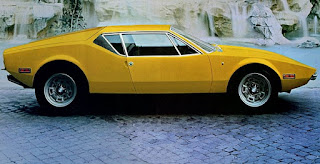
Early standard De Tomaso Pantera

Ford was closely involved, not only as the car’s engine supplier, but also, until 1975, with a distribution agreement which made the car available in the U.S. though the Lincoln Mercury dealer network.  This provided Ford with a ‘European’ style sports car ostensibly within its product range, serving not only as an incremental profit opportunity for its dealers, but also as a halo model to draw interest and prospective buyers to the Blue Oval brand.  And Ford, with its expertise in savvy marketing, was quick to introduce, in the GTS, a ‘premium’ version, enabling a boosted profit margin and additional performance-image charisma. 

The Pantera was not just eye candy.  Ford was enjoying the glow that its success in motor sport had generated through the late Sixties.  Four consecutive Le Mans victories, 1966-69 and the dominance in Formula One of the Ford-badged Cosworth DFV engine had done wonders for image building and marketing.  Dearborn management was keen to add to its new exotic GT’s customer appeal by ensuring that it was highly visible and achieved success on American race circuits.  As a first step, in early 1972, a Group 3-compliant version was made available.  As such, because it was a class allowing only very limited modifications, it was really just a mild upgrading of the GTS variant.  Most significant was an increase in engine power, from 330 bhp for the standard car, to 345 bhp, achieved with a higher compression ratio, better breathing and freer exhaust gas flow.  Also notable, were wider wheels, (Campagnolo alloys), 8 inch at the front, 10 inch rear.

Early Group 3 Pantera

The first batch of Group 3 Panteras were built between December 1971 and April 1972.  It is commonly given that 34 Group 3 Panteras were manufactured, but former De Tomaso director, Giorgio Montagnani, has been quoted as saying that the number was 36.  Further, he recalled that 6 of these were full ‘works’ racecars and 4 rally versions of a similar status.  The prototype, chassis #1070, was purchased in March 1972 by Auto Club Roma.  This car was raced extensively in Italy throughout the decade, by Auto Club and its subsequent owners, Ital Atlantic Express, and then Marco Curti.  Racingsportscars.com records a career of 7 years, with 19 events entered, and 3 class wins.  (This tally does not, however, include results for the initial two seasons.)


#1070 at Magione, 1974

The FIA class regulations of the time offered a greater potential for success in the Group 4 category.  This allowed for modifications to aspects of the car that constituted its weaker aspects: weight, suspension, steering and braking.  The standard engine was not such a feature, but still was the subject of upgrading, (mainly around gas flow optimisation), taking output up to around 450 bhp.  This increase in power, together with a reduction of weight by around 300kg, enabled good potential class competitiveness.  However, a set-back occurred when an unexpected revised regulation minimum weight was announced, this being some 150 kg above that achieved by development work including the use of aluminium in substitution for steel in major panels, fibreglass wing extensions, plastic ‘glass’ and stripped out interior.  A further issue arose during testing as engine reliability became a concern.  This would eventually be addressed by the adoption of lower compression values.  Various sources indicate that De Tomaso built 14 Group 4 Panteras.

At the La Sarthe event, a Claude Dubois-entered car, chassis #2860, crewed by Jean-Marie Jacquemin/Yves Deprez finished 16th, 2nd in class.  Three other Panteras were entered, two for Escuderia Montjuich, the other for Societé Franco-Brittanic, but they were all early retirements with blown cylinder head gaskets.


#2860 at Le Mans, 1972

The following month, Herbert Muller took his Pantera to a Group 4 win in the Euro GT series at Nivelles.  He followed this up in August with another victory in the Deutsche Automobil Rundstrecken Meisterschaft meeting at the Norisring.

#2859 at Nivelles, 1972

In 1973 reliability improved and in June works-entered #2873 won in Euro GT at Imola in the hands of Mike Parkes.  This was a particularly satisfying victory for De Tomaso, as Parkes had been hard at work in ’72 developing the Group 4 version of the Pantera.

#2873 at Imola, 1973

Two months later another ‘big name’ – Clay Regazzoni – took the same car to victory at the Hockenheim round.

#2873 at Hockenheim, 1973

That car certainly earned its keep that season – in October it was a winner once again, this time in the Giro d’Italia with Mario Casoni and Rafaelle Minganti at the wheel.

#2873 Giro d’Italia start, 1973

Casoni was apparently fully au-fait with the Pantera by late season, having achieved another first-place, this time in #2872, the previous month at Casale.  Other Pantera victories in 1973 included Croix-en-Ternois, by Patrick Metral, and at Varano, by Ugo Locatelli. 

1974 saw a substantial number of race entries for Panteras.  Odoardo Govoni scored 3 victories in the Spring at Magione and (twice) at Varano.  A repeat win in the Giro d’Italia was missed, but Govoni and Vincenzo Angelelli's was the best placed of 7 Panteras entered, finishing 3rd.  Four cars ran in the Targa Florio, that of Alex Pesenti-Rossi and Alvaro Valtellina being the highest finisher, in 13th.  At Le Mans, Wicky Racing Team intended to run two cars, but only that of Max Cohen-Olivar and Philippe Carron started, and was out early with timing gear failure.

Wicky Racing Team at Le Mans, 1974

Once again, in 1975, Panteras covered a great many racing miles, but no victories are on record.  Govoni was again a prominent exponent at the wheel, and he was the most successful driver, scoring 2nd places at both the September and November GT events at the Magione circuit.  Partnering Ruggero Parpinelli, he also finished 8th, (and 5th in class), at the Targa Florio.  Four cars ran at Le Mans, but only the early chassis, #2860, still run by Team Claude Dubois and now driven by Pierre Rubens and Paolo Bozzetto, made it to the finish, in 16th place, (8th in class), just as it had done in ’72.

#2873 at the Targa Florio, 1975
 

#2860 at Le Mans, 1975

No less than 10 Panteras were entered for the Giro d’Italia, with the Jolly Club car, driven by Bozzetto and Marco Martinenghi taking 5th place, (3rd in class). 

Highlights of the 1976 season were victories for Pierre Rubens (Team Willeme) at both Zolder and Colmar-Berg, four other podium positions in Europe, and three in Australia.  Although there was a greatly reduced participation at Le Mans and the Targa Florio, seven Panteras ran in the Giro d’Italia, with Govoni and Valentino Balboni finishing 6th.

#2873 Giro d’Italia, 1976

In the early stages of the 1977 season, Rene Tricot, (Team Willeme), took three victories in Belgium, while in November, Maurizio Micangeli and Carlo Pietromarchi scored a significant win in the Group 4/5 event at Vallelunga.  Four cars took part in the Giro d’Italia, Pietromarchi and Giancarlo Naddeo coming 3rd.

Carlo Pietromarchi/Giancarlo Naddeo, Giro d’Italia, 1977

For the remainder of the Seventies, Panteras continued to feature in numbers in national/European series racing, but results were mediocre, with just the occasional win/podium finish.  During the Eighties, participation fell to lower levels, with the cars being considerably less competitive.  This trend persisted in the Nineties, except that in 1995 Thorkild Thyrring was a major force for ADA Engineering in the British GT series, winning the GT1 class championship.

Thorkild Thyrring, British GT, Silverstone, 1995

Today – and in recent times – Panteras are to be seen competing with verve in Historic meetings.  Excellent video is available of the Group 4 example of Luigi Moreschi on the 2018 Vernasca Silver Flag event.  To enjoy the sight and sound of a Group 3 car running at Spa recently, have a look at this video.  A Group 4 Pantera, #2598, is currently offered for sale, having been competing with considerable success in Romania.

#2598, racing in Romania

You may have wondered why I opened this piece with an encomium to Marcello Gandini in relation to a car actually styled by rival, Tom Tjaarda.  Much as I admire Gandini’s work, I’m sorry to say that I think he despoiled Tjaarda’s masterpiece:  In 1989, Alejandro de Tomaso insisted that the job of facelifting the Pantera for 1990 be awarded to Gandini’s consultancy.  What resulted was the Si.

The main focus of the exercise was on the front end.  A ‘heavier,’ more curvy, character was conferred by redesigned/rescaled front wings and bumper.  The effect on the car’s overall form and stance was a loss of the pleasing balanced contrast between a svelte front and a burly centre/rear section.  To some eyes this may have resulted in a more consistent, cohesive design, but, as such, the Pantera’s body was no longer a physical analogy of its hybrid nature – Latin style and dynamic flair combined with American motive heft.


I have derived much information from the excellent www.racingsportscars.com.  This is an invaluable source of data for anyone researching motor sport history.  For the De Tomaso Pantera, refer here: https://www.racingsportscars.com/type/archive/De%20Tomaso/Pantera.html

Other essential resources are:

http://www.detomasoregistry.org/

http://panterainternational.org/detomaso_history/europes_pantera.html

https://detomasodc.co.uk/

https://australianmotorheritagefoundation.org/2021/08/28/the-making-of-the-de-tomaso-pantera-by-gautam-sen/