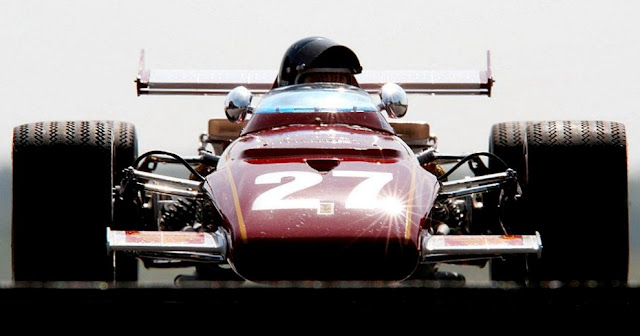
1970 saw the launch of several remarkable new Formula 1 cars. For technical innovation the Lotus 72 was attention grabbing. A great success in its own right, it proved to be highly influential in providing a new basic chassis architecture, one adopted by most F1 designers over several subsequent seasons. The March 701 was quite the opposite – a hastily conceived and constructed machine, characterised by conventional technologies, but astonishing in its production history, with no less than five examples on the grid for the first race, just 3 months after its design had been initiated. Ironically, it was the deficiencies of the 701, attributable largely to the very short design/initial development period, which gave rise to the third notable car, the Tyrrell 001. Commissioned by Ken Tyrrell to replace the March he had bought for Jackie Stewart’s World Championship defence, it was itself created rapidly (and secretly) in mid-season. A good blend of the well-proven, with some innovation, it was the basis of Stewart’s further two World Championships, in ’71 and '72.
The World Championship had been an achievement for BRM in ’62, but since then there had been missteps such as the H16 engine and nothing much, (just eight), in the way of race victories. By the end of the decade the team had a new V12 engine, but it needed the arrival of Tony Southgate in ’69 for a worthy chassis to be designed. His P153 fulfilled the role and enabled a return to front-running competitiveness. Ferrari too had endured a lean decade, just 12 Grands Prix won, only 2 Driver’s Championships – Phil Hill in ’61 and Surtees in ’64. After the formula revision in ’66, Ferrari had deployed a 60° 3.0 V12, which yielded only 3 victories. Following the Scuderia’s refinancing enabled by the FIAT deal, a new 12 cylinder was developed for the ’70 season. This time Ferrari’s Race Department Technical Director, Mauro Forghieri, opted for a 180° (flat) V12, a layout he believed would offer two distinct advantages in comparison with the then dominant Ford Cosworth DFV: 1) a lower centre of gravity, for enhanced handling characteristics, and, 2) a lower physical profile, allowing greater/’cleaner’ air flow to the rear wing, for enhanced aerodynamic properties. And though the engine was the subject of great interest and admiration in its own right, Forghieri also took great pains to create an elegant and functionally effective chassis/body to carry it – the 312B.
Ironically,
the 312B was as good as it was thanks to the mediocre nature of its V12 predecessor. Efforts to improve the engine’s power output
for the ’69 season actually resulted in a car that was not as quick as it had
been in ’68. Ferrari’s reaction was to
reassign Forghieri from his ‘normal’ duties with the race team and devote his
full attention to the design of a new engine and car. This was undertaken at a new purpose-created facility
in Modena, freeing Forghieri from distractions that would have proliferated had
he been in/around the Maranello factory.
Supporting him were Giancarlo Bussi, engines specialist and Franco
Rocchi, chassis expert – a leadership team that had worked together effectively
since ’62.
However
much the rest of us had enjoyed the sixties, Enzo Ferrari had spent the decade mainly
fuming rather than swinging. He had endured
disrespect from the Ford Motor Company, firstly in the eventually failed negotiations
for its acquisition of his company, then followed by four years of humiliation
on track, ’66-69, at Le Mans when the Blue Oval’s coarse but effective GT40s outgunned
his elegant, thoroughbred 330 P3s, 330 P4s and 312P Prototypes. The lack of Formula 1 victories already
mentioned was all the more embarrassing given that it had been a winning decade
for the (mainly British) constructors Ferrari himself so despised. Their success was still increasing, all the
more so from ’67 when the loathsome ‘garagisti’ acquired access to the
‘off-the-shelf’ Cosworth DFV V8 engine, which, just to add insult to injury,
wore Ford badges on its cam covers. But,
while Ferrari was seething as he viewed all this, Forghieri was closely
studying Costin and Duckworth’s handiwork and analysing its several very positive
features. He then made it his business
to incorporate these into his own new design, intent on ensuring that however
good the V8 was, his Flat 12 would be better.


One
characteristic of the DFV that Forghieri did not attempt to replicate was its
casing stiffness which allowed it to be load bearing. A major benefit of this was that it enabled a
weight/strength-efficient chassis architecture whereby the engine could be
simply bolted to the rear face of the monocoque tub without the need for any support
structure such as a subframe. Additionally,
the engine block in combination with the commonly-used Hewland DG300
transmission’s case, provided a robust/stable entity onto which the rear
suspension components could be directly mounted. In the 312B, however, an engine of
significantly greater length than the DFV gave rise to the need for a means of
chassis-integrated support. This
requirement in turn gave rise to a feature of the Ferrari which was not only
functionally efficient but also a prominent element of its distinctive aesthetic
character – the beam extending rearward from behind the cockpit. The engine was attached to the beam’s
underside and was further carried by a subframe which also supported the
transmission and rear suspension. The
engine installation configuration was not exclusively dictated by the rigidity
characteristics of the crankcase. Against
the recent/current contemporary trend, Forghieri did not opt for a monocoque
chassis – that of the 312B was a sort of halfway house, being in the main a
spaceframe with attached (riveted) aluminium sheet panels providing both a 3D form
and strengthening of the multitube frame.
While
Colin Chapman and Maurice Philippe were finalising the side radiator cooling
system on the Lotus 72, which along several other aspects would revolutionise the
early-1970s Formula 1 car paradigm, Forghieri chose to retain a conventional,
nose-mounted location for the 312B. But,
just behind its radiator, the front suspension featured inboard
springs/dampers, an arrangement shared only with the new Lotus, the Brabham
BT33 and Surtees TS7 of the season’s new cars.
The bodywork in this area was both functionally efficient and
aesthetically very pleasing – flattened and subtly down-sloping nose/wide
radiator intake, white coloured front winglets, central NACA duct opening,
raised lip/cut outs for the inner ends of the rocker arms, radiator duct outlet
sculpting and small flared cowlings for the rear mountings of the top wishbones. And, possibly the most ‘characterful’ element
of the frontal bodywork was to be seen behind these details: the overlaid
curvaceous cockpit surround with blue-tinted, bubble-form Perspex screen.
Behind the cockpit, the low
placed cam covers and mesh-protected inlet trumpets, together with the white
exhaust headers, gave the rear of the car a terrific, purposeful ‘look.’ Above, the twin plane rear wing was both
unusual and aesthetically pleasing. A
central vane located the forward aerofoil surfaces to the rollover bar. Thus the wing appeared two-piece, the vane bisecting
it longitudinally. The vane and end
plates were finished in red, while the flat wing surfaces were in white. This colour scheme was continued, providing
excellent visual integration, by the white coloured twin air intake boxes located
under the rear of the wing. These were
specified to deliver cooling air to the oil radiators mounted at the extreme
rear of the car.

The
new car was ready to begin testing behind closed doors by the summer. The task was largely down to Chris Amon,
Ferrari’s lead driver since ’67. In the
two and a half years since, he had, especially in ’68, won numerous poles and
led races, only to encounter problems enforcing retirement. Fearful that his career was at a peak, yet
with no victories to his name and now with a growing ‘unlucky’ tag being
attributed to him, Amon was racked with doubt that another season with the
Scuderia would do justice to his obvious talent and skill. But his initial reaction to the 312B’s
performance and handling was very positive, so his optimism must have grown . .
. only for it soon to be extinguished.
As mileage accrued, problems snowballed, especially – and crucially –
with the engine. It became apparent that
there was an underlying bottom end lubrication issue. As major failures of pistons and the
crankshaft occurred repetitively, a consensus arose that ill-controlled oil
surge was to blame. Also of concern was the
robustness of the crankshaft, particularly in regard to torsion stress. Given that the crankshaft was running in just
the four main bearings, there was focus too on the pair either side of the
centre as these were of the plain type - thus the precise grade of the bronze
used was critical. But, whatever the
cause, Amon was spooked, and after yet another truncated session and failed
engine, walked away. That he was too
hasty is evident when the statistics for the 1970 season are reviewed. From 24 race starts there were just three
engine-related retirements. Furthermore,
none of these was a structural/main reciprocating parts failure – Ickx’s car was
affected by external damage to the sump in South Africa; in France it was a
valve damaged by an ingested stone and in Italy Giunti failed to finish because
of a defective fuel metering unit.
Ferrari
acted swiftly to replace Amon, re-employing Jacky Ickx, who had left the
Scuderia for the Brabham team after the ’68 season. On first acquaintance with the 312 in October
’69, he was favourably impressed, especially pleased with the engine’s
drivability and the amount of torque it was generating. However, as the final stages of pre-debut
development progressed, an ongoing area of focus was on oil consumption. Eventually it was considered prudent to
incorporate a ‘reserve’ oil tank located on the transmission and able to be
‘opened’ for discharge into the main tank by a driver-operated hand control.
Initially,
the Scuderia kept things simple, entering a single car for Ickx at the first four
Grands Prix. The opening round was on
March 7th at the Kyalami circuit in South Africa. In practice the 312 immediately showed encouraging
competitiveness against the front runners – the March 701, Brabham BT33 and the
Lotus 49, all of which were Cosworth DFV-engined. It was quicker than the also Ford-powered
McLarens and the V12 Matras and BRMs.
Ickx qualified 5th, 7 tenths down on the pole-winning March
of Jackie Stewart and just a tenth slower than Jochen Rindt’s Lotus. There were though several engine issues for
the Ferrari mechanics to attend to, limiting the mount of track time Ickx was
able to enjoy. He was nevertheless able
to make an excellent start to the race, moving up to second behind Stewart on
the opening lap. By the sixth lap he was
passed by eventual winner, Brabham, but remained at the front of the following
pack until he had to cede position to the McLarens on laps 16 and 17. Nearly 40 laps later, the 312 was in
collision with Jo Siffert’s March and the flat 12 sustained damage to its sump
with resulting oil loss dictating the car’s retirement. With the strong qualifying performance
despite problems, the initial running in second place and given that Ickx’s
best lap was the 8th fastest, it was an encouraging debut.
There
was a 6 weeks gap between the Kyalami race and Round 2 of the championship,
held at the bland circuit at Jarama in Spain. The non-championship Race of Champions event
had taken place at Brands Hatch in late March, but Ferrari had chosen not to
enter, focusing attention on problem solving/development, including further
track testing at the Autodromo di Modena.
The most significant feature of the Jarama weekend was the first race
event appearance of the unconventional Lotus 72. In the early stages of practice Rindt
experienced some ominous troubles with the 72, while Ickx spent more idle time than
he’d have liked while attempts were made to better assure consistent
lubrication in the flat 12 engine.
Modifications included revised oil tanks and piston rings. A further diversion for Ickx was the request
that he run some laps on Michelin tyres to compare their qualities with the
Firestones specified for the 312. Maybe
because of such distractions, Ickx qualified down in 7th, only the
third of the six 12 cylinders cars present.
But his start was very good, gaining places to be running 5th
as the order settled on lap 1, only to be rammed by Jackie Oliver’s BRM P153,
out of control thanks to a broken stub axle.
The Ferrari’s tanks took the full force of the impact and there was an
immediate fuel spillage, in turn causing a fire engulfing both cars. While both drivers were able to get out of
their cars unaided, Ickx ran into the BRM, falling onto the fuel soaked tarmac. Things appeared very serious when Ickx’s
overalls were seen to be ablaze. Happily
– as was not always the case in the era -competent help and functional fire-fighting
equipment was quickly on hand and the Belgian was saved from really serious
burns. The intensity of the fire – and
its race-long duration, pulled off to the outside of track – was such that the
312 #002, was totally destroyed.
At Monaco
Ickx qualified 5th, quickest of the 12 cylinder cars entered, but
1.5 seconds off Stewart’s pole-winning pace.
Though he moved up to 4th as the race got underway, his 312
was an early retirement, with a broken driveshaft UJ after only 11 laps.
Next
up was Ickx’s ‘home’ race at Spa.
With the 312 by now a ’known quantity,’ Ferrari finally bowed to
political pressure that had been building to have an Italian at the wheel,
entering a second car for Ignazio Giunti.
On the demanding Francorchamps circuit, Ickx put in an excellent
qualifying performance, recording the 4th fastest time, again the
leading 12 cylinder. Giunti, making his
F1 debut, was within 2 seconds of Ickx’s time, good enough for 8th
on the grid. In the race, Ickx
maintained 4th place for almost 80% of the race distance, only to
have to make an unscheduled pit stop because of a cockpit fuel leak, rejoining
with enough time lost to relegate him to 8th place at the finish. In contrast, Giunti consolidated his
excellent qualifying effort by completing the race in 4th place,
earning the Scuderia its first World Championship points of the season.
A
fortnight later, there were again two 312s for the next Grand Prix, at Zandvoort. But this time the second chassis was for
Clay Regazzoni. This was to be Regga’s
Formula 1 debut – and not before time, as he was already 30 and had been a
front line presence in Formula 2 in ’68 and ‘69, driving mainly for Tecno, but
also for Ferrari; he continued with Tecno in the category in ’70, winning the
European Championship by a clear margin from Derek Bell and Emerson Fittipaldi.
Forghieri
had been continuing to seek more power/greater reliability and new pistons were
being tried. But both cars gave several engine problems during practice – notably
overheating, fuel system anomalies and exhaust fractures. Despite this, Ickx managed to qualify his car
3rd, with Regazzoni 6th.
Good, but salutary, not just for the Scuderia, but also for the other
leading teams, they were .5 second and 1 second off Rindt’s pole time,
reflecting the coming-right of Lotus’s daring 72 design. Nevertheless, Ickx’s start was exemplary and
he got the jump on both Rindt and Stewart, leading the Grand Prix until lap 2
when Rindt reasserted the superiority of the 72, moving up to first place by an
outside pass at Tarzan. Though Rindt
simply cleared off, Ickx comfortably held Stewart behind in 3rd. This seemed set to continue for the rest of
the race, but Ickx’s 312 suffered a rear puncture not long after half distance. Though this enforced a pit stop and delay, he
was able to recover to 3rd by the end, one place in front of
teammate, Regazzoni.

Giunti
was back in the second car for the French Grand Prix at Clermont-Ferrand,
5th July. The circuit didn’t
suit several of the drivers – the numerous gradients/corners induced a number of
motion sickness cases, and loose stones flying up from the tarmac were a source
of personal-safety concern – the latter validated in practice by a facial
injury sustained by Rindt; (and indeed this hazard was again encountered at the
circuit two years later when Helmut Marko lost an eye in similar
circumstances). Ickx however, was
apparently not intimidated, securing pole position with a lap half a second
quicker than Beltoise managed in the Matra MS120. Giunti was 11th. With every hope of a maiden win for the 312, Ickx
must have been especially disappointed to be forced to retire before
half-distance (after just 16 laps) – his engine developing a misfire following
ingestion of yet another wayward stone.
The victory had up to that point looked very probable as Ickx had been
able with relative ease to hold Beltoise off and the two of them were well
clear of the following runners. With
Beltoise also in engine trouble later in the race, the win went to Rindt, his
second in succession, and now on a run which would result in his World Championship-clinching points total.
Giunti had performed well considering his lack of F1 experience and
unfamiliarity with the track, but his engine too faltered. Thus he was three laps down at the finish,
the last car classified, in 14th place.
The 312s were again fully
competitive at Brands Hatch, for round 7 of the championship. Ickx qualified his in 3rd place, (just
three tenths down on Rindt and Brabham’s times), with Regazzoni in 6th. This reflected the good level of power being
generated by the engine, but there was concern about reliability, focused once
again on the lubrication system. There
was a definite question mark over oil surge and the tank baffles had been
revised as a cautionary measure. Nonetheless,
Ickx was not holding back at the start and assumed the lead as the cars accelerated
out of Paddock Hill Bend and approached Druids.
In the early laps he was able to gradually extend his lead, but on lap 7
he encountered a gear selection problem, his progress stumbling, and was passed
by both Brabham and Rindt, then stopping altogether, the race’s first
retirement. Regazzoni fared much better. He ran strongly throughout, enough to
displace Hulme in 3rd in the closing stages, but only for the
McLaren man to reclaim the place, though Regga was just a half second behind at
the flag. So, very nearly a podium place
in just his second Grand Prix, adding to the expectation that the second seat
would sooner or later become his rather than Giunti’s.
With
Rindt’s charge towards World Championship victory now looking irresistible,
Scuderia Ferrari staked its claim as ‘best of the rest’ at Hockenheim
for the German Grand Prix. Ickx even
managed to beat Rindt to pole position in qualifying and Regazzoni claimed 3rd,
just one tenth ‘slower’ than the Austrian champion apparent. These grid positions were especially
gratifying for the team as the 312s had been problematic – both engine and
transmission issues – in recent testing at the circuit. In the race, the Ferraris proved to be the
only cars able to get anywhere near Rindt’s pace. Indeed Regazzoni was able around half
distance to briefly take the lead, while Ickx enjoyed six spells at the front. However, Rindt probably always had something
in hand and took the win, even if only with a margin of less than 1
second. Regazzoni lost a
virtually-certain 3rd place when forced to retire with engine
failure after 30 laps.
With
four consecutive race victories now under his belt, Rindt must have felt
confident that he would see a further triumph at his home Grand Prix at the Österreichring. That this would be the outcome seemed
confirmed when qualifying saw Rindt seize the pole, half a second quicker than
Regazzoni, with Ickx third. With the
Scuderia now confident in both the performance potential and reliability of the
312, a third car was entered for Giunti, who got within half a second of Ickx,
sufficient for 5th place on the grid. As the opening lap unfolded, the cheering in
Maranello must have been audible in Spielberg because the order was Regazzoni,
Ickx, Rindt, Giunti. Regga soon deferred
to his team leader, allowing Ickx into a lead he would preserve to the race’s
conclusion. After an early set-back,
Rindt speeded up and starting making progress at a rate that suggested he might
be able to catch the 312s in 1st and 2nd, but with 20
laps completed, his DFV failed, forcing his retirement from what would be,
tragically, his last Grand Prix. The
only car able to stay at all on terms was the Matra MS120 of Beltoise and for a
while it looked possible that Giunti would be displacing it, enabling a 1-2-3
result for the Scuderia. However, damage
to a tyre and the consequent pit stop put paid top this, leaving Giunti to come
home in 7th. Though the first
win of the season for a Ferrari, it was a comprehensive one and Ickx and
Regazzoni were clearly class of the field.

With
the next Grand Prix at Monza, it was not surprising that once again
three Ferraris were entered. With that circumstance
and the previous race result inspiring the Tifosi, the milieu for Friday
practice was noisy and expectant. The
speed of the 312s was emphasised by their competitive performance in ‘normal,’
winged trim while others followed the usual practice for the circuit by removing
downforce aids in search of lower drag on the long, high speed straights. Ickx was fastest, with Regazzoni 3rd
and Giunti 4th. Saturday
proved to be one of the dark days of motor sport – Rindt’s accident on entry to
the Parabolica proving fatal because of three factors: apparent failure of left
hand front inboard brake shaft; inadequate anchoring of the Armco barrier
support post; incomplete securement of Rindt’s safety harness. Naturally the febrile atmosphere rapidly
collapsed and there was no gusto during the late stages of the practice
session, though it did conclude with Ickx on pole, Regazzoni 3rd and
Giunti 5th. Surprisingly, in
the race Stewart and Rodriguez moved up to 1st and 2nd, and
the 312s ran 3-4-5 for a while.
Regazzoni took up the challenge, running in close company with the
Tyrrell and the BRM, assuming the lead intermittently. Though Ickx eventually moved up to run in the
leading group, his race was over when his 312 suffered clutch failure before
half distance. But Regazonni kept at it,
battling in particular with Stewart, Beltoise and Hulme for the lead. Then, with the finish approaching, he
asserted the superiority of his car – which he had perhaps been concealing –
and pulled clear to take the first of his five Grand Prix victories.

For
the Canadian Grand Prix at Mont Tremblant the Scuderia reverted to a two car entry,
for Ickx and Regazzoni. The event was notable
as being the venue for the first championship race appearance of the Tyrrell
001 for Jackie Stewart, replacing the March 701 he had driven since the start
of the season. Its potential, already
suggested by a debut run at the Gold Cup race at Oulton Park where it had
recorded fastest lap, was confirmed by Stewart’s pole position, although his
time was just one tenth faster than Ickx in second place; Regazzoni was
third. Stewart and his new car asserted
themselves as the race started. Ickx
,maintained his grid position, but was outpaced by the Tyrrell, while Regazzoni
was further back after a poor start. By
around quarter distance Regazzoni had battled back up to third. Stewart’s apparently certain win prospect was
negated at one third race distance when the Tyrrell stopped with a failed stub
axle. This left Ickx and Regga 1-2, positions
they were able to keep through to the chequered flag.
At
this point, intriguingly, against Rindt’s 45, Ickx had scored 28 points –
should he win both the remaining two races, the Belgian would have 46, just
enough to deprive the mourned Austrian of the title.
It
remains fascinating to ponder on how Ickx felt about the situation – basic
human sentiment would surely have tended to rein-in his eagerness to dominate
the upcoming Grands Prix, but his natural competitive spirit would no doubt
have had him keen to respond to the tempting prospect of his first World
Championship.
Watkins
Glen was the venue for the U.S
Grand Prix in early October. Ickx
managed a potential pole time on Friday, but there was expectation that the
Stewart/Tyrrell 001 combination would better that the following day. However, cold/wet weather intervened, leaving
the lead 312 at the head of the grid, with Regazzoni no further forward than
sixth. This was disappointing enough,
without also his suffering of a troubled race – his 312 required three pits
stops, for a tyre, then ignition faults and, finally, for attention to the
exhaust system. This was all enough for
Regga to lose seven laps, resulting in a miserable 13th place
finish. Ickx fared better, finishing 4th. Halfway through he had been second only to
Stewart, but on the 57th lap he had to pit for attention to a fuel
leak, losing eight places. Back on track
he put in a spirited drive in almost making it to the podium, but the chance of
a title triumph had gone. Of the
enforced pit stop/delay, Nigel Roebuck reported Ickx as saying: "That was
a huge release. I didn't want to be champion, beating a man who . . . wasn't
there anymore. Where would have been the
glory in that? Jochen deserved the
championship - if God exists, he made the right decision.”
So
the pressure was off as the season concluded with the Mexican Grand Prix at Mexico
City. Regazzoni just managed to keep
Stewart from pole position – Regga’s time being two one hundred’s of a second
quicker! Ickx was third. The race was chaotic because of the circuit’s
lack of spectator containment/protection features. This circumstance coupled with the high
degree of enthusiasm and excitement on the part of the racegoers allowed for
them to encroach right to the very edge of the track, placing themselves in
considerable danger and causing the drivers anxiety that they might be involved
in what could have been a major disaster.
As it was, a crowd-endangering incident did not occur during the Grand
Prix, though the precarious nature of the event was brought home to Jackie
Stewart. With his still relatively new
Tyrrell allowing him to be the most serious challenger to the potential
superiority the Ferraris had demonstrated in practice and qualifying, Stewart
had the disappointment of an early enforced pit stop for attention to the car’s
steering column. Re-emerging close
behind Ickx and Regazzoni though a lap down, he was able to match their pace. Indeed, he unlapped himself from Regga and
was closing on Ickx when he encountered a dog on the track – the consequent
canine collision damaged the Tyrrell enough to necessitate its retirement. Thus Ickx and Regazzoni ran on to an
apparently untroubled 1-2, finishing the season on a high and with every
prospect of a win-replete 1971 given the fundamental qualities of the 312 and the
reliability it had acquired over the 13 Grands Prix it had by then completed.
1970
Scuderia Ferrari SpA SEFAC Formula 1 World Championship – summary of results
with the Ferrari312B, drivers Jacky Ickx, Clay Regazzoni and Ignazio Giunti:
International Cup for F1 Manufacturers: 55
points, (52 with best 11 rule applied). 2nd place in the
Championship, (won by Lotus with 59 points).
World Championship of Drivers: Jacky Ickx, 40
points, 2nd place; Clay Regazzoni, 33 points, 3rd place;
Ignazio Giunti, 3 points, 17th place.
Starts: 24; Wins :4; Podiums: 9;
Poles: 4; DNFs: 7


