Showing posts with label Moretti. Show all posts

Thursday, May 8, 2025

The Fiat 850 Coupe's Glamorous Cousin

As said in the Do Look Back post, ‘Small but Perfectly Formed,’ with the advent of the 1960s, Moretti transitioned from an automotive manufacturer to an ‘enhancer,’ upgrading Fiat mainstream products with, mostly, aesthetic improvements – though some mechanical upgrades were also available at customer request.  Given Moretti’s previous affinity with the sports car sector – the 750 Gran Sport being obvious testament to this – it’s not surprising that the marque took a keen interest in the Fiat 850 Coupe at its ’65 launch.  With a powertrain specification different from the saloon model, the Coupe’s engine, running on a Weber 24/32 or 28/36, delivered 47 bhp with 59 Nm torque, enabling it to be ‘sporting’ enough for the era on a kerb weight of 725 Kg.  For anyone wanting more urge, the factory would arrange tuning by Giannini, resulting in an additional 50% bhp.  And the ‘look’ was good too, with in-house styling led by the father and son Boanos.  So, it was felt that a profitable niche market sector opportunity existed for a Moretti-bodied/badged version for customers valuing a measure of exclusivity.  The resulting car was styled by Dany Brawand who had become familiar at the Grugliasco factory while working for Micholetti (and moonlighting) prior to joining the Moretti business on an official basis in late ’65.  The Tipo 100G, named ‘Sportiva,’ was unveiled at the Turin Show in early November ’65.  It is therefore likely that Brawand was working on the design much earlier in the year as a personal job while still employed by Michelotti – it was Michelotti’s discovery of such moonlighting that prompted him to fire Brawand.

Production and sales of the ‘Sportiva,’ model S, began in ‘66, with pricing ‘from’ 1,095,000 lire (about) £635.  A ‘SS’ model with 50 bhp and 62 Nm torque was also offered, this being priced at 1,350,000 lire.  Two cars with ’66 attribution are present on the Moretti Registry - #0524208 and #0636135.  A photograph of that second car, seen below, shows that head on, there was a hint of Corvette about the early Sportiva front end:

#0636135 Courtesy Moretti Registry

Whilst much has been written about the generally pleasing aesthetics, including favourable comparison with the Fiat Dino, the front panel/nose profile/headlighting has been the subject of some criticism.  One objection is to the bluff front panel, unrelieved by any aperture/grille, not functionally necessary of course with the rear engine location.  Also apparently disappointing to some eyes is the modest headlighting – it being suggested that a ‘sporting’ character would have been better indicated by a four lamp array, and that this too would have helped counteract the bland vertical plane of the front panel.  Moving to a 3/4 or side view, adverse comment has been made about how the leading edges of the front wings interact with the front panel, with the charge that there is no harmonious flow in how these components come together.  The disjointed  character is emphasised by an abrupt change of plane in the front wings above the leading edge of the front tyres, (circled in the photograph below).

#0677840 Courtesy Vintagesarasota (BaT)


This infelicitous aspect of the car was resolved by the ’68 facelift which created the ‘S2’ model, as seen in the example below:

#1445000 Courtesy Moretti Registry


Although some critics have suggested that the rear of the Sportiva S is plainer than the curvaceous front might lead you to expect, the various elements seem to me well matched and blended.  The engine deck lid is the main component, the upper surface of which is well relieved by the five groups of (10 each) cooling intake slots.

#100G-1084286 Courtesy Moretti Registry

The full width, wraparound rear bumper and circular tail lamps (standard Fiat items) are unfussily styled and work well with the rear panel and wings.  Two distinctive points to notice – the additional length of the side elements of the bumper, required by the Sportiva’s greater measure of overhang, and the central, twin hemispherically-capped licence plate lamp bulb arrangement, (Fiat versions using a single, lozenge-form element).

Courtesy Moretti Registry; Car and Classic


The Sportiva was badged, 1) Script ‘FIAT MORETTI’, chrome with black or deep red ground, mounted centrally on front panel, (with chrome ‘whiskers’ running either side to the headlamp apertures); 2) ‘MORETTI,’ chrome, red and white castellated shield crest over rectangular ‘MORETTI TORINO’ script with chequer pattern, mounted on the front wings between the trailing edge of the wheel arch and the leading edge of the door aperture; 3) ‘MORETTI’ and ‘FIAT 850’ or ‘850 Special’ chrome script badges on the rear panel.

Courtesy Rajveteranu.cz; Kristoj (BaT); OldMotors.net

For the SS model, a signifying chrome script badge was added, usually between the ‘FIAT 850’ script and the right hand rear tail lamp.  See below; #0524208, for example.

Courtesy Moretti Registry

Inside the Sportiva, a Moretti crest was usually to be seen on the gear knob, horn button and dashboard, (central, above the centre console). – see below:

Courtesy Kristoi (BaT)

Nardi steering wheels were a popular choice for Sportivas – both black and wood rimmed, some signed on the right hand spoke, and some with a Nardi badged horn button.  An alternative was the Ferrero two spoke model.

Courtesy Wikiwand; ClassicVirus.com

Standard road wheel rims were 12” (145 width tyres) either Borrani wires or Cromodora alloys.

Courtesy Car and Classic; Kristoi (BaT)

For ’68, an additional version became available.  At 1,500,000 lire, the ‘1000 Sport Coupe’ offered an appreciable enhancement of performance capability thanks to the additional capacity (139 cc), a Solex 34 PBIC carburettor, (in place of the Weber), and increase in the compression ratio from 9.2:1 to 9.5:1.  The result was 62 bhp, enough to reduce the 0-60 mph time by 3.4 seconds.  At the same time, the base model was re-designated ‘S2’ and upgraded with a substantial styling facelift to the front end bodywork and lighting, as illustrated above by #1445000.  At the car’s rear, a more subtle revision was that to the engine decklid with four groups of cooling intake slots as opposed to the five on the original design.  An ‘S2’ badge was added to the rear quarter panels.

S2 Courtesy Kristoi (BaT)
 
One of the fundamental compromises for the Sportiva was the lack of any +2 seating.  Where, on other such cars, there might have been some semblance of seats that might accommodate small children, the Sportiva had just a luggage storage area between the engine compartment and the seat backs.  This was largely due to the lack of boot space ahead of the cabin, this being taken up by the spare wheel which could only be mounted horizontally in what was a shallow void.  Moretti sought to address this limitation of the Sportiva’s appeal by creating a four seat version, named S4 and first-shown at the ’69 Turin Show.

Sportiva S4 as shown in a Moretti range leaflet

The S4 sold to those liking the basic concept of the Sportiva whilst wanting more interior room, but its looks must have been a significant deterrent to a broader appeal.  Although the model was launched after the S2, it had not adopted the latter’s more aesthetically successful front end.  Also less pleasing was a top heavy impression given by a disproportionately ‘tall’ glasshouse coupled with seemingly too-small wheels.  The rear quarter panels too appear ‘odd,’ as does the shape of the rear side glass.  Notable is the use of an S2 type engine deck lid and six elements tail lamps. 

Two examples of the S4 appear on the Moretti Registry, #1266944, below, and #1282958, lower below, both ’70:


In regard to both the S and S2 variants, ‘Special’ was added to the nomenclature, (and indicated by a rear panel-mounted badge), in some instances, but clear documentation of what specification upgrades gave rise to this designation is not available.
 
A convertible version of the Sportiva was marketed in 850 form initially, subsequently as an SS and finally in 1000 guise.  Very small numbers were made and there are no examples on the Moretti Registry.  I have also been unable to find details of a convertible Sportiva being sold in recent times.
 
Even at the beginning of the Sportiva’s production run, Moretti had turned its attention for future model lines to the new Fiat products – ultimately with a revised drivetrain format - which would emerge in the second half of the Sixties.  Initially, this saw Brawand drawing a coupe body for the Fiat 124 chassis and this resulted in both 5 seat and 2+2 versions introduced in ’66.  Within short order, the larger Fiat 125 was used as a basis for another new Moretti, titled GS 1.6.  Then, in ’69, Moretti presented its coupe version of the 128, especially significant in view of its front wheel drive layout, breaking with the rear engine configuration with which it had worked for so long.  The phase in which the company had created a coupe on the Fiat 850 saw justified respect for its product, with the Sportiva widely admired – especially in its S2 form – for its looks and general character.  It is usually given that Moretti built about 300 Sportivas and that 52 of those were of the S2 type.  Final sales occurred in ’71.

Saturday, February 15, 2025

Small but Perfectly Formed

Giovanni Moretti established his motorcycle manufacturing business in 1925 in Fabbrichetta, an area in the Grugliasco district, just to the west of Turin’s city centre. Though it was not long before he began to experiment with vehicles which would today be termed ‘microcars,’ the first Moretti recognisable as a conventional ‘car,’ the Cita, did not appear until ’46. Subsequently, an unusually wide and diverse range of models emerged. With the following decade came a model line utilising Moretti’s own 4 cylinder 747 cc engine, a development of the Cita’s 350 cc twin cylinder and ‘600’s’ 592 cc 4 cylinder power units . Although mainly known for his work for Alfa Romeo and Maserati, Ing. Alberto Massimino is thought to have been responsible for the design of this engine. Development soon resulted in a twin cam version, subsequently enhanced with additional main bearings, (5 in total), allowing a high rpm capability, opening up Moretti’s sport and racing ambitions, power output being a competitive 55-60 bhp, (twice that made by the original, single cam version. In competition barchetta applications, this engine was capable of over 70 bhp).

750 Moretti Twin Cam engine. Courtesy VeloceToday

Thinking about Moretti also brings to mind Tecno and its racing cars. Mostly the Etceterini were in effect modifiers of Fiat vehicles and parts. Both Moretti and Tecno were intent on designing/making everything for their products including the engines – and Tecno didn’t hesitate even when it came to the ‘need’ for something as complex and challenging as a Flat 12.

The ‘750’ would be utilised to power twelve Moretti models from ’52 through to ’60 by which time the basis of new products and ongoing production was switched to Fiat models in a methodology similar to that adopted by Abarth after its split with Simca.  By far the most charismatic Moretti of the Fifties was the Gran Sport Berlinetta.  A range of introduction dates have been suggested, but it is probably accurate to say that the model was made only in the years ’53 and ’54.  In considering this model, it is useful to also refer to the barchetta ‘Sport,’ of similar configuration.  Only three of these were initially constructed, (with a further two in ’56 for Le Mans).  In comparison, the coupe’s built-count is heady at around twenty!  Testifying to the esteem in which the model is held, no less than twelve survivors are currently catalogued in the Moretti Registry, (https://moretti-registry.com/ ).

The bodywork, styled by Giovanni Michelotti, sits on a spaceframe chassis - not a backbone type as misreported elsewhere – constructed with square section tubing.  The body itself has been said to have been made at Motto, but I have not seen any certain confirmation of this, and the Carrozzeria’s badges are not evident on the cars.  The possible confusion may result from a misunderstanding of the two similar company names.  A proportion of Motto’s work was as a subcontractor, including commissions from Vignale, the carrozzeria with which Michelotti was associated from 1949 onwards.  Additionally, around the same date, Moretti created another coupe model, differentiated by being powered by a ‘1200’ (1204 cc) version of the twin cam engine.  This model’s body is generally accepted as having been Motto-built.
 
750 Gran Sport chassis frame. Courtesy Karl Ludvigsen

A wide range of values has been quoted for the kerb weight of the Gran Sport, all the way from 655 Kg down to 495 Kg. The latter figure is credible given the car’s size and the usually-given 0-60 mph time of around 11 seconds, (for the 57 bhp output version engine).  For comparison, early versions of the Abarth 750 GT Zagato weighed a touch under 600 Kg and deployed about 47 bhp maximum power from the engine, enabling a 0-60 mph capability of around 17 seconds. 

The earliest-produced car for which I have images is #1037.  This is the single recorded Gran Sport with a Zagato body.  The basic outline of the car is similar to the Michelotti design as seen in the illustration below:

Left: #1037, Gran Sport Zagato; right: Gran Sport #1293

Notable variations as seen in these photographs: nose profile/intake aperture; bonnet panel; wheel openings; roofline; rear side windows/C post; rear wings.  (Note – the grille in the front aperture of #1293 is customised in egg-crate style – a horizontal slatted style is standard). 

Some previous citations about this car attribute a single cam engine, unlikely in my view with its apparent competition history.  Source Picryl comments on a photograph of the car starting the ‘54 Mille Miglia, “The Moretti Registry thinks this was the only one, and that it was more recently owned by Stuart Schaller in the USA before sold to Japan (seen in white/red at a Concours d'Elegance in Tokyo with license plate "S85264 ROMA". They also claim that Elio Zagato raced it early 1954.“  I have tried to verify the latter claim, but without success.

#1037. Courtesy Carrozzieri-Italiani; Angelo Giambra II

#1037 on ’54 Mille Miglia. Courtesy Cliff Reuter


#1290 is a very well known Gran Sport on both sides of the Atlantic.  On the East Coast of America, Max Hoffman established not only a business, but also an interest-culture in European cars immediately after WWII.  As his portfolio of agreements grew with various manufacturers -notably Jaguar, Volkswagen, Porsche, Alfa Romeo, Mercedes Benz and BMW – his business became highly profitable given the great volume of cars distributed and retailed from the New York base.  On the other coast, a garage proprietor/racer, Ernie McAfee shared Hoffman’s interest in Europe’s more sporting automotive products, though the scale of his vision was nothing like as heady.  With a particular expertise in customisation and liking for high performance – for example taking William Doheny’s Ferrari 121 4.4 LM Spider to a series of victories in ‘55/’56 – McAfee began to explore opportunities to import lesser known Italian cars with competition potential, notably OSCA, Siata and Moretti.
 
'56 McAfee advertisement. Courtesy HobbyDB

The performance in competition of the Moretti 750 Barchetta inspired McAfee in ’53 to order a batch of Gran Sports – usually cited as a batch of ten.  #1290 is one of these.  Its first owner, customising bodyshop (Rich & Jones) joint-proprietor, Harry Jones, was persuaded to loan it to Road & Track for a road test, the report of which was published in the magazine’s August ’54 issue. This was concluded with the summary: 

Summed up, the Moretti Coupe is one of the most appealing automobiles we’ve ever seen or driven.  Its few faults could easily be corrected by any enthusiast-owner and the price is reasonable* for a custom bodied machine that can go out and bring home a class H** win at any sports car event you can name. 

*At the beginning of the article, mention was made that the Moretti was twice the price of the other cars featuring in road test reports that month – Volkswagen, Nash-Metropolitan and Austin A30.  The retail price of $4200 for an aluminium-bodied Gran Sport in ’54 has been quoted by Conceptcarz.  **Class H was for 500-750 cc cars.
  

#1290. Courtesy Erik Fuller


After a brief spell in Europe around ‘05, the car was sold at Monterey by RM Sotheby’s ex the Skip Barber Collection in ’16 for $132,000.

The next available chassis number, #1291, was assigned to another Gran Sport which has spent time both in the U.S. and in Europe.

 
#1291. Courtesy Moretti Registry

Restored around 2010, the car was repainted in a near-maroon, darker red, and the condition of its engine and its interior was considerably ‘improved,’ as seen below:
 
#1291. Courtesy Bonhams

The Moretti Registry records that #1292 was in August 2017 in the USA and undergoing restoration.  Some in progress photographs are posted, including a view of the bare bodyshell, seen below:

#1292. Courtesy Moretti Registry

Another Gran Sport familiar to enthusiasts in the U.S. is #1293.

#1293. Karl Ludvigsen on the 1998 Mille Miglia. Courtesy VeloceToday

Knowledge about this particular car was much increased by its ownership from ’79 to ’01 by the prolific automotive/motorsport author, Karl Ludvigsen.  From his writing it is evident that Karl greatly enjoyed his Gran Sport and was confident enough in its performance and reliability to run it in the Mille Miglia in ’98.  Generally, he was complimentary about its characteristics, though I was amused by what he recently told me about the steering: “Its worst feature is the steering, which wanders its way up and around the front of the engine to get to the right front wheel. But it manages to work pretty well.”

#1293 Whilst in England (‘80s/90s). Courtesy Moretti Registry

Over a quarter of a century before Ludvigsen’s acquisition, #1293 was just one half of deal McAfee made with Mrs Alejandro De Tomaso, (then with the maiden name, Elizabeth Haskell, and liking to be known by her middle name, Isabelle, she was of a very wealthy family and with a love of fast cars, to the extent that she held a competition licence).  McAfee supplied #1293 as a new vehicle to Isabelle along with the similar specification #1294 – apparently, one for road use, the other primarily as a racing car. 

Various circumstances have led to the curious position whereby each car nowadays runs with the other’s original engine.  Furthermore, according to the Californian dealer, Fantasy Junction, #1294’s current unit has been substantially modified – in its description for sale of the car in circa ’08, the dealer stated: “This car was recently restored by Butch Bucciarelli of Southern California with vintage racing in mind. The motor was rebuilt and re-engineered with Carrillo rods, billet Moldex crank, arias pistons, and Mazda Miata oil pump thus solving a historical oil circulation issue with the 750 engine.“

 
#1294 at Walterboro, South Carolina, ’58. Courtesy Moretti Registry

#1294. Original chassis plate, and, centre and right, as restored. Courtesy Moretti Registry
 
Noted in the Moretti Registry in 2017 as an exhibit in the Autoworld Museum in Brussels, #1296 is another Gran Sport painted in red/black.  A YouTube video - https://www.youtube.com/watch?app=desktop&v=X-u9mVVioFA – provides a 360° view of the car on display in the Museum.
 
#1296 at Autoworld, Brussels. Courtesy Perico001 (Flikr)

The view of the car above emphasises the unusual dimensional nature of the 15” wheel : body size ratio.  Similarly notable is how narrow the tyres are by contemporary standards, tending to undermine the impression of the car’s performance capability from this viewpoint.  The ‘look’ is compounded by the relative lack of negative wheel offset, (seen below on #1290).

Courtesy Erik Fuller


Mirbach Schuttenbach is a dealer located at Anzing near Munich.  Its corporate ‘number plate’ is attached to #1297 in the photograph below, date unknown.  At some point the car apparently suffered from some ‘blow-over’ repainting, with items such as the front grille and window frames finishing up in the same overly-bright red hue.  Captioned, ‘ex-Tanner, Fronrath and Noble,’ there are several photographs of the car in competition on the excellent Cliff Reuter Etceterini website, but I have been unable to trace the specific races events involved.

#1297. Courtesy Moretti Registry

Ada Pace – also known as Sayonara – was Turin-born race/hillclimb/rally driver active from the late 40s (initially on scooters) through to ’64.  She owned and raced a Moretti 600 early in the 50s and the Moretti Registry has posted a photograph of her at the wheel of #1298, as below.  The car was apparently destroyed long ago and further information about it has not been discovered as yet.
 
#1298. Courtesy Moretti Registry

The ’54 running of the Mille Miglia saw the first appearance of the Gran Sport in a major motor sport event.  Indeed, it was a double debut as #1332 and, as mentioned above, the Zagato-bodied #1037 were entered.  #1037 was driven by Rinaldo Pravettoni and Piero Moscatelli, while #1332 was crewed by Fontana/Gino Munaron.  Unfortunately, neither car completed the course.  There are six period photographs of #1332 in competitive events on the Moretti Registry website, including that below which was taken at Montlhery in ’54 with race number #53.

#1332 at Montlhery, '54. Courtesy Maurice Louche

An unusual feature of #1459 is its right hand drive configuration.  From late in the production run – in ’54 – the car is also distinctive in its competition history, appearing in the ’54 Tour de France and the ‘55 12 Hours of Hyeres.  In the first of those events, in the hands of Ernest de Regibus, it was disqualified, while there is no detailed information about the following year’s 12 hour race.
 
#1459 om '54 Tour de France

21st century photographs of the car while it was still located in France are posted on the Moretti Registry website, example below.  Apparently, it is now in Germany.
 
#1459. Courtesy Moretti Registry

#1508 is another Gran Sport with some documented competition history, including four hillclimbs in ’58.  It is pictured below on display at the Museo Mille Miglia, Brescia.
 
#1508. Courtesy Pablo Rivas (Facebook)

The car was recently featured on Facebook with an indication that it had been long-term operated in and around a village near Avignon, France.  It was apparently restored late last century with the bodywork aspect handled by Carrosserie Alesi Franck, a specialist business owned by Franco Alesi, father of Jean, the former F1 driver.
 
#1508 is the latest known survivor by dint of its chassis number.  In ’54 a new series of ‘Gran Sports’ began to emerge from the Moretti factory, this time equipped with a 1200 cc version of the 4 cylinder twin cam engine.  By the beginning of the new decade a transition was well underway, resulting in Moretti’s role changing from that of a manufacturer to modifier/upgrader in contractual association with Fiat – an arrangement eventually also adopted elsewhere, for example with BMW/Alpina and Mercedes Benz/AMG.
 
Further points to ponder:

It may seem fairly obvious why Max Hoffman was moving so many more imported cars in the U.S. than Ernie McAfee managed during his period of activity trading as Ernie McAfee Engineering from the late '40s through to April ’56, (when Ernie was killed at the Pebble Beach Roadway Course).  However, a factor beyond his control was the Moretti policy of requiring up-front payment amounting to 50% of the projected purchase price before a car’s (built-to-order) manufacture was initiated.  It is telling that McAfee did not vigorously market the Gran Sport Moretti – he probably had enough leads/prospective customers available to him, through networking on the West Coast motorsport/custom car scene, relative to the time he could spare from his other strands of business.  Note his ‘56 advertisement below, in which no mention is made of the Moretti marque:
 
After McAfee’s death, Jack Brumby’s Italia Motors, East Hollywood, took over the importation of Moretti cars.
 

As with other small-scale, specialist Italian makers, a lot of Moretti’s production could be thought of as ‘one-offs,’ as the built-to-order process meant that only rarely were two cars exactly the same in terms of detailed specification.  At a high level, there was the option to have a Gran Sport in either Stradale or Competizione form.  The latter would come with an aluminium body and this accounts for the inconsistency seen across the internet in published specification summaries, where the quoted kerb weight for the model simply named as ‘750 Gran Sport’ is given, variously, as 494 Kg (VeloceToday), 499 Kg (Sports Car Market), 520 Kg (Roarington), 544 Kg (Conceptcarz), 562 Kg (AutoCatalog), 665 Kg (Auta 5P) and 667 (ZePerfs).  Some of this may be the result of confusion with the overtly race-purpose Grand Sport Barchetta model. 

A similarly loosely defined situation applied also with engine performance.  Maximum output in the model’s basic form was quoted as 51 bhp, the figure given in the Road & Track road test of Harry Jones’s Gran Sport mentioned above.  Not surprisingly, this resulted in the test’s data including a 0-60 mph time of 15.5.seconds.  Elsewhere a 71 bhp peak was cited, presumably for a car in Competizione form.  Such examples would be capable of a sub-10 seconds 0-60 mph time. 

The Moretti 750 Gran Sport won a great deal of affection and respect in the U.S., though this was mainly confined to the West Coast.  Without McAfee’s energetic enthusiasm and with escalating pricing – reaching to $4,500 -  from the factory, the 1200 failed to maintain momentum in the Marque’s American presence.  However, the number of survivors is high considering the small number of cars made and it’s clear that present day owners are more than happy to fund expensive restorations and ongoing maintenance.  Auction-paid prices in excess of £100,000 in recent years seem to me relatively modest for such a characterful and rare classic GT.

The Moretti Registry has been by far the most valuable resource in my researches and I'd like to thank originator, Fred, for all the excellent work he has put in to build the database and website.  He has just advised me that Moretti will be featured at the 2025 Pebble Beach Concours d'Elegance on 17th August 2025 - a celebration of the Marque's 100th anniversary.  Also, later this year, I'll be posting a survey of the Fiat Moretti Sportiva models

Friday, April 7, 2023

The Versatile Giorgio Pianta

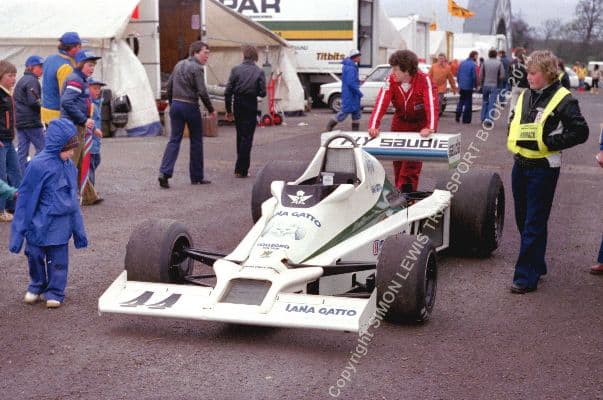
Today the general perception that Formula One is the be-all and end-all of motorsport is more marked than ever, with recent other-category innovations having failed to really grab headlines.  Formula E does not command very much interest and Sportscars/Prototypes in the hybrid era have failed to impress, having none of the aesthetic/technical/competitive charisma that we saw in the eras of Jaguar and Aston Martin at Le Mans, Ford vs. Ferrari in the 60s, 917 vs.512, 956 vs. Lancia and Sauber in Group C.  At the same time, ‘junior’ formulae such as F3 now lack pizazz, being spec formulas, with little of interest in technical developments/differing car capabilities.  So, from a contemporary perspective, we would expect that a F1 seat would necessarily represent the pinnacle of any driver’s career.  On that basis, I’m showing below the Williams FW06 that Giorgio Pianta piloted in 1979:


And although Pianta scored an excellent 5th place at Nogaro in that car, his career highlights can be chosen, mixed and matched, from this more than impressive list: 1965 Italian Rally Trophy; 1966/67 European Touring Car Championship campaigns with Squadra Corse Lancia and Porsche; team ETCC driver with Autodelta, 1968/69; class winner of the Italian Touring Car Championship, 1971/72 and developed the 1971 Targa Florio class winner for Conrero; 3rd in an Osella in the Targa Florio in 1977; developed the Fiat Abarth 124 Rally and X1/9 competition models; 1986-96, manager of Alfa Romeo Corse, in which period the Marque achieved many wins in Touring Car racing, including a spell of domination in the DTM; subsequently returned to Fiat to take charge of Fiat Auto Corse.  During his main driving career, Pianta took part in around 700 race events, winning three Italian National Championships.  This article is focused on Pianta’s circuit racing activities/career – he also saw much achievement in the realms of rallying, not covered here, but well documented elsewhere. 

The earliest regulated motorsport participation recorded for Giorgio was a drive in the Mille Miglia in 1953.  Pianta was at that time 18 years old.  He shared the wheel of an Alfa Romeo 1900 Ti with Piero Palmieri, but they failed to finish. 

An outing at Monza five years later saw him competing in a GT Cup race organised by the renowned Sant Ambroeus scuderia.  Giorgio is seen below in his Fiat 500.


Nowadays, the importance of networking is emphasised to people beginning their commercial career, as if a recently invented ‘science.’  Yet, over sixty years ago, Giorgio was proving himself a natural, effective practitioner.  He managed to arrange for himself a co-drive with the son of Ferrari’s Eugenio Dragoni in an Abarth 1000 TC.  Exploits in this car attracted the attention of Sandro Fiorio, PRO for Lancia.  This turned out to be an especially rewarding contact, as Sando’s son, Cesare, was responsible for the Lancia HF Squadra Corse.  Thus, in 1963, Giorgio found himself with a ‘works’ Lancia drive.  As a result, he was soon at the wheel of such cars as the Flaminia Sport, as seen below at Monza:


Giorgio also remained associated with the Scuderia Sant Ambroeus for several years, driving various of its cars, for instance: Ferrari 250 GT SWB in 1962, Alfa Romeo TZ in 1964 and the arcane ASA RB 613 in 1965’s Targa Florio.  Partnering Giorgio Bassi, a 3rd in class resulted.  The car is seen below:

Courtesy of Vittorio Giordano

1966 saw Pianta co-driving with Lancia rallying star, Sandro Munari, at the Nurburgring 500, where they took their Flavia Sport Zagato to 4th in Division 3 of the Touring Car class:

Courtesy of H-J Roegler

The following season was a notably successful one for Pianta in touring cars, this time in a Division 3 Scuderia Sant Ambroeus 2.0 Porsche 911.  Best results of the year were the outright victory in Belgrade, and a class win in Budapest. 

By early 1968, his recent performances in touring cars had impressed Carlo Chiti enough for him to recruit Giorgio to the Autodelta driving contingent.  Pianta soon repaid Chiti’s confidence with a Division 2 class win at Monza in a Giulia Sprint GTA 1600, co-driven by Teodoro Zeccoli.  For Le Mans that year, Pianta was back with Scuderia Sant Ambroeous, entrusted in company with Enrico Pinto with the team’s Iso Rivolta.  But the car was accident damaged in practice and thus failed to make the start.

The Sant Ambroeus Iso Rivolta for Pianta/Pinto, Le Mans, 1968

Giorgio rounded off the Sixties with drives of increased diversity, both in terms of entrants and types of car – BMW 2002 Ti – Porsche 910 – Lancia Fulvia HF;  Escuderia Nacional CSEcurie Nat. Espagnole.  Another ‘new’ employer coming to note in 1970 was Monzeglio Corse, which entered an AMS-Alfa for the Targa Florio to be driven by Giorgio and Mario Zanetti.  And they made a good job of it: winners of the P 1.3 class.

Left: In the Targa Florio pits, (Schlegemilch). Right: Courtesy of John Phillips

Virgilio Conrero was a significant personality on the Turin automotive scene, especially so in the Fifties/Sixties when he was closely associated with Alfa Romeo.  For engine tuning and modifications requested by customers and motor sport Alfisti, Conrero fulfilled the role eventually performed by Autodelta when set-up as a factory ‘extension.’  In fact, the establishment of Autodelta and thus a loss of business volume, led Conrero to branch out into enhancement developments for other makes and to step up his focus on Renault engines, which had been a secondary interest during the period of concentration on Alfa Romeo.  But perhaps the most important new involvement was with the Opel brand.  A major strand of this was an agreement with General Motors to utilise his Conrero Squadra Corse to run Opel products on-track.  The project was facilitated by the efforts of Romano Artioli, leading dealer for Opel in Italy.  He maintained a steadfast optimism that the GT model could be made an effective Group 4 racer and persuaded Conrero to commit to its development, whilst he also managed to raise necessary funds from his fellow Opel dealers.  Eventually, this enabled chassis improvements to be made and an engine output of near 200 bhp achieved – impressive, considering that the standard production version boasted just 88 bhp.  Conrero took Pianta on to play a lead role in this work, drawing on Giorgio’s extensive experience in developing cars for competition.  It proved to be a very successful arrangement, with Pianta becoming the large engine class winner in a 3.0 Opel Commodore of the Italian Touring Car Championship in both 1971/72.  At the same time, he oversaw modifications to, and the preparation of, four Opel GT 1900s for the 1971 Targa Florio.  Against tough opposition – especially numerous Porsche 911s - the example driven by Paolo Monti and Salvatore Calascibetta achieved an excellent 9th overall, first in class finish.  Pianta also co-drove, with Pino Pica, but his Opel was forced to retire on the fourth lap.  Also failing to finish was the similar car of Giuseppe Marotta and Gianpaolo Benedini.

1971 Targa Florio. Left: Marotta/Benedini, courtesy Sergio Tino; 
Centre: Pianta/Pica, courtesy Maurice Van Sevecotte; Right: Monti/Calascibetta, ©Schlegemilch

Conrero mounted a similar effort for the 1972 Targa.  Further development had resulted in a new cylinder head, enabling an increased power output of over 200 bhp.  Of the three GTs entered, two were carburettor-equipped, whilst that to be driven by Pianta and Giorgio Schön featured Kügelfischer mechanical fuel injection, and this enabled a further power increase, to 214 bhp.  This was enough for Pianta to be able to post a 2000 cc class fastest time in practice, significantly below what the Porsche competition was managing.  However after an enforced power unit change, the engine could not be fired-up for the start of the race.

1972 Targa Florio. Pianta/Schön in practice. Courtesy Revs Institute

Giorgio reverted to his 1971 partner, Pino Pica, for the 1973 event.  On this occasion they were flying the Conrero colours on a sports racing car which had been created in 1972 for Momo proprietor, Giampiero Moretti.  The car’s designer was Giorgio Valentini, (also known for designing the BWA single seaters, Bertone Panther, Mystère prototype and Osella FA1C).  Valenti began work on the design in September 1971.  Moretti had requested several innovations, in particular in the suspension and steering layout/operation and inboard brakes.  It was a super-light-weight chassis – the frame being just 55 kgs – with a quick-change, transverse fuel tank.  As initially raced by Moretti/Corrado Manfredini at the 500 kms of Interlagos in 1972, the car was powered by a 265 bhp Abarth-Osella 2.0, but, as taken over by Conrero, it was fitted with an Opel unit as was used in the racing GT 1900s.  But, once again, Pianta suffered the disappointment of a race non-finish, the car being retired after 4 laps.

Conrero-Opel on 1973 Targa Florio (Pica driving)

Also in 1973, Giorgio raced a Lola T280-Ford DFV for Jolly Club at three major events.  Again partnering Pino Pica, a 7th place finish was achieved at the Dijon 1000 kms.  The pair were together once more for the Monza 1000 kms but were out before quarter distance due to a failed coolant hose.  Further disappointment followed at the Nurburgring 1000 kms for Giorgio and co-drivers, Mario Casoni and Manfred Mohr, when gear linkage problems caused an end to their race after just 6 laps.

1973 World Championship for Makes, Lola-Ford 280. Left: Nurburgring (Courtesy Girardo);
Centre: Monza (MotorsportImages); Right: Dijon (MotorsportImages)

Jolly Club replaced the car with a T282 model for the 1974 season, again enlisting Giorgio to drive it.  At the Monza 1000 kms, a race dominated by the Alfa 33s, Pianta/Pica finished 6th after winning a close battle with the Porsche 908 of Joest/Casoni.  At Spa, the Lola was sidelined with ignition failure.  He used the same car for the Targa Florio, qualifying it fastest of the entire field.  This was the first year after the Targa’s de-rating as a championship event, so the competition was less intense than formerly, but Pianta’s achievement in taking pole is validated by the fact that he outpaced the two Stratos entered by Lancia Corse.  However, the car failed to finish the race, suffering a rear tyre failure after 4 laps.  In the photograph below, Pianta is seen in the centre, behind the rear wing.


Towards the end of the year, in October, Pianta shared the Abarth works’ Fiat Abarth SE030 with Christine Beckers on the Giro d’Italia.  This was a new product development car which was a forerunner of the Lancia Montecarlo.  In addition to looking good, it ran well too, and was bettered in the event only by the Group 5 Lancia HF Squadra Corse Stratos Turbo of Jean-Claude Andruet and Michèle Espinosi-Petit.  On this event the following year, Pianta went one better and took the overall first place in a Group 5 Fiat Abarth SE031, this time co-driving with Bruno Scabini.

Left: Partnering Christine Beckers on the Giro d’Italia, 1974, ©Pininfarina,
and, right, co-driving to victory on the same event, 1975, with Bruno Scabini

Otherwise in 1975, Giorgio was putting mileage on Jolly Club-liveried Lolas, partnering with Vittoria Brambilla, but it proved to be a run of races that was characterised by DNFs and accidents.  No doubt he was pleased to get his hands on a Scuderia Aneneo/Jolly Club Stratos for the Targa Florio, and, sharing the driving with Giorgio Schön, he made the most of the opportunity, finishing 7th, 4th in class.

1975 Targa Florio – Pianta/ Schön (Targapedia)

Giorgio’s best showing in 1976 was at Salzburg, where, in the 200 mile Salzburger Festspielpreis race, he came in 6th, 3rd in the 2.0 class.  This was in a Jolly Club Osella PA3.  Around this time, Giorgio was more often at the wheel of Osellas, where previously he had had a run of Lola drives.  In the Targa Florio of 1977 he was again paired with Giorgio Schön and they had an Osella PA5 BMW at their disposal.  In this, the last (though lesser status) Targa, and on his tenth entry for the event, Pianta achieved his best result - 3rd overall and 2nd in the 2.0 class.  The Jolly Club car, with Giorgio at the wheel, in the pits, is shown below:

Courtesy of Vittorio Giordano (Targapedia)

Pianta followed up the Targa success with an even better one 17 months later, sharing the Giro d’Italia-winning Group 5 Stratos HF with Markku Alén and Ilkka Kivimäki:


1979 was a season which reflected Pianta’s involvement at Corse Lancia where he was significantly instrumental in developing the Montecarlo model for the track, creating the turbocharged version which was highly successful in seasons, 1979-81 – see Any Tine, Any Place – Montecarlo for Instance.  In addition to much effort contributed in the workshop and on the test track, Giorgio drove early versions of the Montecarlo at the 1979 Six Hours races at Mugello, Silverstone and Vallelunga.  Whilst these outings resulted in non-finishes, the performances helped to establish the car’s competitiveness and support developments for improved reliability. 

The Seventies/early Eighties had seen Pianta with a roving brief, testament to his versatility: leading test driver at Corso Marche for Abarth;  influential ‘behind the scenes’ at Lancia with the development of the S4 Delta;  at Alfa Romeo he strove without success to help establish an Indycar campaign with a March CA90 chassis powered by a 2648 cc turbocharged V8 engine.

Alfa Indycar Turbo V8 engine, 1990.
Courtesy of Roberto Motta

After a long period of uncertainty and its inability to return to profitability, Alfa Romeo was absorbed into the Fiat Group in 1986.  Autodelta’s ‘abolition’ had been commenced in 1982 when responsibility for running the F1 cars was transferred to Giampaolo Pavanello’s Euroracing team.  The operating base of Autodelta was moved to Senago, and, not long after, the business effectively closed with the Fiat buy-out.  As a replacement function, Fiat revived the Alfa Corse name and appointed Giorgio to run it as a factory department.  Initially, Pianta sought to revitalise the perception of Alfa Romeo as a leading light in motorsport by developing the Alfa 164 V10 Procar.  Though this project stalled, the engine was utilised in the development of a proposed new Group C prototype for endurance racing.  The car emerged after collaboration with Abarth as the SE048SP, but with a change of power plant to the Ferrari 3.5 V12.  However, by autumn 1990 it was apparent that the revised Group 6 rules for which the car was designed would not be attracting substantial entries from other manufacturers, and this project too was cancelled.
 
Left: 164 Procar. Courtesy of Michael Ward     Right: SE048SP Group C. ©Kevin Van Campenhout

After the disappointments of the aborted Procar and Group C programmes, Alfa Corse turned its attention to the touring car category with the Alfa 75 model.  Whilst this was relatively low-key, it laid the foundation for a more concerted campaign beginning in 1992 with the new 155 GTA model.  Promising though this appeared to be, the Ti AWD model was preferred for an assault on the DTM the following season.  With leading drivers Nicola Larini and Alessandro Nannini, the car was very successful in 1993 and the following three seasons, racking up 38 victories and winning the DTM in 1993 and the BTCC in 1994.  It has been reported that Pianta took every opportunity while running the programme to test cars on-track and was well known for being able to set fully competitive times. Going a stage further, it is said that he clandestinely drove in some races - in his appreciation of Pianta Peter Collins writes: 

At one time he was itching to drive a GTA in a race, but Fiat shuddered at the implications. He still did it, under the pseudonym of ‘Sonnenkinde’ – child of the sun. 

Collins also recounts this anecdote, attesting to Pianta’s driving abilities and attitude: 

Sometimes testing did not always work to plan.  One day at La Mandria, testing a Delta S4 on a circuit, the technicians called him in and told him that their telemetry showed that he was not driving quickly enough through a particular corner.  “But I cannot drive any quicker through there or I will have a large accident,” said Giorgio.  “Nonsense, the figures show that you can. Go out and try harder,” said the engineers.  Off went Giorgio, trying harder than ever (at that moment making loud puffing and wheezing sounds as of an S4 flat out).  Suddenly, there was silence.  After a while, a visibly shocked Giorgio arrived back on foot carrying the mangled remains of the driver’s door – there was little else left of the car.  “Was that fast enough for your machines?” asked Giorgio. 

After the period of Alfa Romeo touring car successes, Pianta was put in overall charge of Fiat Auto Corse, thus affording him opportunities to direct the sporting enterprises of Fiat, Alfa Romeo, Lancia and Abarth.  In addition, he was president of the Associazione Nazionale Corridori Automobilisti Italiani, (similar to the BRDC) and contributed to the work of the Italian motorsport governing body. 

Giorgio died in 2014 at the age of 79.