Showing posts with label Sprint. Show all posts

Thursday, March 2, 2023

The Elixir Drinking Honda

Here's my list of three of the best things to have come to us courtesy of the Japanese automotive manufacturing industry: Honda Formula One and Indycar engines, the Mazda paint colour, Soul Red, and the Honda CRX. 

In the late 90s, when my wife’s Scirocco suffered an existential crisis, she showed me an ad for a model of car I’d not previously much noticed.  As we looked around it, I found myself thinking it was quite a neat little car with understated styling, and, though it was around ten years old, it was in rather nice condition.  All quite cosy and unremarkable, until . . . we got in it and went for a test drive.  I immediately felt at one with it, very much in the same way I’d liked so much about a couple of Alfasud Sprint Veloces I’d run a decade and an half previously.  They were cars that seemed to fit just like a glove, giving a feeling of a seamless connection with the steering wheel and pedals and making the driving of them an especially pleasurable physical experience.  But the CRX felt even better - quicker, with an apparently rock solid chassis, and considerably more power.  You’ll not be surprised to learn that it came back home with us that same afternoon. 

The relationship between mother and son is often said to be especially loving and empathetic; cue a big question mark in this instance – my eldest boy had engineered a swop within a couple of weeks whereby my sweet natured missus had become the usual driver of his Nova ‘Swing,’ whilst he was now out and about, terrorising the locals, as he hustled the CRX around the neighbourhood streets. 

I should have disapproved, but I was rather more inclined to envy him.  Especially for the combination of excellent handling and generous grunt he now had at his disposal.  To my mind this little Japanese skunk works product was everything the Alfa Sprint should have evolved into.  Apart from having appropriate performance capability – notably, a 29% bhp advantage – the CRX remained a ‘cleanly’ styled car while the Alfa, undergoing facelifts, became more cluttered with bits of plastic cladding, a spoiler and trim complications, such that Giugiaro’s original vision had become disfigured.  Ironically, it has been said that the CRX’s overall form was based on the Alfa Junior Z, a car owned by one of the Honda design team.

Left: In its original guise as the Alfasud Sprint.  Right: By the late Eighties, as the less ‘pure’ Alfa Sprint 1.7 Green Cloverleaf

The Sprint has often been cited as one of Giorgetto Giugiaro’s best middle-period designs.  It was launched in 1976, featuring the Alfasud’s chassis, engine options, (initially 1.2, then 1.35/1.5, and, eventually 1.7), and mechanicals.  Later in the production run the more mundane 33 platform was adopted, and the last cars were a little less felicitous to drive with fuel injection on the 1.7 engine replacing the Weber or Dellorto carburettors which had conferred excellent throttle response - a key Sprint characteristic.  As with the 105 bhp final iteration of the Alfasud 1.5 Ti, misplaced customer complaints about ‘torque steer’ also undermined the Sprint’s perceived reputation as a good enthusiast-driver’s car.

Below are three of Giugiaro’s early design studies for the Sprint.  Left: A render of the original 1:1 model in plaster made in 1970.  This has echoes of the Alfetta GT design, especially the rear, which Giugiaro had completed in 1969.  Centre: An interim, evolutionary development, notably without front window quarterlight.  Right:  A render of the metal prototype, (1971).  The further changes leading to the production version were largely dictated by findings from wind tunnel testing in Stuttgart.


The CRX began life as a new variant of the Honda Civic model, (3rd series) family in 1983.  This version is distinctive in being slightly awkwardly balanced, as the front and cabin lines flow sweetly whilst the rear end appears boxy and clumsy.  Four years later, a 2nd series CRX was introduced – this being the definitive version, as bought for my wife.  It is easily distinguished from the earlier model by its revised B post angle, C pillar which facilitates a nicely radiused lower corner to the rear side window and a taller, more abruptly truncated, tail.  The series 1 and 2 cars are shown below, left and right, respectively:

Left: Early CRX with its slightly angular tendencies. Right 2nd series CRX with tall tail and spoiler prominent


In 1992, the 2nd series CRX was replaced by a targa roof model, CRX del Sol.  Although equipped with the ESI and VTECH engines, this model lacked the character of the earlier versions and has attracted the soubriquet, a hairdresser’s car!  It, and the CRX model name, was discontinued in 1998.  Shown below are some studies for the CRX in its original form and in development towards the series 2 version:


By Q3 2022, there were just 103 Sprints and 98 CRXs still registered/running in the UK.  With the interest currently evident in Historic Racing, and Alfa Romeo’s profile in Motorsport, a Sprint is much more likely to be encountered at racing circuits.  However, this CRX, raced in the Kent Oval Outlaws series, (Lydden Rods class), at Lydden Hill, driven by Michael Burke, certainly looks very striking in its bashful shade of green:


Admittedly, this is a glimpse of motorsport at a modest level, whereas when the Alfasud Sprint was still in production it had featured in Division 1 of the European Touring Car Championship, and for a while it was highly competitive – see here. 

Both cars were readily suitable for racing applications thanks to their notably sophisticated engine architectures.  The Sprint’s Alfasud flat 4 engine was imbued with considerable capacity enlargement protentional and was inherently track-friendly with its configuration enabling a car to have the handling benefits of a low centre of gravity.  The original 1186 cc version was notably oversquare and thus very ready to rev, producing peak power of 63 bhp at 6,000 rpm, and plenty of torque (65 lb-ft at 3,200 rpm).  Eventually, (1990), in 1712 cc/16 valve form, the unit was generating 132 bhp at 6,500 rpm.  So, in the interim, tuners and race teams had no difficulty with achieving relevant class-competitive performance, especially with induction-related modifications and upgrades.  With the 1351 cc capacity, for instance, 125 bhp was easily attainable.  A particularly celebrated racing Sprint is the Team Bigazzi lightweight example, featuring many Autodelta modified parts, seen below:


When offered for sale in November 2022 by Bonhams, catalogue notes referred to the car’s race history as being a championship winner in 1982 and 83.  In the photograph, the car wears the 1983 livery as run in the Trofeo Sprint Europa and driven by Luigi Calamai to the title honours.

Although there was some emphasis in Honda’s marketing on the CRX’s virtues in terms of fuel efficiency, the range-topping VTECH versions were also noted for their high performance attributes.  Deploying multiple camshaft profiles, the system is able to enhance fuel economy when the engine is under light load, but also optimise the charge volume for increased power at higher rpm.  The peak power rating thus enabled made the CRX a natural basis for racing developments.  (Alfa Romeo had been a little ahead of Honda in putting variable valve timing into production – on the 4 cylinder in line Nord (Arese factory) engines, though this technology was absent on the Sud factory flat fours).  So, while the Sprint’s image was well promoted by the Trofeo series, both at National and International level, the CRX featured in its own one-make/model championship in England – an example race, at Snetterton in 1989, is seen in this video.
 
The CRX Challenge had been the subject of a Motor Sport magazine article in August 1988.  This noted that the series had been devised by Honda UK as an initiative seeking to attract interest in the Marque from a younger demographic, the average age of a Honda owner then being 57.  Honda prepared and sold the cars direct to would be competitors at a subsidised price just short of £10,000.  All the cars used the 1.6 16 valve engine, with 130 bhp on tap.  The series winner was Patrick Watts, (a feat he repeated in the 1990 season).  Below is an example Honda CRX Challenge car from the 1989 series:


More about this car – which was driven in-period by Steve Waudby – can be seen here.

The success of the Challenge here in the UK led to similar series being set up elsewhere in Europe and in the U.S.
 
Two characterful cars with true sporting spirit.  Since the cessation of their production – the Sprint in 1989, the CRX (series 2) in 1991 – there has been nothing new quite like them.  For instance, the revival of the Scirocco name by VW in 2008 did not introduce a model with the combination of compact coupe form with good engine performance, relative light weight and excellent handling which characterised the Sprint and the CRX.  They remain emblematic of a very different era, prior to the current global warming-aware manufacturing milieu.

Tuesday, March 15, 2022

Corse Alfasud

When I started working at BMW Concessionaires GB Ltd in 1971, our cars were not ten-a-penny on London’s more affluent streets. The trendy thing to drive then was an Alfa Romeo. The 105 Series Giulia models offered a heady mix of great styling, courtesy of Bertone and Pininfarina, together with exhilarating performance reflecting the Marque’s racing successes, primarily with the brilliant GTA variant. On my first visit to Munich, I was told that with the impending Tii version of the 2002 and further development of the E9 coupe, it was hoped that Alfa would find itself with a worthy Bavarian competitor. By the time I moved to Alfa Romeo GB Ltd. (ARGB) at the end of the decade, places like Kensington and Hampstead were knee-deep in BMWs, whereas, though its UK registrations were peaking, Alfa Romeo’s reputation and market share was beginning its woeful decline. Both the sales volume zenith and the collapse of esteem for the Marque’s products were mainly attributable to the Alfasud. 

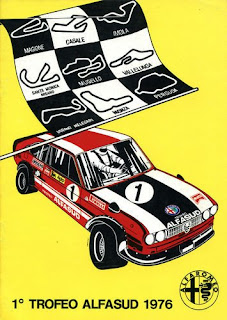
Whatever the big picture aspects of the Alfasud in terms of its commercial viability and effect on Alfa Romeo’s prestige, its specification made for the basis of an excellent small racing saloon, given its light weight, compact footprint, rev-happy flat four engine and inboard front brakes. In standard form the throttle response was very good and it was soon found that even with just the substitution of carburettor make/model – Weber or Dellorto – increased horsepower was relatively easy to achieve. With numbers of ‘Sud’s appearing on circuits in 1975 – notably in Austria - recognising the promotional potential, Alfa Romeo instituted the ‘Alfasud Trofeo’ race series in 1976. The version to be used was the 1.3 Ti which had supplemented the range in ’73, initially in 1200 cc form. The car could be modified by the use of an Autodelta-marketed kit of parts. In standard production specification the Ti’s engine produced 75 bhp, whereas a Trofeo version managed 115 bhp on the twin Webers included in the Autodelta kit. Given a minimum weight of 800 kgs, this made for a quick car, further enhanced by the other kit components which included competition exhaust, springs and dampers, wheel arch extensions and lightweight Campagnolo alloys. In Italy the series was comprised of 9 races, at Magione, Casale Monferrato, Imola, Misano, Mugello, Vallelunga, Varano, Monza and Pergusa.


The inaugural championship was won by a clear margin by Filippo Niccolini, from Claudio Pizzi.  Niccolini was the victor at five of the championship rounds.  His car was advertised for sale in 2016 by Weekend Heroes of Munich:


With increasing awareness across Europe, Trofeo series were also introduced in Austria, Germany and France.  Confirming the high level of interest from competitors, circuits and enthusiasts, 1977 also saw the establishment of a ‘Trofeo Europa Alfasud,’ bringing together the better drivers from the various national series.

The Europa series gained additional attention by the running of some rounds as support races to Formula One Grands Prix.  First champion was Italy’s Aldo Cerruti.  Notable among the Trofeo Europa competitors was Gerhard Berger, future F1 high-achiever with McLaren and Ferrari, who took seventh place in 1981.

Gerhard Berger and his Trofeo Alfasud

Alfasud Trofeo racing tended to be close and frantic, as can be seen in the photograph below:

In the UK, Alfasuds also appeared on-track in 1976, run by the Campari-sponsored Dealer Team.  Two cars were entered to the Tourist Trophy for Jon Dooley/Simon Kirby/Rex Greenslade.  Another ‘Sud was entered for this event by the stalwart Bolton dealership, Westune – drivers, Malcolm Wayne/John Myerscough. 

From 1977, examples of the Sprint variant began to compete.  In Division 1 (1300) of the European Touring Car Championship, Sprints of Team 43-70 were class winners in 9 of the 11 rounds and clear class champions.

Sprint of Marquez/Perrado (Team 43-70) at Brno, ETCC, 1977

1978 proved to be a much tougher year for the Sprints in the ETCC.  Of the twelve rounds, a Sprint was able to take the class victory at only two events – at the Nurburgring and Silverstone.  Early in the season, Fiat 128 Coupes and Alfa GT Juniors had better pace, and, later, the Skoda 130RS proved superior.  However, a Sprint was 1st in class at 5 races, and consistent results from the Belgian pair, Richard Mattozza and Jacques Berger, were a major contribution towards Alfa Romeo securing the manufacturer’s Division 1 championship.  But by the end of the decade, the ‘Sud in both Berlina and Sprint form was not a significantly competitive race car, and results were mediocre at best. 

Development of the Alfasud during the late Seventies/early Eighties took production versions’ power output up to 105 bhp, with the 1.5 litre capacity engine.  The Sprint eventually gained a 1.7 variant, and this boasted 112 bhp.  Nevertheless, neither this car, nor the ‘Sud’s replacement, the 33, were found to be a good basis for a competitive racing car.  At ARGB we dabbled with a turbocharged version of the 33, (around 130 bhp), in conjunction with Terry Drury Racing, but this too proved to be an ineffective circuit racer.  So there was quite a hiatus in motorsport terms, before the advent of the 155, which would certainly turn out to be a formidable and successful touring car for the Marque.