Showing posts with label Appiagtz. Show all posts

Tuesday, January 21, 2025

OSCA 1600 GT Zagato - A Survey of Survivors


Courtesy carstyling.ru

I briefly summarised the OSCA 1600 GT in its various body forms in June ’22 – here.  Of the models created by Fissore, Boneschi, Touring and Zagato, the latter’s version was made in the greatest number - this is a more detailed survey of the Z-badged cars.
 
Though the 1600 GT was finalised at the OSCA factory in ’60, serial production was delayed until ’62.  The FIA homologation papers, dated 8th October ’62, referring specifically to model ‘GT2,’ indicate that production was initiated in ’61.  Although it was stated at the time that 128 GTs were made, (and it was claimed that 98 of these were Zagato-bodied), recent studies of historic data have concluded that the actual total was less than 60.  Whilst this may reflect a slow rate of sales, it also probably stems from disappointing manufacturing productivity which prevented the target of a minimum 12 cars per month being consistently met.  The last of the Zagato versions were probably made in late ’64.  At that point the restructured company, (sale of the majority interest by the Maserati family to Meccanica Verghera Augusta having taken place the previous year,) announced new models.

At the heart of the GT was the 1568 cc 4 cylinder, in line, twin cam engine made for OSCA by Fiat.  This was an evolved version of the unit that had powered the marque’s sports racers through the 50s.  Introduced for the MT4 in ’48, its capacity then was 1092 cc and it was rated at 70 bhp.  Though the block was Fiat-designed, the cylinder head was the work of Ernesto, youngest of the OSCA proprietor Maserati brothers.  It was not long before the head was converted from a single to a twin cam layout, at which point a 1342 cc capacity version was also launched.  Another increase in capacity came in ’53, with around 110 bhp extracted from 1453 cc.  In ’54, further revisions – identified with ‘TN’ designation - enabled a maximum power output of 125 bhp.  A single Weber 28-36 DCLD3 carburettor was specified for the 1600 GT – good for 95 bhp.  However, the GT2 employed twin Weber 38DCOEs, (105 bhp), whilst a GTV version was on twin 42DCOE3s, (125 bhp), and the GTS, though also 42DCOE-equipped, gave 140 bhp – the extra 15 bhp flowing from the twin spark ignition set-up.
 
The hybrid theme was continued in the 1600 GTZ with the use of OSCA’s own 4 speed gearbox which employed Fiat internal components.  With an ongoing incidence of failure in racing GTZs, the unit became suspected of being under-specified for reliable handling of the power generated by the GTV and GTS engines.  Other notable mechanical features on the GTS were Dunlop-designed/Girling-made disc brakes, front/rear, and independent suspension on both axles.  All in all, it proved to be a fast, well handling car, thanks also to relatively light weight – 862 Kg for the basic version, with the GTS 7% lighter at 800 Kg.
 
At the time, a basic GT was a little under £2,000 in the UK, (about £45,000 in current terms).  The GTS would have been approximately £2,250.
 

OSCA built the rolling chassis for delivery to Zagato, (and the other involved carrozzeria), utilising a frame made by Milan-based specialist constructor, Gilco.  The company had established a high profile in the industry, especially because of its long term status as a supplier to Ferrari.  For in-depth information about Gilco, its website is well worth a visit.  One of Gilco’s period advertisements is shown below:


Another third party-supplied item of particular note was the distinctively styled 4.5j x 15” Elektron/Magnesium alloy wheel branded as Amadori, a maker which was bought out by Campagnolo in its strategic evolution from being a bicycle wheels manufacturer.  These wheels eventually became the subject of criticism – like the gearbox – which contended that they lacked strength when run in competition on cars with over 125 bhp.  Breakages were not uncommon.

Amadori wheel. Courtesy SymbolicInternational

There are, however, no doubts about the quality of standard OSCA 1600 GTZ steering wheel. This was a 400 mm wood rimmed wheel made by Personal. Little has been written about the company’s founding/early days, but it is generally held that it originated in ’60. It is probable that OSCA would have been inclined to buy-in wheels for the GTZ from the well-known/respected maker, Nardi, another long term supplier to Ferrari. Personal secured the business however as the company was prepared to undercut Nardi on price in order to establish its presence in the market, enhanced by implied endorsement from the Maserati-linked association. Subsequently, Personal was in commercial collaboration with Nardi. The Nardi brand was separated from Personal in ’68 and its wheels continued to be marketed through to the present day.

The 1600 GTZ ‘Personal’ 400 mm steering wheel. Courtesy ExoticAutoParts28

Despite the problems that dogged the start-up of series production, an OSCA GT 1600 Zagato made the model’s race debut at the March ’62 Sebring 12 Hours – see photograph below.  Entered by N.A.R.T. for drivers, H Spencer Lichtie and Robert Publicker, the car had to be retired early, after only 33 laps (of winner’s 206), because of head gasket failure.

OSCA 1600 GT Zagato at Sebring, ’62. Courtesy Homer Willi

Earliest car by chassis number of which I have detail photographs is #0007, which was run as a factory entry – alongside #0036 – in the 24 Hours of Le Mans, June ’62.  Both cars are seen below, #0007 being the white car wearing race number 37.

Courtesy The GPL Collection

Driven by George Arents and Jose Behra, #0007 was still running into the 23rd hour, but had to be retired after 227 laps with transmission failure.  It had run as high as 15th overall and was likely on for a 2nd in class finish.  (#0036 was out after just 13 laps with big end bearing failure.  It was a significantly different car from #0007 in having a flat roof and the live rear axle in place of the independent suspension normally installed in GTS Competizione models).
 
Chassis #0006 is a red 125 bhp GTS on twin 42 mm Webers.  The car changed hands in ’19 at Gooding’s Amelia Island sale for $489,000.

Weber 42DCOE3 carburettors, as fitted to #0036. Courtesy Petrolicious


#0006. Courtesy Gooding & Company

When Bonhams sold ’62-registered #0011 in October ‘19, the lot description included the statement, . . .according to marque expert Christophe Pund, (this car) is one of a mere 7 Zagato-bodied cars that were raced; indeed, '011' is probably the most raced of all OSCA 1600 GTs. Its driver was Fausto Mariani, who achieved numerous successes with '011' during the 1964 and 1965 seasons.  Little is documented about Mariani’s motor sport achievements and the events in which he campaigned the car were of regional/national status, such as the Trofeo Venturi, (Frascati), Hillclimb held in June ’65.  However, a class victory, (Coppa Gallenga Hillclimb) is cited in the ’65 season.
 
As is evident in the photograph below, #0011 has been restored in recent times.  Despite its good condition, it failed to sell at auction in 2016 but made €379,500 at the Bonhams sale three years later.  Note that the period photograph on the right below shows uncovered headlamps.  The earliest chassis number of which I have a photograph showing Plexiglass headlamp covers is the second ’62 Le Mans car, #0036.

#0011, left, seen in ‘19 and, right, racing in ’65. Courtesy Bonhams

#0029 is a ’62 GTS which was photographed, as below, at the Le Mans Classic in 2002.

#0029 is a ’62 GTS which was photographed, as below, at the Le Mans Classic in 2002

As mentioned above, #0036 appeared alongside #0007 at the ’62 Le Mans 24 Hours.  In the photographs below, the rear view clearly shows the 87 litres fuel tank fitted to GTS/Competizione GTs, while the frontal shot, with intake grille removed, well illustrates the frame/locating fastener for the Plexiglass headlamp cover.  That this car’s engine was the twin spark variant is evident from the view of the engine bay.

#0036. Courtesy Petrolicious


In ’66, the car was in the Bahamas, where George Waltman contested both the Governor’s Trophy/Nassau Tourist Trophy and the Nassau Trophy. Waltman was the Sport 1.6 class winner in the latter race. The following year he used #0036 to compete at Sebring in the 12 Hours, but failed to finish. Incidentally, it has been written that Waltman subsequently ran #0036 in the ’68 Daytona 24 Hours, driving the entire race unpartnered. However, he achieved this remarkable feat in a Morgan Plus 4, not the OSCA.


Since its foundation in 2007, Bring a Trailer has had a major effect on the market for classic/collectible cars. A factor in its success has been the encouragement of fully detailed descriptions of items offered for sale, supported by large numbers of good quality photographs. As a side benefit, these are often invaluable for researchers seeking to verify detail points of specification of a vehicle model/variant. The BaT listing for #0070 provides a good example of this feature. 302 images are presented, providing numerous exterior/interior views, including points of fine detail, engine bay and underside shots, identity plates and stampings and various documents, both model and specific chassis number related. In this instance, for example, the excellent quality of the photographs of the carburettors facilitates easy identification of this car as a GT2 – see below:

Courtesy SymbolicInternational

#0070 is unusual in being equipped with full width bumpers front and rear – GTS/Competizione models had not been fitted with these originally and it would appear that surviving GT/GT2s commonly have had OE bumpers and irons removed for aesthetic reasons – the race car ‘look’ being widely regarded as more attractive.


Courtesy SymbolicInternational


Restored in 2018, #0078 is a GT2 in the unusual off-white colour.  In photographs taken to advertise its sale, (on offer from La Montini Automobili in Autumn 2024), there is a good view of the GT Zagato’s handsome profile.  The limited boot space, (to accommodate the spare wheel), is clearly seen, as are the seats, which are the same type as fitted to the Alfa Romeo Giulietta Sprint Zagato.  The chassis identity plate is also well represented.

Courtesy Montini Automobili

Speedholics Society reported on RM Sotheby’s 2023 offer for sale of #0094 with notes on its early use: ‘Sold to its first owner—Alberto Luti—in 1963, the Italian campaigned the diminutive GT with great success.  A class win at that year’s Coppa Belvedere Hillclimb followed a 2nd in class finish at Ascoli-Colle San Marco and 3rd in class at Pontedecimo-Giovi.’

Courtesy RM Sotheby’s

#0094’s is an example of branding to the engine by an O.S.C.A. script applied to the right hand cam cover.  On some this is absent but a small branding plate is fixed to the same side of the cover, above the front end of the camshaft, as seen on #0078 – see below, #0094 left, and #0078 right:

Courtesy RM Sotheby’s and Montini Automobili


The interior of #0094 is especially attractive, the photograph below showing the clarity of the instrumentation and the generally good ergonomic characteristics of the controls.

Courtesy RM Sotheby's

At one time, Peter Kraus’s Rosso Bianco Museum in Aschaffenburg, near Frankfurt housed the largest collection of classic sports cars in the world.  Amongst the cars on show was #0097, a GT Zagato first registered in Rome in April ’63.  Before the museum’s closure, (in ’06), the car was sold to German author, Winfried Reiss, who had it fully restored before the millennium.  Since then it has changed hands a few times and seen success at various European concours events.

Courtesy Kidston

#0101, a GT2, was driven by Mario Nardari and Ottorino Zarattin in the ’64 Targa Florio, finishing 27th, 5th in class.  Nardari ran the car in ’63 and ’64 at the Consuma hillclimb and at circuit events at Imola, Mugello and Monza.  Best result was 4th place at Imola in April ’64 in a GT2.5 race.  Other events entered are listed here.  The car is seen ‘then and now’ below.

#0101. Courtesy Ruote da Sogno Srl


Badges:

The circular O.S.C.A. Fratelli Maserati Bologna badge was centrally mounted, halfway between the leading edges of the bonnet and front panel:

#0101. Courtesy Ruote da Sogno Srl


#0029. Courtesy Wouter Melissen

 
A chrome script OSCA 1600 badge was applied centrally to the boot lid, halfway between the panel’s top edge and the top edge of the numberplate recess:


Courtesy Tomini Classics


#0101. Courtesy Ruote da Sogno Srl


As was usual with Zagato-bodied cars of the era, a ‘Z’ badge, engraved, ‘Zagato Milano,’ was applied to each front wing.  On most cars the badge is located between the indicator repeater lamp and the trailing edge of the front wheel arch, approximately in line (but a little lower) with the door handle.  The badge itself featured black infill, but this was often lost because of weathering, resulting in a largely uniform aluminium finish.

Courtesy (left to right) Kidston, SymbolicInternational, Petrolicious


The steering wheel boss is decorated with the ‘Maserati OSCA’ badge as seen below, (#0094):

Courtesy Speedholics


Where fitted, the wheel hub caps featured an OSCA script:

Courtesy SymbolicInternational


Literature/Documentation:


The OSCA 1600 GTZ naturally shares many of the aesthetic attributes of Zagato’s multi-marques output in the opening years of the 60s decade.  For comparison, see below, left - OSCA 1600 GTZ; centre, top - Alfa Romeo Giulietta SZ Coda Tronca, centre, below – Alfa Romeo Giulietta SZ Coda Tonda; right – Lancia Appia GT Zagato.


Most notably, the OSCA’s cab is relatively rearward set and the car incorporates a considerably more substantial C pillar. The rear of the OSCA has a particular affinity with that of the first version (Coda Tonda) of the Alfa, with the treatment of the rear wheel arch, with an emphasised swage line, very similar. The OSCA’s nose profile is markedly bluff in contrast with this part of the bodywork of the Alfa and Lancia. Fully distinctive on the OSCA are the air vent extraction ducts echoing the twin roof bubbles. This aspect brings to mind the Abarth 750 GT Zagato on which similar forms are seen on the engine deck lid. However, that car, being a mid-fifties design, is generally less comparable with the OSCA, Alfa and Lancia. All three are superb examples of Italian styling of the era, the shapes suggesting fast, wind-cheating machines, yet they were created just before the aerodynamic principles of drag reduction and the generation of downforce became better understood and capable of being accurately measured. Around 1960 the formula for a sports car of light weight, compact footprint and small capacity/high output 4 cylinder engine was becoming increasing seen as a preferred option, and the OSCA employed it especially well, but it was also the foundation of the Alfa and the Lancia. All three are true icons of mid-century automotive design.

Thursday, December 19, 2024

A Fast and Nimble Camel?

Lancia introduced its new Appia model in 1953.  Powered by a 1.1 litre, 10° version of the marque’s V4 engine, the initial variant was a four door Berlina.  In Spring ’55, the model was significantly updated.  The improvements included the adoption of a platform type of chassis.  This opened the possibility of carrozzeria-built variants to extend the range.  To explore the potential, Lancia supplied a number of chassis to various of the Italian carrozzeria in late ’55.  As a result, Zagato was able the following April to present its version at the Turin Show.  This car, with chassis number 812.01.1005, incorporated Zagato’s signature body-form cues in terms of twin roof bulges and echoing reiterations of these in the bonnet and boot panels.

Lancia Appia GT Zagato prototype, 812.01.1005.  © IXO Collections SAS © Lancia D.R.

Lancia itself was not at first especially taken by Zagato’s interpretation – preferring to ‘approve’ a drophead by Vignale and a closed coupe by Pinin Farina.  Zagato, however, decided to pursue a programme of its own, believing that its coupe could prove especially attractive to the ‘gentlemen racer’ type of customer the Carrozzeria had already engaged with for its sporting versions of models made by Alfa Romeo, Abarth, Maserati and OSCA – for here was a felicitous compounding of positive features, Zagato’s method of construction not only allowing the creation of aerodynamically efficient/attractive body styles, but also, in combination with the use of aluminium, enabling very light kerb weights, further enhancing performance capability.

Six Phases: 

As a result, production of the Appia Zagato went through six phases, with a total of around 700 cars being built.  The phases were: 1. ’56 ‘Cammello’ Prototype;  2. ’57 GTZ Pre-production;  3. ‘57 GT and GTS models;  4. ‘58 GTE;  5. ’59 GTE2;  6. ’61 Sport.  Production ceased in January ’63.  The cars were built on the Appia Berlina second series chassis until the advent of the GTE2 version in ’59 when the third series chassis was made available to Zagato.
 
The Cammello was readily recognisable in addition to the roof, bonnet and boot humps by its open headlamps, deep front intake grille, quarter bumpers, rear wing-top fins and circular style wheel arches.  The Phase 2 cars featured multiple variations in body specification but generally had roof humps, raised rear haunches, shallow front grille and straight-top style wheel arches.  An example of the Phase 2 body style is shown below:

Phase 2 Pre-production GTZ, 81201.1026.  Courtesy Gino Giugno/Actualfoto SRL

My category ‘Phase 3,’ embraces the cars designated GT and GTS.  These had variations appropriate for the former being a ‘stradale’ type, whereas the GTS, intended for competition use, was equipped with a tuned version of the V4 engine, giving 3.5% more power, at 59 bhp.  Inconsistencies remained the order of the day, the GT usually not having a humped roof, while the GTS usually did.  A GT, 81201.1176, is shown below, the open headlamps, straight-top wheel arches and rear fins being clearly evident.  However, whilst the overrider elements are in place, the front bumper bar is not fitted.

Phase 2 GT, 81201.1176.  Courtesy Gino Giugno/Actualfoto SRL

The contemporary GTS, 81201.1142, seen below, illustrates the differing nose profile around the headlamps, absence of rear haunches/tail fins and relocation of indicator lamps to the front wings.

Phase 3 GTS, 81201.1142.  Courtesy Gino Giugno/Actualfoto SRL


November ’58 saw the launch of the Esportazioneversion, ‘GTE.’  Not only was this a more consistently specified and built product, but it was also officially a regular model within Lancia’s range, no longer classed as a carrozzeria’s ‘special.’  The 52 bhp engine was the usual power unit fitted.  The body became more standardised, key features being flat roof, elongated nose with faired, covered headlamps, front and rear full width bumpers, (often with overriders), no rear fins, rectangular front indicator lamps and the rear light cluster noticeably recessed.  ’59-registered 81201.2533 is shown as an example GTE below:

Phase 4 GTE, 81201.2533.  Courtesy Lawrence Romanosky

The GTE’s production run was a short one.  A second series was introduced within 6 months and would remain in production for three years.  Its main significance was its foundation on a new, third version of the Appia chassis.  There were a number of mechanical enhancements, most importantly, a more efficient braking system, and, from ’60, standardisation on the 59 bhp engine.  The GTE2 was identified by the new type number, 81203, of which 167 were powered by the 52 bhp V4 and 134 were built with the 59 bhp engine.  The usual, (though with some exceptions, as below), headlamp form reverted to the open type, necessary to meet new regulations in Italy and also as appropriate for the U.S., a market becoming of increasing importance thanks to the model’s advocacy by the New York importer who had also pioneered the market for Porsche, BMW, Alfa Romeo and Abarth, Max Hoffman.  The example below, 81203.5053, was sold at auction in August 2024 for £28,688 in unrestored condition.

Phase 4 GTE2, 81203.5053.  Courtesy Iconic Auctioneers

The Appia Zagato’s final iteration was the Sport, model 81205, produced from ’61 to ’63.  (Production years/Chassis numbers were: ‘61/#1001-#1090; ‘62/#1091-#1200).  Improvements over the GTE/GTE2 were both dynamic and aesthetic, the former particularly helped by a wheelbase reduced by 6% (to 2350 mm).  The increased nimbleness this allowed was also supported by a 200 mm reduction in overall length, and the car was also slightly lower and less wide.  This all made for a more svelte and elegant Appia Zagato.  The relatively subtle styling revisions which brought this about were the work of Ercole Spada.  At just 23 years of age, he had joined Zagato in early ’60 and within his first 12 months there he was responsible not only for the Appia Sport but also for the Aston Martin DB4 GTZ, Alfa Romeo Giulietta SZ and OSCA 1600 GTZ.  The four designs share several ‘signature’ cues, the Appia especially benefiting from a more assertively raked line rear of the C post.  The greater poise Spada’s work endowed upon the model is well illustrated below by 81205.1117:

Phase 6 Sport, 81205.1117.  Courtesy Bonhams Cars

Badges:
 
Most Appia Zagatos have a chrome script model badge mounted centrally on the front panel about midway between the bonnet’s leading edge and the upper edge of the front grille aperture, as seen here on ’57 GTZ, 81201.1258:

’57 GTZ, 81201. 1258.  Courtesy  Bonhams Cars


Courtesy RM Sotheby’s


The position and style was maintained for the GTE model, as for example below on 81201.3793:

Courtesy Corgy’s


On early GTEs, this same script badge was mounted centrally on the rear boot lid about one third up from the panel’s lower edge, for example on 81201.2472:

Rear Appia GTE badge, 81201.2472.  Courtesy RM Sotheby’s

This rear script badge has also been seen mounted at an angle rather than horizontally orientated, for example on 81201.2533:

Rear Appia GTE badge, 81201.2533.  Courtesy Lawrence Romanosky

Here is another variation, displacing the script, horizontally mounted, off centre as on 81201.4564:

Rear Appia GTE badge, 812014562.  Courtesy Bonhams Cars
The script itself was again revised for the Sport model’s front badge, this example on 81205.1093:

Front script badge, 812051093.  Courtesy The Cultivated Collector LLC


Occasionally, cars – usually Sports - are seen today without the front badge – as with so many other points of detail, it’s impossible to judge from photographs if this is the result of restoration/body repairs or was original specification.  Examples: 81205.1040, 81205.1139, 81205.1174 and 81205.1182.

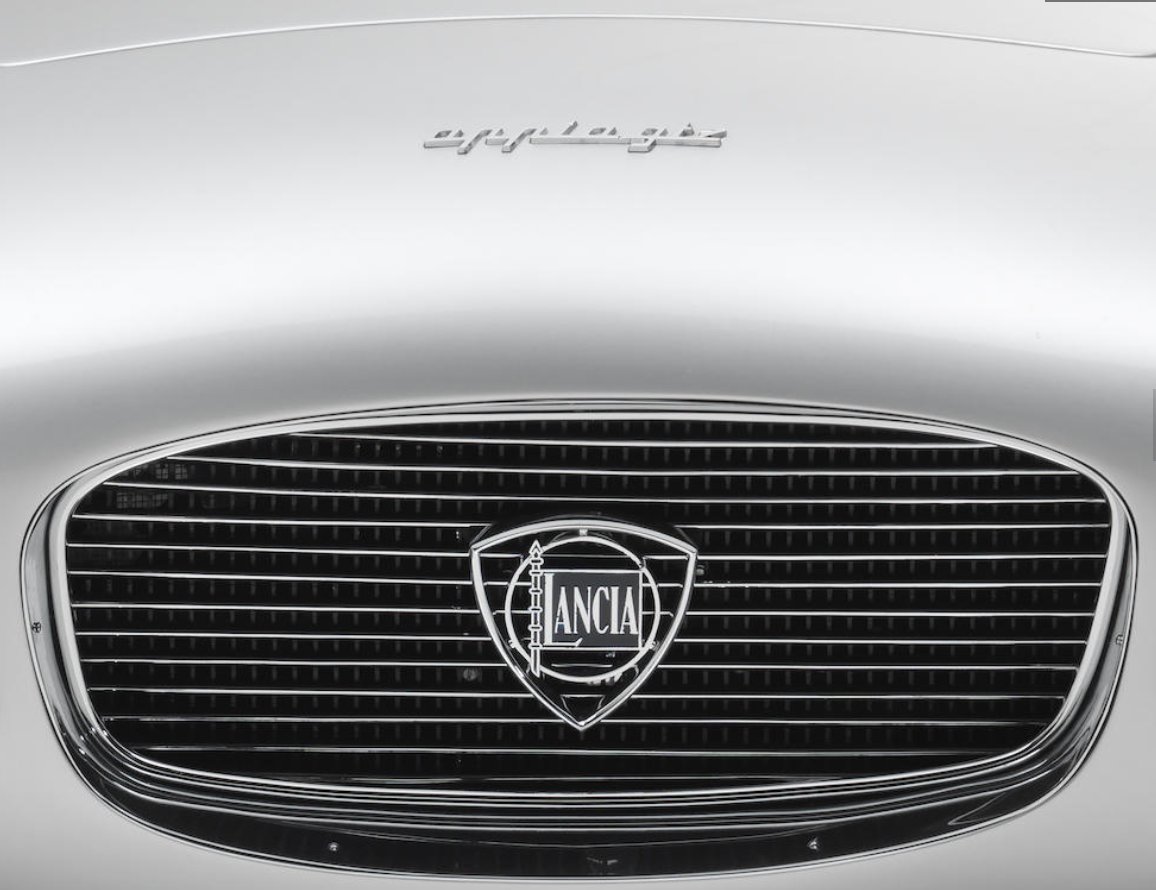
The standard Lancia shield was mounted centrally on the front grille, as here on 81201.3358:

Lancia shield, 81201.3358.  Courtesy Montini Automobili

Not long within the GTE’s production run, a chrome handle/rear licence plate bulbs holder mounted on the lower edge of the boot lid was introduced.  This incorporated the model name, Appia, script on a red field in its central area:


By the time of the introduction of the Sport, the script/ground had been restyled and re-coloured, as seen below on 81205.1117:

Rear Appia Sport badge, 81205.1117.  Courtesy Bonhams Cars


On some very late Sports, the script badge section was replaced by an orange reflector lens:


As previously established with other Zagato-styled/built bodies, the only external branding applied by the Carrozzeria was a ‘Z’ on each front wing, mounted between the leading edge of the door and the trailing edge of the front wheel arch.  Considerable variability is seen in terms of the height and of the longitudinal position of the mounting.  On an early Phase 2 GTZ, it is in line with the side strake/door handle and much nearer to the wheel arch than the door aperture:

Zagato front wing badge, 81201.1258.  Courtesy Bonhams Cars

On this GTE, the mounting is midway between the door leading edge and the wheel arch – at this time – ’59 - perhaps the most common location:

Zagato front wing badge, 81201.2472.  Courtesy RM Sotheby’s

The badge itself is most usually seen with black infill, as below, on 81205.1092:

81205.1092 Zagato badge.  Courtesy Cristiano Luzzago

Hubcaps:  Where steel wheel rims were original fitment, they featured chrome hubcaps adorned simply with ‘Lancia’ and the spear icon engraved rather than any Appia-specific script or icon:

‘Lancia’ branded hubcap, 81201.2533.  Courtesy Lawrence Romanosky

Steering wheel horn button:  The original equipment wheel, as on GTE 81201.2472, features a boss with Appia-specific decoration:

Steering wheel horn button, GTE, 81201.2472.  Courtesy RM Sotheby’s

Dashboard:  A script badge is sometimes seen mounted on the dashboard vertical face between the row of switches/ashtray and the right hand end of the panel, as below on 81205.1092.  Being uncommon, it is likely that this is customisation by the owner:

Script badge applied to dashboard, 81205.1092.  Courtesy Cristiano Luzzago

Chassis plates:  Examples of early (left) and late (right) are shown below:


Door handles: 

The door handle design was of the flush type on early cars, as seen left, below on 81201.1258 (’57).  Later cars have a raised version, as right below on 81205.1182 (63):


Tail Lamps: 

The tail lamp units stood proud on early cars, and, as seen below on the left, 81201.1258, the lens format was brake-above-indicator.  This was inverted on late cars and the unit was fully recessed into the rear panel, as, right, 81205.1117.

Left, ’57 GTZ; Right, ’62 Sport.  Courtesy Bonhams Cars

Engine Bay: 

This feature of the Sport, 81205.1117, is notably well-presented:

Engine bay, 81205.1117.  Courtesy Bonhams Cars


The matrix below shows engine bays of the GTZ, GTE and Sport models, illustrating how carburation and ignition systems have been modified/updated over the years in service:


Images courtesy, Bonhams Cars; Ruotedasogno; Andreanannetti; RM Sotheby’s; Lawrence-Romanosky; Yukio Yoshimi; Iconic Auctioneers; Corgy’s; Maisonbibelot; Conceptcarz; Car & Classic; The Cultivated Collector; Classic Promenade.


These photographs serve to show the diminutive nature of the Appia engine – for example, it appears dwarfed by the radiator.  Being so dimensionally compact, there was no requirement – as with the Fulvia – for the V4 to be mounted canted over by 45° to the left and at a shallow inclination.

Notes on the engine:

Lancia’s adoption of the V4 engine format in the 1920s was something of a surprise to many of its competitors and observers of the industry – many of them predicted that it was a temporary craziness and it would not be long before Vincenzo would come to his senses and approve the development of an in-line replacement.  Yet, as the Marque’s future model programme began to be planned after WWII, designer Ettore Zaccone Mina was allowed the freedom to create new small capacity units with their four cylinders still in V form.  With the expectation that a much larger 50s/60s mass market would want smaller cars, the attraction of a V4 was enhanced, since its inherent compactness enabled vehicle dimensions to be optimally constrained.  To this end, though the ’old’ engine’s vee angle had seemed narrow at 20°, Mina’s first new version emerged with the even shallower angle of 12°45’.  In addition to the further-reduced unit footprint this enabled, it also allowed a single cylinder head to utilised.  The Appia model was specified with a yet narrower, Vittorio Jano-designed, 1089 cc capacity version, designated type 81400.  The engine was notable for its performance and quality of construction – ingenious valve gear and extensive use of aluminium being key features.  Lorenzo Morello described the unit in his ‘Lancia: A Story of Technological Innovation in the Car Industry:’  (as with) the Ardea, the V valves were arranged transversely to the engine, and were controlled by a system of rods and rocker arms and by two camshafts located in the crankcase, one either side of the engine. The V-configured engine was the most compact ever made by Lancia, with an angle of just 10° 14’; a crankshaft with just two supports was deployed to help reduce the length of the motor. There was an improvement across-the-board in terms of performance, in part by increasing bore and stroke, which now became 60 and 75 mm . . .  Power for the Berlina application was developed up to 48 bhp for the  Series 3 version, but for the Zagato bodied cars, 53 bhp, and this was uprated to 59 bhp in ’60 for the model designated GTE2.  This same version featured in the Sport model through to the cessation of Appia Zagato production in early ’63. 

Sample engine numbers of extant Appia Zagatos are: 81400.5787 (GTZ); 81400.2472 (GTE); 81400.3588 (GTE); 81400.4587 (GTE); 81400.5749 (Sport); 81400.5808 (Sport).

Type 81400 engine cutaway showing the layout of the valve gear.  Courtesy lanciaservice.nl

Engine and transmission.  Courtesy Gino Giugno


Literature 

Sales brochures:

’59:

Courtesy Viva-Lancia
’60:

Courtesy Zagato-cars.com

Appia Zagatos in motor sport: 

Contemporary with the development of its version of the Appia, Zagato was also occupied with its new Abarth collaboration to create and manufacture the body for the 750 GT, an overtly racing/fast road machine.  The Appia had the potential to match the Abarth’s performance capability which was initially restricted by its Fiat 600-derived single cam engine which in ‘56/’57 was typically generating a few bhp less than the Appia’s at 45-50 bhp, though the car was some 200 Kg lighter at around 600 Kg.  However, the Lancia factory management was not especially sanguine.  Antonio Fessia, Technical Director, in particular was opposed to any spending on direct factory participation in motor sport, believing that this would not support profitability through incremental sales volume.  Nevertheless, Zagato saw potential and had faith that the model would appeal to amateur motor sport competitors.  This was soon vindicated.  The original, ‘Cammello’ prototype competed on the ‘57 Mille Miglia, driven by Giorgio Lurani to 3rd in the GT 1100 class.  Five other early Phase 2 GTZs also took part, with the best result for Luciano Mantovani’s #12 which was the class winner.  Just five places overall behind, Enrico Anselmi went on to finish 3rd in the Coppa Inter-Europa at Monza in September.  The following month, both Mantovani and Anselmi ran at the Trieste Opicina hillclimb and Mario Constantini began using a GTZ for rallies. 

During the period ’59-65, Appia Zagatos were highly successful in Italian National/Regional championships, especially those for hillclimbs – principal champions are shown in the table below – based on data in Gino Giugno/Loris Chioetto’s Lancia da corsa Appia Zagato. 

‘59

Giovanni Kerschbaumer

GTE #2130

‘60

Herbert Demetz

GTE

‘61

Cesare Fiorio

GT #1119

‘62

Silvano Stefani

Sport Competizione #1004

‘63

Silvano Stefani

Sport Competizione #1004

‘64

Giovanni Marini Balestra

Sport Competizione #1008

‘65

Enrico Romanini

Sport #1154

Also utilising information, (with some updates/corrections from other sources), published in the Giugno/Chioetto book, the following list of Appia Zagato class victories can be drawn up:

’57 August

Trapani-Monte Erice Hillclimb

GTZ

Natale Gotelli

’57 October

Trieste Opicina Hillclimb

GTZ

Enrico Anselmi

’58 July

Bolzano Mendola Hillclimb

GTZ

Nicola Cafiero

’58 July

Trento Bondone Hillclimb

GTZ

Corrado Ravanelli

’58 August

Giro delle Calabrie

GTS

Elio Zagato

’58 September

Coppa Intereuropa, Monza

GTZ

Enrico Anselmi

’58 September

Mulino del Rocco-Cucconato Hillclimb

GTZ

Nicola Cafiero

’58 December

Messina San Rizzo

GTZ

Gregorio Rizzotti

’59 April

San Marino Rimini 

GTE

Giovanni Kerschbaumer

’59 May

Coppa Sant Ambroeous, Monza

GTE

Giovanni Kerschbaumer

’59 May

Mille Miglia

GTE

Giovanni Kerschbaumer

’59 June

Coppa dell Consuma, Firenza Hillclimb

GTZ

Francesco Prioglio

’59 June

Coppa Citta di Asiago, Hillclimb

GTZ

Enrico Agostini

’59 June

Coppa della Sila, Consenza Hillclimb

GTZ

Enrico Agostini

’59 July

Bolzano-Mendola Hillclimb

GTE

Giovanni Kerschbaumer

’59 July

Monte Eriche Cronoscalata Hillclimb

GTE

“Comar”

’59 July

Trento Bondone Hillclimb

GTE

Giovanni Kerschbaumer

’59 July

Garessio-Colle San Bernado, Cuneo Hillclimb

GTZ

Enrico Agostini

’59 July

Trieste Opicina Hillclimb

GTE

Giovanni Kerschbaumer

’59 August

Coppa Gallenga, Rome Hillclimb

GTZ

Enrico Agostini

’59 August

Colli Torinesi Sassi-Superga, Turin Hillclimb

GTZ

Enrico Agostini

’59 September

Aosta-Pila Hillclimb

GTZ

Enrico Agostini

’59 September

Coppa Intereuropa, Monza

GTZ

Enrico Agostini

’59 September

Pontedecimo-Giovi, Genova Hillclimb

GTZ

Enrico Agostini

’59 September

Catania-Etna Hillclimb

GTZ

Gregorio Rizzotti

’59 October

Coppa Nissena , Caltanissetta Hillclimb

GTZ

Gregorio Rizzotti

’59 October

Sardinia Rally

GTE

Mario Casula

’59 November

Rigano-Bellolampo, Palermo Rally

GTZ

Gregorio Rizzotti

’60 March

Frascati-Tuscolo Hillclimb

GTZ

Enrico Tuccari

’60 April

Coppa Belmonte, Avola Hillclimb

GTZ

Franco Fiorentino

’60 April

Targa del Busento, Reggio Calabria

GTE

Amedeo Bartoccelli

’60 May

Corsa al Monte Pellegrino, Palermo Hillclimb

GTE

“Comar”

’60 May

Castell’Arquato-Vernasca, Piacenza Hillclimb

GTE

Giorgio Da Crema

’60 June

Salsomaggiore-Monte Sant’Antonio, Parma Hillclimb

GTE

Luigi Baldini

’60 June

Santo Stefano-Gambarie, Reggio Calabria Hillclimb

GTE

“Comar”

’60 June

Valdesi-Santa Rosalia, Palermo Hillclimb

GTE

Salvatore Vecchio

’60 June

Varese-Campo dei Fiori Hillclimb

GTE

Ugo Piperno

’60 July

Syracuse 3 Hours

GTE

Amedeo Bartoccelli

’60 July

Trento Bondone Hillclimb

GTE

Herbert Demetz

’60 July

Trieste Opicina Hillclimb

GTE

Herbert Demetz

’60 August

Trapani-Monte Erice Hillclimb

GTE

“Comar”

’60 August

Giro Automobilistico dei Due Mari, Cantanzaro

GTE

Giorgio Ammanniti

’60 August

Coppa Fasano-Selva, Brindisi Hillclimb

GTE

Antonio Tarantini

’60 August

Colli Torinesi Sassi-Superga, Turin Hillclimb

GTZ

Cesare Fiori

’60 September

Coppa della Sila, Consenza Hillclimb

GTE

Salvatore Vecchio

’60 September

Trofeo Lumezzane, Brescia

GTE

Gianni Lado

’60 September

Catania-Etna Hillclimb

GTE

Salvatore Vecchio

’60 September

Coppa Nissena, Caltanissetta Hillclimb

GTE

Salvatore Vecchio

’60 September

Coppa Intereuropa, Monza

GTE

Herbert Demetz

’60 October

Pontedecimo-Giovi, Genova Hillclimb

GTE

Herbert Demetz

’60 October

Tre Ponti-Castelnuovo Hillclimb

GTE

Vanni Zulian

’60 October

Coppa d’Oro, Modena

GTE

Angelo Bersani

’60 October

Coppa Leopoldi Carri, Monza

GTE

Angelo Bersani

’60 November

Passo di Rigano-Bellolampo, Palermo Hillclimb

GTZ

Gregorio Rizzotti

’60 December

Coppa F.I.S.A., Monza

GTE

Ugo Piperno

’61 March

Coppa Sant Ambroeous, Monza

GTE

Gianni Lado

’61 March

Trofeo Franco Venturi

GTE

Mario Pompeo

’61 April

Avola-Avola Antica, Sicily Hillclimb

GTZ

Franco Fiorentino

’61 April

Stallavena-Boscochiesanuova, Verona Hillclimb

GTE

Gianni Lado

’61 May

Coppa Alberto Ascari, Monza

GTE

Franco Ghiazza/Luigi Caronni

’61 May

Coppa Citta di Asiago, Hillclimb

GTE

Gianni Lado

’61 May

Castell’Arquato-Vernasca, Piacenza Hillclimb

Sport

Gianpiero Moretti

’61 May

Corsa al Monte Pellegrino, Palermo Hillclimb

GTZ

Franco Fiorentino

’61 May

Salsomaggiore-Monte Sant’Antonio, Parma Hillclimb

GTE

Gianni Lado

’61 May

Cividale-Castelmonte, Udine Hillclimb

GTZ

Riccardo Di Manzo

’61 June

Coppa dell Consuma, Firenze Hillclimb

GTE

Cesare Fiori

’61 June

Coppa Gallenga, Rome Hillclimb

Sport

Corrado Ferlaino

’61 June

Garessio-Colle San Bernado, Cuneo Hillclimb

GTZ

Giacinto Vivaldi

’61 June

Valdesi-Santa Rosalia, Palermo Hillclimb

Sport

“Jonny”

’61 June

Predappio-Rocca delle Caminate, Forli Hillclimb

Sport

Silvano Stefani

’61 June

GT Grand Prix, Monza

GTE

Cesare Fiori

’61 June

Compiano-Vetto d’Enza, Reggio Emilia Hillclimb

GTE

Gianni Lado

’61 July

Trento Bondone Hillclimb

Sport

Silvano Stefani

’61 July

Aosta-Pila Hillclimb

GTZ

Giacinto Vivaldi

’61 July

Trieste Opicina Hillclimb

GTE

Cesare Fiori

’61 August

Cesana-Sestriere Hillclimb

GTE

Gianni Lado

’61 August

Grand Prix, Pescara

GTE

Cesare Fiori/Piero Frescobaldi

’61 September

Trofeo Lumezzane, Brescia

Sport

Silvano Stefani

’61 September

Coppa Intereuropa, Monza

GTE

Cesare Fiori

’61 September

Pontedecimo-Giovi, Genova Hillclimb

GTZ

Giacinto Vivaldi

’61 September

Catania-Etna Hillclimb

Sport

Corrado Ferlaino

’61 October

Alghero-Scala Piccada Hillclimb

Sport

Silvano Stefani

’61 October

Euganean Hills, Padova Hillclimb

GTE

Enrico Gibelli

’62 April

Trofeo Edgardo Lazzaroni, Rome Rallye

GTE

Enrico Gibelli

’62 June

Predappio-Rocca delle Caminate, Forli Hillclimb

GTE

Gastone Petrini

’62 June

Coppa della Primavera, Amalfi Hillclimb

Sport

Corrado Ferlaino

’62 July

Coppa Citti di Monopoli, Hillclimb

Sport

“Gipsy”

’62 July

Trento Bondone Hillclimb

Sport

Silvano Stefani

’62 July

Cesana-Sestriere Hillclimb

Sport

Ugo Bagnasacco

’62 July

Trieste Opicina Hillclimb

Sport

Ugo Bagnasacco

’62 July

Bolzano Mendola Hillclimb

GTE

Vito Gnutti

’62 August

Trapani-Monte Erice Hillclimb

Sport

Giulio Pernice

’62 August

Coppa Citta di Sciacca, Sicily Hillclimb

Sport

Giulio Pernice

’62 August

Santo Stefano-Gambarie, Reggio Calabria Hillclimb

Sport

Giulio Pernice

’62 August

Coppa Citta di Chieti Hillclimb

Sport

Gianpiero Bianchetti

’62 September

Coppa Gallenga, Rome Hillclimb

GTE

Gastone Petrini

’62 September

Catania-Etna Hillclimb

Sport

Giulio Pernice

’62 September

Corsa al Colle San Marco, Acoli Piceno Hillclimb

GTE

Gastone Petrini

’62 November

Trofeo d’Autumno, Vallelunga

Sport

Ugo Bagnasacco

’63 March

Frascati-Tuscolo Hillclimb

GTE

Bruno Faenza

‘63 March

Coppa Acqua Cerelia, Bologna Hillclimb

Sport

Alessandro Ferretti

’63 April

Stallavena-Boscochiesanuova, Verona Hillclimb

Sport

Ugo Bagnasacco

’63 June

Corsa al Monte Pellegrino, Palermo Hillclimb

Sport

Vito Coco

’63 June

Coppa dell Consuma, Firenze Hillclimb

GTE

Marcello Pilli

’63 June

Coppa Citta di Asiago, Hillclimb

Sport

Silvano Stefani

’63 June

Garessio-Colle San Bernado, Cuneo Hillclimb

Sport

Mario Regis

’63 June

GT Grand Prix, Monza

Sport

Silvano Stefani

’63 July

Bolzano Mendola Hillclimb

Sport

Silvano Stefani

’63 July

Santo Stefano-Gambarie, Reggio Calabria Hillclimb

Sport

Mario Raimondo

’63 July

Trento Bondone Hillclimb

Sport

Silvano Stefani

’63 July

Trieste Opicina Hillclimb

GTE

Giovanni Marini Balestra

’63 July

Scalata al Colle Sant’Eusebio, Brescia

Sport

Dante Oliva

’63 July

Coppa Agordo-Frassene, Belluno Hillclimb

GTE

Umberto Porcu

’63 July

Cesana-Sestriere Hillclimb

Sport

Alessandro Ferretti

’63 August

Aosta-Pila Hillclimb

Sport

Alessandro Ferretti

’63 August

Corsa lago di Montefiascone, Viterbo Hillclimb

GTE

Giovanni Marini Balestra

’63 August

Trapani-Monte Erice Hillclimb

Sport

Vito Coco

’63 September

Corsa al Colle San Marco, Acoli Piceno Hillclimb

Sport

Giovanni Marini Balestra

’63 September

Catania-Etna Hillclimb

Sport

Silvano Stefani

’63 September

Coppa Luigi Fagioli, Osimo Hillclimb

Sport

Giovanni Marini Balestra

’63 October

Alcomo-Monte Bonifato, Palermo Hillclimb

Sport

Mario Raimondo

’63 October

Trofeo Sanramese della Montagna, Sanremo Hillclimb

Sport

Giacinto Vivaldi

’63 November

Coppa F.I.S.A., Monza

GTE

Salvatore Genovese

’64 March

Coppa Gallenga, Rome Hillclimb

Sport

Fausto Verginelli

’64 April

Coppa Grand Touring Trofeo Shell, Imola

Sport

Giovanni Marini Balestra

’64 April

Magione-Veroli, Frosinone Hillclimb

Sport

Giovanni Marini Balestra

’64 April

Vergato-Cereglio, Bologna Hillclimb

Sport

Alessandro Ferretti

’64 May

Frascati-Tuscolo Hillclimb

Sport

Alberto Antoniucci

‘’64 May

Corsa al Monte Pellegrino, Palermo Hillclimb

Sport

Antonio Barbagallo

’64 May

Coppa dell Consuma, Firenze Hillclimb

Sport

Mario Regis

’64 May

Bologna-Passo della Raticosa Hillclimb

Sport

Giuseppe Battiplagia

’64 June

Scalata al Colle Sant’Eusebio, Brescia

Sport

Dante Oliva

’64 June

Cuorgne-Alpette, Turin Hillclimb

Sport

Mario Regis

’64 June

Coppa Citta di Asiago, Hillclimb

Sport

Giovanni Marini Balestra

’64 June

Coppa della Sila, Consenza Hillclimb

Sport

Giovanni Marini Balestra

’64 June

Circuito del Mugello, Scarperia

Sport

Giovanni Marini Balestra

’64 July

Corsa Lago di Montefiascone, Viterbo Hillclimb

Sport

Giovanni Marini Balestra

’64 July

Trento Bondone Hillclimb

Sport

Giovanni Marini Balestra

’64 July

Cesana-Sestriere Hillclimb

Sport

Mario Regis

’64 August

Trapani-Monte Erice Hillclimb

Sport

Mario Raimondo

’64 August

Coppa Agordo-Frassene, Belluno Hillclimb

Sport

Enrico Romanini

’64 August

Trofeo Micangeli, Avezzano Hillclimb

Sport

Giovanni Marini Balestra

’64 August

Corsa al Colle San Marco, Acoli Piceno Hillclimb

Sport

Giovanni Marini Balestra

’64 August

Cividale-Castellamonte, Udine Hillclimb

Sport

Giovanni Marini Balestra

’64 September

Coppa del Cimino, Viterbo Hillclimb

Sport

Giovanni Marini Balestra

’64 September

Trofeo Lumezzane, Brescia

Sport

Benito Jose Calvino y Teijeiro

’64 September

Coppa Nissena, Caltanissetta Hillclimb

Sport

Mario Raimondo

’64 October

Coppa Luigi Fagioli, Osimo Hillclimb

Sport

Giovanni Marini Balestra

’64 October

Campocatino, Hillclimb

Sport

Riccardo Carafa/Enrico Romanini (?)

’64 October

Corongui-Campuomu, Cagliari Hillclimb

Sport

Mario Casula

’65 January

Trofeo d’Inverno, Vallelunga

Sport

Cesare Righetti

’65 April

Stallavena-Boscochiesanuova, Verona Hillclimb

Sport

Enrico Romanini

’65 April

Avola-Avola Antica, Sicily Hillclimb

Sport

Enrico Romanini

’65 April

Coppa della Primavera, Amalfi Hillclimb

Sport

Francesco Varese

’65 May

Cividale-Castellamonte, Udine Hillclimb

Sport

Riccardo Carafa

’65 May

Alghero-Scala Picada, Sassari Hillclimb

Sport

Orazio Scalia

’65 May

Antignano-Monteburrone, Livorno Hillclimb

Sport

Enrico Romanini

’65 May

Vezzano-Casina, Reggio Emilia Hillclimb

Sport

Orazio Scalia

’65 May

Sorrento-Sant’Agata Hillclimb

Sport

Riccardo Carafa

’65 May

Salerno-Cava de Tirreni Hillclimb

Sport

Riccardo Carafa

’65 May

Bologna-Passo della Raticosa Hillclimb

Sport

Angelo Bonaccorsi

’65 June

Scalata al Colle Sant’Eusebio, Brescia

Sport

Dante Oliva

’65 June

Vittorio Veneto-Cansiglio, Treviso Hillclimb

GTE

Umberto Porcu

’65 June

Coppa Citta di Asiago, Hillclimb

GTE

Umberto Porcu/Enrico Romanini (?)

’65 June

Alcamo-Monte Bonifato, Trapani Hillclimb

Sport

Salvatore Maggiore

’65 June

Trofeo Venturi, Frascati Hillclimb

Sport

Riccardo Carafa

’65 June

Corsa al Monte Pellegrino, Palermo Hillclimb

Sport

Umberto Porcu

’65 June

Coppa della Sila, Consenza Hillclimb

Sport

Mario Raimondo

’65 July

Bolzano Mendola Hillclimb

Sport

Enrico Romanini

’65 July

Termini-Caccamo Hillclimb

Sport

Mario Raimondo

’65 July

Trento Bondone Hillclimb

Sport

Enrico Romanini

’65 July

Trieste Opicina Hillclimb

Sport

Enrico Romanini

’65 July

Cesana-Sestriere Hillclimb

Sport

Enrico Romanini

’65 August

Trapani-Monte Erice Hillclimb

Sport

Mario Raimondo

’65 September

Coppa Nissena, Caltanissetta Hillclimb

Sport

Orazio Scalia

Competizione versions:
 
From the outset, GT and GTE models were often modified for the track by specialist tuning/elaborazione firms.  Later, as was common practice at other Italian factories, customers could order a new race-specified Sport selecting from a range of options.  Such a vehicle was designated as a ‘Competizione.’  Known chassis numbers of Competiziones include:  #1002, #1004, #1006 #1008, #1026, #1030, #1103, #1123, #1125.  (At least two GTEs, #3634 and #3762 were forerunner examples of this specification process).
 
Central to the Competizione programme, was the derivation of engine variants which drew on the learnings from experience of the Appia motor’s deployment in the single seater Formula Junior category.  Introduced as a new formula in ’58, the requirement was either a 1000 cc or 1100 cc engine according to the car’s weight.  Tuner and race car preparation expert, Angelo Dagrada, chose to develop the Appia unit as a FJ engine.  The result was a tremendous increase in power, to over 90 bhp.  This was achieved mainly by extensive reworking of the head, reconfiguring it on the crossflow principle and installing larger (38 DCOE) twin Weber carburettors.  Dagrada also constructed FJ cars at his Milan workshop, supplying one of these to future F1 driver, Giancarlo Baghetti.  Though young and inexperienced, Baghetti achieved excellent results with the car in ’60.  It is said that Enzo Ferrari was sufficiently impressed by Baghetti’s performances that he invited him to test for the Scuderia – subsequently becoming a Ferrari works driver in ’62.  Also effective in race-modifying/preparing Appia engines, the Rome-based De Sanctis operation – though primarily Fiat-focused – offered special components such as better flowing manifolds.  Similar options were offered by Turin-based Bosato and Carlo Facetti’s business at Bresso near Milan.  The factory interpretation of such possibilities resulted in Competizione engines which typically featured Weber 40 DCOE carburettors, reprofiled camshafts and either Kolbenschmidt or Mahle high performance pistons.  To further optimise speed potential, body weight was saved in the main by the absence of bumpers, (and their irons), and the use of Perspex for the side and rear windows.  Another minor item, advised to me by Gino Giugno, which especially interested me, (because of my enthusiasm for the ‘donor’ Alfa Romeo model), was the minimalist door handle first used on the Giulietta Sprint Zagato.

Competizione door handle, as Giulietta SZ.

The Dagrada-modified Appia engine.  Courtesy VeoceToday


The design/specification/production history of the Lancia Appia Zagato models has been documented only to a limited extent.  However, in my own researches I have been able to substantially benefit from the published work of Gino Giugno, author of ‘Lancia da corsa Appia Zagato,’ 2019 ISBN 978-88-909220-1-5, in conjunction with Loris Chioetto.  Gino has also created a privately-published 530 page Dossier on these cars and has kindly helped me in direct communications with a number of detail enquiries.  I am very grateful to Gino for all his help.